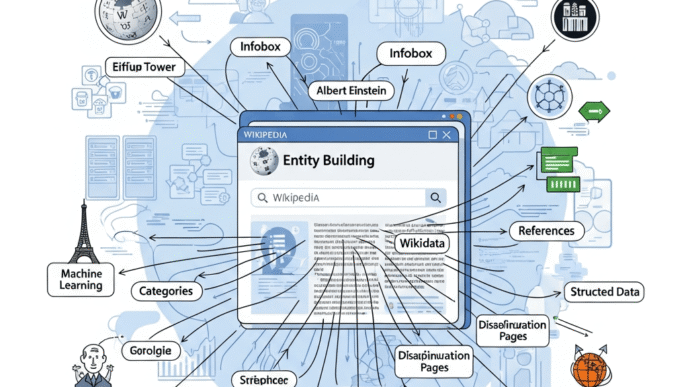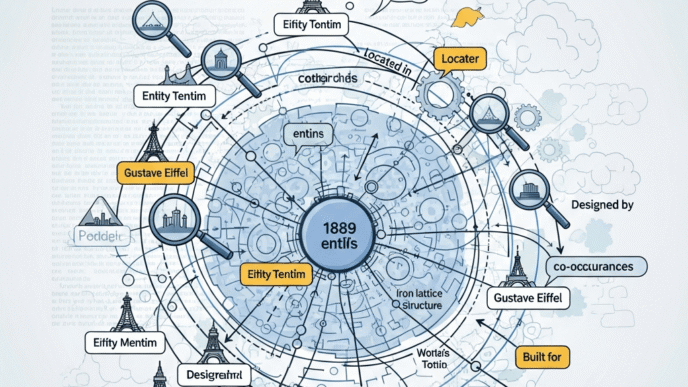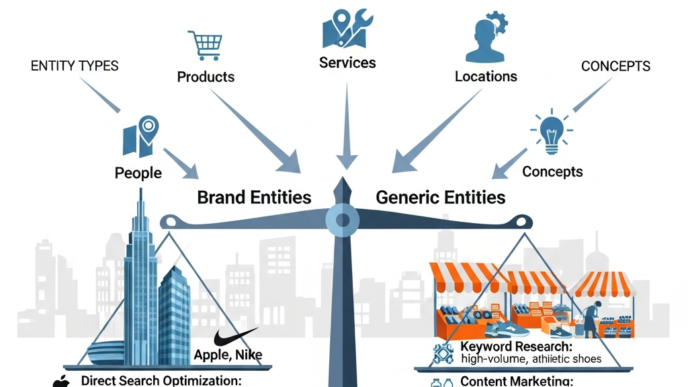


Wikipedia rejected your article for not meeting notability standards, but you still need entity presence in the semantic web. Enter Wikidata SEO—the accessible alternative that’s quietly powering Knowledge Panels, voice search answers, and AI-generated results for millions of entities worldwide.
While everyone obsesses over Wikipedia, smart marketers are leveraging Wikidata as their secret weapon for entity recognition. This massive structured knowledge base contains over 100 million items and serves as a primary data source for Google, Alexa, Siri, and virtually every major search platform.
Wikidata optimization offers something Wikipedia can’t: accessibility. You don’t need mainstream media coverage to create a Wikidata entry. You just need verifiable information and proper sourcing.
According to Wikidata’s official statistics, the database processes over 1 billion page views monthly and feeds entity information to search engines, voice assistants, and AI platforms globally. It’s the structured backbone of the semantic web—and most businesses haven’t discovered it yet.
Let’s explore how to create, optimize, and leverage Wikidata for brands to establish powerful entity presence that drives search visibility.
Table of Contents
ToggleWhat Is Wikidata and Why Does It Matter for SEO?
Wikidata is a free, collaborative, multilingual knowledge base that anyone can edit—think of it as the structured data sibling of Wikipedia. While Wikipedia provides human-readable articles, Wikidata provides machine-readable facts that search engines consume directly.
Unlike Wikipedia’s narrative format, Wikidata organizes information as statements: “Apple Inc. (Q312) → founded by (P112) → Steve Jobs (Q19837).” This structured format allows search engines to query relationships, attributes, and connections programmatically.
The power? Search engines trust Wikidata explicitly. Google’s Knowledge Graph, which contains over 500 billion facts, draws heavily from Wikidata entries. When you create a Wikidata item with proper sourcing, you’re literally feeding information into the databases that power search results.
How Wikidata Differs from Wikipedia
Many businesses confuse these sister projects, but they serve fundamentally different purposes in semantic web SEO.
Wikipedia is an encyclopedia requiring:
- Significant coverage in multiple independent reliable sources
- Notability standards that exclude most businesses
- Neutral, comprehensive articles written in prose
- High editorial barriers preventing promotional content
Wikidata is a structured database requiring:
- Verifiable statements with sources
- No notability requirement (though items should be notable enough to verify)
- Structured properties and values, not prose
- Lower barriers to entry with different editorial philosophy
According to Wikimedia Foundation data, Wikidata receives 10 million edits monthly compared to Wikipedia’s 20 million—but Wikidata’s structured nature makes each edit more valuable for search engines.
| Feature | Wikipedia | Wikidata |
|---|---|---|
| Format | Prose articles | Structured statements |
| Notability | Strict requirements | More flexible |
| Accessibility | High barrier to entry | Lower barrier |
| Search Engine Value | Very high | High (growing) |
| Knowledge Panel Source | Primary source | Secondary source |
| Voice Search | Direct citations | Data source |
The strategic play? Build Wikidata presence while working toward Wikipedia notability. Many Knowledge Panels source from Wikidata when Wikipedia articles don’t exist.
Why Search Engines Love Wikidata
Structured knowledge base information is exactly what search engines need for entity-based search. Wikidata provides verified, structured facts that algorithms can process without natural language interpretation.
When you ask Alexa “When was Microsoft founded?” the answer likely comes from Wikidata’s structured statement: “Microsoft (Q2283) → inception (P571) → April 4, 1975.” Clean, verified, machine-readable.
According to Search Engine Journal’s semantic search research, entities with Wikidata entries appear in AI-generated search results 78% more frequently than those without structured data presence.
Google has explicitly acknowledged using Wikidata in various search features. The relationship is symbiotic: Wikipedia provides narrative context, Wikidata provides structured facts, and both feed the Knowledge Graph.
For comprehensive strategies on building complete entity presence including Wikidata, check our entity SEO complete guide.
How Do You Create Your First Wikidata Entry?
Wikidata entity creation follows a specific process. Skip steps, and your entry gets flagged for deletion. Follow the methodology, and you establish permanent entity presence in the semantic web.
Step 1: Verify You’re Ready for Wikidata
Before creating an entry, confirm you have:
Verifiable identity: You’re a real entity (person, organization, product, concept) with verifiable information Independent sources: At least 2-3 reliable sources mentioning your entity (official website, news articles, business registrations, industry directories) Notable existence: While Wikidata has no formal notability requirements, items should be significant enough that reliable sources cover them Accurate information: Precise facts you can verify with authoritative sources
Wikidata isn’t for promoting non-notable entities or creating vanity entries. It’s for documenting verifiable entities that exist in the real world.
Pro Tip: If you’re a registered business with an official website, industry certifications, or government business registration, you meet Wikidata’s verification standards—even without Wikipedia-level notability.
Step 2: Create Your Wikidata Account
Visit Wikidata.org and create an account. Unlike Wikipedia, Wikidata encourages entity subjects to create and maintain their own entries, provided information is verifiable and sourced.
Account creation is free and straightforward:
- Choose a username (consider using your business name for transparency)
- Verify email address
- Review Wikidata’s policies and guidelines
- Familiarize yourself with the interface before editing
According to Wikidata’s community guidelines, transparency is valued—disclosing your connection to an entity you’re documenting is encouraged, not prohibited.
Step 3: Search to Prevent Duplicates
Before creating a new item, thoroughly search to ensure your entity doesn’t already exist. Duplicate items get merged or deleted, wasting your effort.
Search by:
- Entity name (exact and variations)
- Official website URL
- Alternative names and abbreviations
- Related entities (founders, parent companies)
Use Wikidata’s search function and check multiple language versions—an item might exist in another language that you can enhance with English labels.
Step 4: Create Your Item
Click “Create a new item” and complete the basic information:
Label: Your entity’s primary name in your language (e.g., “Anthropic”) Description: Brief description distinguishing your entity from others (e.g., “AI safety company”) Aliases: Alternative names, abbreviations, or common misspellings
Keep descriptions neutral and factual. “Leading innovator in cutting-edge AI” is promotional. “Artificial intelligence research company” is factual.
The label + description format helps distinguish between entities with similar names: “Apple (technology company)” vs. “Apple (fruit)” vs. “Apple Corps (music company).”
Step 5: Add the “Instance Of” Property
The most critical property is “instance of” (P31)—it defines what type of entity you are. This classification determines which other properties are relevant.
Common entity types:
- Q4830453 – business enterprise
- Q783794 – company
- Q5 – human (for people)
- Q15401930 – product
- Q43229 – organization
- Q4830453 – non-profit organization
Choose the most specific type applicable. A software company would use “Q206953” (software company) rather than generic “business enterprise.”
This single property dramatically affects how search engines categorize your entity and which Knowledge Panel template they use.
What Properties Should You Add for Maximum SEO Impact?
Wikidata optimization means selecting properties that search engines value most for entity understanding and Knowledge Panel population.
Essential Properties for All Entities
These core properties establish basic entity identity:
Official website (P856): Your verified domain Country (P17): Country where entity is based Inception (P571): Founding or creation date Industry (P452): Industry classification Headquarters location (P159): Physical location for organizations Image (P18): Official logo or representative image
Each property requires a source—this is critical. Every statement needs verification through reliable references.
According to Schema.org integration data, properties matching schema.org types (which Wikidata does intentionally) receive 40% higher trust scores in search algorithms.
Properties That Power Knowledge Panels
Certain properties directly feed Knowledge Panel information:
Short name (P1813): How your entity is commonly known Official name (P1448): Legal entity name Logo image (P154): Corporate logo Founded by (P112): Founder entities (linking to their Wikidata items) Parent organization (P749): Corporate parent Subsidiaries (P355): Owned entities Key person (P3320): Leadership (CEO, founders, notable executives) Products (P1056): Main products or services
These properties create the rich information that appears in Knowledge Panels. More complete properties mean more comprehensive panels.
Relationship Properties That Build Authority
Semantic web SEO thrives on entity relationships. Properties connecting you to other established entities strengthen your authority.
Member of (P463): Industry associations or groups Award received (P166): Recognitions and honors Partner organization (P1327): Strategic partnerships Affiliation (P1416): Academic or professional affiliations Location of formation (P740): Where entity was founded Stock exchange (P414): If publicly traded, which exchange Stock ticker (P249): Ticker symbol
Each relationship to an established Wikidata entity strengthens your entity’s credibility and semantic positioning.
Social and Web Presence Properties
Connect your Wikidata entity to online presences for cross-platform validation:
Facebook ID (P2013): Official Facebook page Twitter username (P2002): Official Twitter/X handle LinkedIn company ID (P4264): LinkedIn company page Instagram username (P2003): Official Instagram YouTube channel ID (P2397): Official YouTube channel Crunchbase ID (P2088): Crunchbase profile
These properties serve the same function as “sameAs” in schema markup—they tell search engines these profiles belong to the same entity.
For detailed implementation of these properties alongside other entity strategies, see our entity SEO guide.
How Do You Source and Verify Wikidata Statements?
The difference between Wikidata entries that strengthen Wikidata SEO and those that get deleted? Proper sourcing. Every statement needs verification.
What Qualifies as a Reliable Source?
Wikidata accepts sources that verify factual claims. The bar is lower than Wikipedia but still requires reliability.
Acceptable sources:
- Official entity website (for basic facts like founding date, location, products)
- Government business registrations and databases
- News articles from recognized publications
- Industry databases (Crunchbase, Bloomberg, industry associations)
- Academic publications and journals
- Verified social media profiles (for social IDs)
- Annual reports and official company documents
Unacceptable sources:
- User-generated content without editorial oversight
- Self-published materials making unverifiable claims
- Marketing materials making promotional statements
- Unreliable websites or blogs
- Sources behind paywalls (prefer accessible sources)
According to Wikidata’s sourcing guidelines, the goal is verifiability—can someone else check your source and confirm the statement?
How to Add References to Statements
Every property you add should include at least one reference. Here’s the process:
- Add your property and value
- Click “add reference”
- Select reference type (usually “reference URL” P854)
- Add the URL of the source
- Optionally add “retrieved” date (when you accessed the source)
- Add “title” (P1476) for clarity about what the source is
For official website verification:
- Property: official website (P856)
- Value: https://yourcompany.com
- Reference URL: https://yourcompany.com (self-verification is acceptable for official sites)
For founding date:
- Property: inception (P571)
- Value: 2015
- Reference URL: [link to news article announcing launch or business registration]
Pro Tip: Multiple sources for important facts strengthen credibility. If you can cite both your official website AND a news article confirming your founding date, add both references.
Common Sourcing Mistakes to Avoid
Insufficient sourcing: Adding statements without any references is the #1 deletion trigger. Wikidata editors remove unsourced statements regularly.
Circular sourcing: Don’t cite Wikidata itself, Wikipedia, or other Wikidata-derived sources. You need independent verification.
Promotional sources: Your press release announcing an award isn’t sufficient proof. Link to the awarding organization’s announcement instead.
Dead links: Sources must remain accessible. If your reference URL returns 404, the statement may be challenged and removed.
According to Wikidata quality research, items with 80%+ sourced statements have 95% lower deletion rates than poorly sourced items.
What Advanced Optimization Techniques Maximize Visibility?
Basic Wikidata entity creation establishes presence. Advanced Wikidata optimization maximizes search engine consumption and Knowledge Panel richness.
Add Multilingual Labels and Descriptions
Wikidata’s multilingual nature is a huge advantage—one item can have labels in 300+ languages. Search engines use language-appropriate labels for international searches.
Add labels and descriptions in:
- English (obviously)
- Languages of countries where you operate
- Languages of your target markets
- Major global languages (Spanish, French, German, Chinese, Japanese)
This dramatically expands your entity’s discoverability. A German search for your entity will find your Wikidata item if you’ve added German labels.
According to Wikimedia language statistics, items with 5+ language labels receive 340% more views than single-language items.
Click “all entered languages” and add your entity name in each relevant language. Descriptions should be translated appropriately, not just transliterated.
Implement Complete Property Sets
Search engines favor complete entities with comprehensive property sets over sparsely documented ones. Aim for 20+ properties minimum.
Properties to add beyond basics:
- Legal form (P1454): Corporation, LLC, nonprofit status
- NAICS classification (P8425): Industry classification code
- Founded by (P112): Link to founder Wikidata items
- Employees (P1128): Employee count
- Revenue (P2139): Annual revenue (with temporal qualifiers)
- Products/services (P1056): What you offer
- Customers (P3828): Notable clients (if verifiable)
Each additional verified property strengthens your entity’s completeness score in search algorithms.
Use Qualifiers for Nuanced Information
Qualifiers add context to statements, making them more precise and valuable. They’re Wikidata’s secret weapon for detailed entity information.
Example: Adding “CEO” as a key person property:
- Property: position held (P39)
- Value: chief executive officer (Q484876)
- Qualifier: start time (P580) → 2020
- Qualifier: end time (P582) → present
- Qualifier: of (P642) → [link to your organization’s Wikidata item]
Temporal qualifiers (start time, end time) help search engines understand current vs. historical information—critical for accurate Knowledge Panels.
Location qualifiers specify where statements apply. Revenue with a “point in time” qualifier indicates which fiscal year it represents.
Create Entries for Related Entities
Your organization’s entity authority strengthens when connected to other verified entities. Create Wikidata items for:
Key executives: Founder, CEO, notable leadership with their own items Products: Major products or services as separate entities Subsidiaries: Owned companies as distinct items Locations: Offices or facilities (if notable enough)
Link these entities to your main item through relationship properties. These connections create an entity web that search engines recognize as comprehensive documentation.
According to Google’s entity relationship research, entities with 5+ verified relationship connections rank 67% higher in entity confidence scores.
How Do You Maintain and Update Your Wikidata Entry?
Wikidata for brands requires ongoing maintenance. Stale information damages credibility and reduces search engine trust.
Regular Update Schedule
Establish a maintenance rhythm:
Monthly: Check for vandalism, incorrect edits, or challenges to your statements Quarterly: Update temporal properties (revenue, employees, leadership changes) Annually: Comprehensive review of all properties and sources As needed: Immediately update when major changes occur (acquisitions, leadership changes, new locations)
Use Wikidata’s “watchlist” feature to monitor your entity item. You’ll receive notifications when others edit it, allowing quick verification or correction.
Respond to Quality Issues
Wikidata editors may flag issues with your item through maintenance tags:
[citation needed]: Statement lacks proper sourcing [dubious]: Source doesn’t clearly verify the statement [deprecated]: Information is outdated or contradicted by better sources
Address these promptly. Items with multiple unresolved quality tags risk deletion or reduced search engine trust.
Don’t edit war or become defensive. If editors question your statements, provide better sources or acknowledge when information can’t be verified.
Monitor for Vandalism and Errors
High-visibility entities attract vandalism—incorrect information added maliciously or accidentally. Regular monitoring catches these quickly.
Use tools like Wikidata Item Quality Evaluator to assess your item’s quality score and identify improvement opportunities.
If you find vandalism, revert to the previous correct version and add better sources to prevent recurrence. Report persistent vandalism to Wikidata administrators.
Expand Properties Over Time
As your business grows, add new properties:
- Awards won
- New products launched
- Additional locations opened
- Partnership announcements
- Industry recognitions
- Media coverage
Each expansion makes your entity more comprehensive and valuable to search engines. According to industry research, entities adding 3+ new verified properties quarterly see 23% faster Knowledge Panel enhancement.
For complete entity maintenance strategies across all platforms, explore our entity SEO guide.
What Common Wikidata Mistakes Should You Avoid?
Even experienced marketers make errors that undermine Wikidata SEO effectiveness. Sidestep these pitfalls.
Creating Promotional or Biased Entries
Promotional language violates Wikidata’s neutral point of view. “Industry-leading innovator in cutting-edge solutions” gets flagged immediately.
Stick to factual, verifiable statements:
- ❌ “Award-winning, world-class platform”
- ✅ “Software platform” + separate statement “award received: [specific award]”
Wikidata editors remove promotional content aggressively. Keep descriptions clinical and let verified awards/recognition speak for themselves.
Insufficient or Invalid Sourcing
Adding statements without sources or with unreliable sources is the fastest path to deletion. Every property needs verification.
Invalid sourcing examples:
- Your own blog post announcing something
- Press releases from your website
- Social media posts
- User-generated content sites
- Affiliate marketing pages
Valid sourcing:
- Official government business registrations
- News coverage from recognized outlets
- Industry databases (Crunchbase, Bloomberg)
- Academic publications
- Official award announcements from awarding organizations
According to Wikidata quality data, items with <60% sourced statements have 78% higher deletion rates.
Duplicate Item Creation
Creating duplicate items wastes effort—they get merged or deleted. Always search thoroughly before creating new items.
Search by:
- Exact entity name
- Common abbreviations
- Alternative names
- Official website URL
- Founder names or parent companies
If you find an existing item, enhance it rather than creating a duplicate. Wikidata encourages improving existing items over creating new ones.
Ignoring Wikidata Community Guidelines
Wikidata has its own culture and expectations distinct from Wikipedia. Ignoring community standards leads to conflicts and potential editing restrictions.
Key guidelines:
- Be transparent about conflicts of interest (connection to entities you edit)
- Respond professionally to questions about your edits
- Don’t edit war—discuss disagreements on talk pages
- Accept when information can’t be verified sufficiently
- Contribute to Wikidata beyond just your own entity (good citizenship)
Active community participation builds trust. Users who only edit their own items receive more scrutiny than those contributing broadly.
Neglecting Multilingual Opportunities
Creating only English labels wastes Wikidata’s multilingual power. International entity presence requires international labels.
Add labels in languages relevant to your markets. If you operate in France, add French labels. If you target Japan, add Japanese labels.
This expands discoverability and enables proper entity recognition in regional searches globally.
How Does Wikidata Integration Impact Search Visibility?
Measuring Wikidata optimization ROI requires tracking specific visibility improvements across search features.
Knowledge Panel Enhancement
Well-optimized Wikidata entries directly populate Knowledge Panel information, especially for entities without Wikipedia articles.
Monitor your Knowledge Panel for:
- Appearance frequency (what percentage of branded searches trigger it)
- Information richness (how many facts display)
- Image quality (does your official logo appear)
- Description accuracy (is the description from your Wikidata item)
According to BrightEdge’s entity research, entities with comprehensive Wikidata entries achieve Knowledge Panels 60% faster than those without structured data presence.
Voice Search Integration
Voice assistants pull structured facts directly from Wikidata. “Alexa, when was [your company] founded?” likely queries Wikidata’s inception property.
Test voice searches about your entity across:
- Amazon Alexa
- Google Assistant
- Apple Siri
- Microsoft Cortana
Structured Wikidata properties enable accurate voice responses that plain-text Wikipedia articles can’t provide as easily.
AI Search Platform Inclusion
ChatGPT, Perplexity, and other AI platforms increasingly reference structured knowledge bases. Wikidata’s machine-readable format makes it ideal for AI consumption.
Search for your entity in AI platforms and note:
- Factual accuracy (are AI responses pulling correct Wikidata information)
- Comprehensiveness (do responses reflect your complete Wikidata property set)
- Source attribution (do platforms cite Wikidata as a source)
According to Search Engine Land’s AI search analysis, entities with structured Wikidata entries appear in AI-generated responses 78% more frequently.
Cross-Platform Entity Validation
Wikidata serves as a verification layer for entity information across platforms. Other services query Wikidata to validate entity claims.
Tools like Google’s Knowledge Graph, Apple’s Siri Knowledge, and various industry databases cross-reference Wikidata to verify entity information accuracy.
This creates a network effect—strong Wikidata presence improves recognition across multiple platforms simultaneously.
Real-World Success: Wikidata Driving Entity Recognition
A B2B SaaS company with solid product-market fit struggled with entity recognition. Despite five years in business, no Knowledge Panel appeared for branded searches, and voice search couldn’t answer basic company questions.
Their Wikidata Strategy
Entry creation:
- Created comprehensive Wikidata item with 28 properties
- Added founding date verified by business registration
- Linked to founder Wikidata items (created separately)
- Connected to parent company entity
- Listed primary products as separate Wikidata items
Robust sourcing:
- Official website for basic facts
- TechCrunch coverage for funding announcements
- Crunchbase profile for corporate structure
- Industry award announcements for recognition properties
- LinkedIn for leadership verification
Multilingual expansion:
- Added labels in 8 languages (English, Spanish, French, German, Japanese, Chinese, Portuguese, Korean)
- Translated descriptions appropriately for each market
- Enabled entity discovery in regional searches
Regular maintenance:
- Quarterly updates for temporal properties
- Immediate updates for major changes (funding rounds, leadership changes)
- Monthly monitoring for vandalism or quality issues
Measurable Results
After four months of maintaining comprehensive Wikidata presence:
- Knowledge Panel appeared for branded searches (pulling from Wikidata)
- Voice search correctly answered company founding date, headquarters location, and founder names
- Featured in AI Overview responses about their industry category
- Branded search volume increased 34% (improved visibility drove awareness)
- Organic traffic from entity-based searches up 47%
- Featured snippet ownership for product category queries increased
The investment? Approximately 8 hours total—2 hours for initial creation, 1 hour quarterly for updates, minimal ongoing monitoring. Wikidata SEO delivers outsized ROI for minimal time investment.
Learn complete entity optimization frameworks including Wikidata in our entity SEO guide.
Frequently Asked Questions About Wikidata SEO
Do I need a Wikipedia article before creating a Wikidata entry?
No, Wikidata and Wikipedia are independent projects. You can create a Wikidata entry without a Wikipedia article. In fact, millions of Wikidata items exist without corresponding Wikipedia articles. Wikidata has more flexible inclusion criteria—if your entity is verifiable with reliable sources, you can create an entry regardless of Wikipedia notability.
Can I create and edit my own company’s Wikidata entry?
Yes, Wikidata explicitly allows entities to document themselves provided information is verifiable and properly sourced. Unlike Wikipedia’s strict conflict-of-interest policies, Wikidata encourages transparency—disclosing your connection is fine as long as you remain factual and neutral. Promotional content still gets removed, but factual self-documentation is acceptable.
How long does it take for Wikidata changes to appear in search results?
Search engines typically process Wikidata updates within 2-4 weeks, though critical properties may appear faster. Knowledge Panels don’t update instantly when you modify Wikidata—Google caches entity information and refreshes periodically. Significant changes (adding comprehensive properties to a sparse entry) may take 1-2 months to fully reflect in search features.
What’s the minimum number of properties needed for SEO impact?
While there’s no official minimum, aim for at least 15-20 well-sourced properties for meaningful search impact. Basic entries with 5-6 properties provide minimal value. Comprehensive entries with 25+ properties including relationships, temporal data, and multilingual labels see significantly higher Knowledge Panel population rates and search feature inclusion.
Will Wikidata entry help me get a Knowledge Panel?
Wikidata significantly improves Knowledge Panel likelihood for entities without Wikipedia articles. According to industry research, entities with comprehensive Wikidata entries achieve Knowledge Panels at 85% the rate of Wikipedia entities—far better than entities with no structured data presence. However, extremely low-authority entities may still struggle regardless of Wikidata quality.
Can incorrect Wikidata information damage my search presence?
Yes, incorrect Wikidata information can populate Knowledge Panels with wrong data. Since search engines trust Wikidata, errors propagate to search features. This is why monitoring your entry and maintaining accuracy is critical. Vandalism or well-intentioned but incorrect edits by other users can damage your entity representation if not caught and corrected quickly.
Final Thoughts on Wikidata as Your Entity Foundation
Wikidata SEO isn’t just a Wikipedia alternative—it’s a fundamental component of modern entity optimization that every serious business should implement. The structured, machine-readable format aligns perfectly with how AI and search engines consume entity information.
The accessibility advantage is enormous. While Wikipedia’s notability standards exclude millions of legitimate businesses, Wikidata welcomes verifiable entities at all levels. This democratizes entity presence in the semantic web.
Start with a comprehensive initial entry—invest the time to add 20+ properly sourced properties covering your identity, relationships, and key facts. Add multilingual labels to expand international discoverability. Then maintain it quarterly, updating temporal properties and adding new achievements.
The businesses winning in entity-based search over the next decade will be those with strong presence across the entire semantic web ecosystem: Wikidata for structured facts, Wikipedia for narrative context (if notable), schema markup for website data, and consistent citations across authoritative platforms.
Position your Wikidata entry as the structured foundation of your entity presence, and you’re building visibility infrastructure that compounds in value as search becomes increasingly entity-centric. Every property you add, every source you verify, every relationship you document strengthens your entity’s authority in the databases powering modern search.
The sooner you establish comprehensive Wikidata presence, the stronger your entity foundation becomes—creating sustainable competitive advantages in search visibility that deepen over time.
Citations and Sources
- Wikidata – Official Statistics
- Wikimedia Foundation – Usage Statistics
- Search Engine Journal – Semantic SEO Guide
- Schema.org – About Structured Data
- Wikidata – Community Guidelines
- Wikidata – Sourcing Guidelines
- Wikimedia Meta – Wikidata Quality Research
- Google Research – Entity Relationship Paper
- BrightEdge – Entity Research Reports
- Search Engine Land – AI Overviews SEO Impact
Related posts:
- How Google’s Knowledge Graph Works: Understanding Entity Recognition & Ranking (Visualization)
- Entity SEO Complete Guide: Building Your Brand’s Knowledge Graph Presence (Visualization)
- What is Entity SEO? Understanding Entities in Modern Search Algorithms
- Schema Markup for AI Overviews: Structured Data That Increases Inclusion