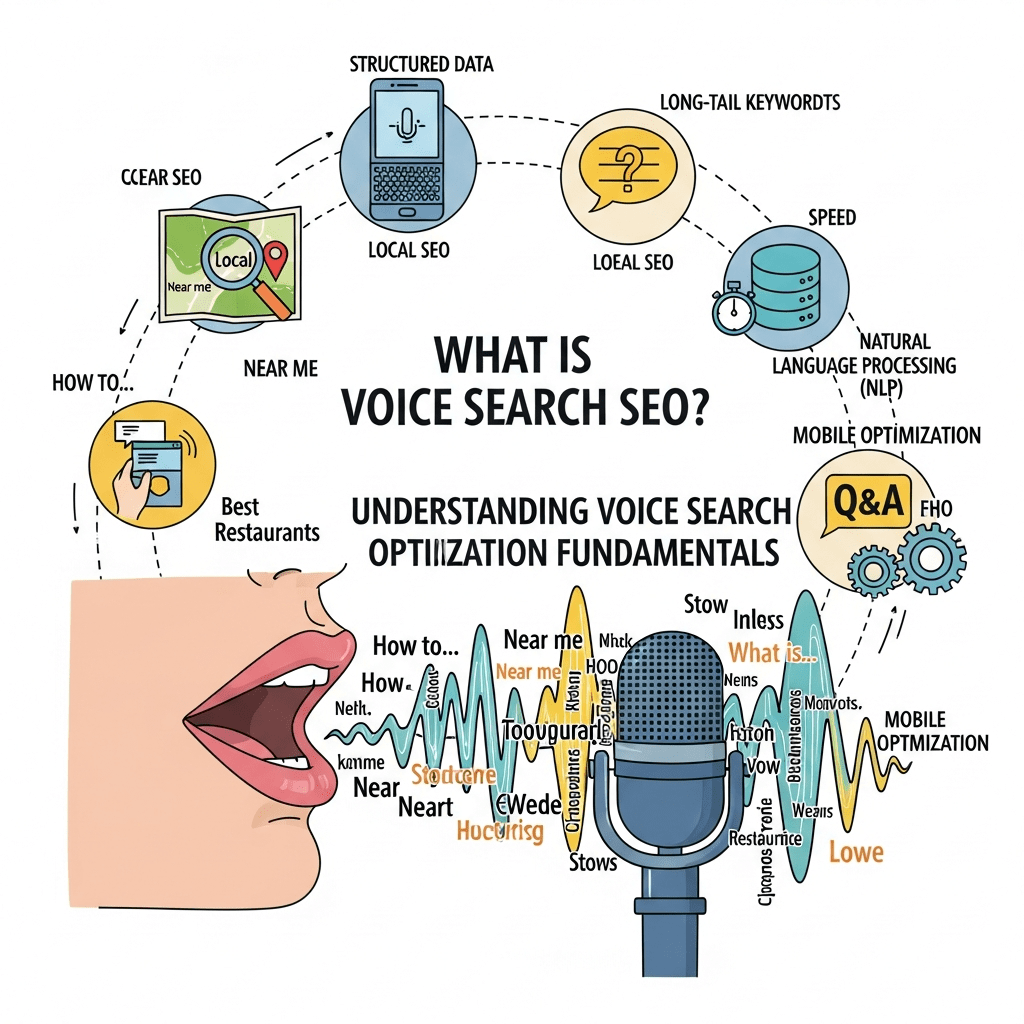
What is Voice Search SEO? Understanding Voice Search Optimization Fundamentals
You just asked Siri where the nearest coffee shop is. Alexa told you tomorrow’s weather while you brushed your teeth. Google Assistant helped you find that recipe with your hands covered in flour. Welcome to the revolution—voicesearch SEO is no longer optional.
Over 8.4 billion voice assistants are active worldwide, according to Statista’s 2024 report. If your business isn’t optimized for these spoken queries, you’re invisible to half the internet.
Table of Contents
ToggleWhat Exactly is Voice Search SEO?
Voice search SEO is the practice of optimizing your content so it appears when people ask questions aloud to smart devices. Instead of typing “Italian restaurant Chicago,” users now ask “Hey Google, what’s the best Italian restaurant near me?”
The shift is massive. ComScore research indicates that 50% of all searches are now voice-based. That’s billions of queries your competitors might be capturing while you’re stuck in text-mode optimization.
Think of what is voice search this way: it’s the natural evolution of how humans communicate. We don’t talk in keywords—we ask full questions. Voice SEO adapts your content to match this conversational reality.
How Does Voice Search Actually Work?
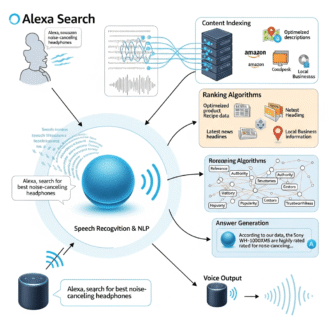
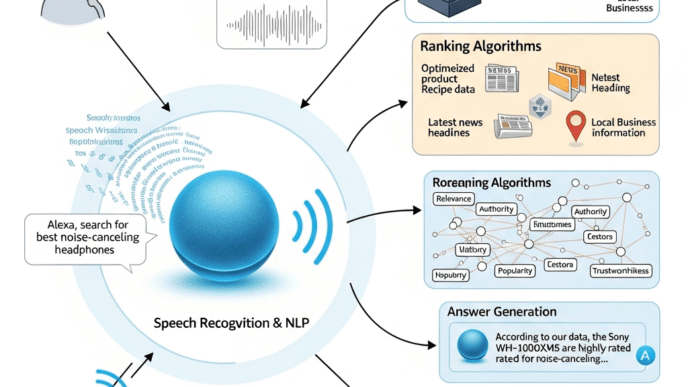
When you speak to a smart assistant, sophisticated technology kicks into gear. Natural Language Processing (NLP) converts your speech to text, interprets your intent, and delivers the most relevant answer from its database.
Google Assistant pulls from Google’s index and Knowledge Graph. Siri relies on Bing, Yelp, and Apple’s proprietary sources. Alexa prioritizes Amazon’s ecosystem alongside Bing results.
This matters because optimization strategies differ by platform. What works for Google might not work for Alexa—though voice search fundamentals remain consistent across all assistants.
According to Backlinko’s voice search study, the average voice search result is written at a 9th-grade reading level. Simplicity wins.
Why Voice Search Differs from Traditional Search
The gap between typing and talking is enormous. When someone types, they use abbreviated phrases: “weather NYC.” When they speak, they use complete sentences: “What’s the weather in New York City today?”
How voice search differs from traditional search comes down to three key factors:
Query Length: Voice searches average 29 words compared to just 2-3 words for text queries (Backlinko research)
Conversational Tone: People speak naturally to devices, using question words like who, what, when, where, why, and how
Intent Clarity: Spoken queries often reveal stronger intent—”near me” searches indicate immediate action, not research browsing
Think about your own behavior. You probably type “pizza” but say “Where can I get the best pizza delivered right now?” That difference transforms SEO strategy completely.
What Are the Core Components of Voice Search Optimization?
Understanding voice search basics means grasping several essential elements that work together. You can’t optimize just one piece and expect results.
Conversational Keywords
Traditional SEO targets short keywords. Voice SEO requires long-tail conversational phrases that mimic actual speech patterns.
Instead of “plumber services,” target “How do I find a reliable plumber near me tonight?” Natural language wins every time.
Use tools like AnswerThePublic to discover real questions people ask about your topic. These become your optimization goldmine.
Featured Snippets
Position zero is everything in voice search. Google Assistant reads featured snippet content for 40.7% of all voice results according to Stone Temple’s research.
Featured snippets appear in those boxes above regular search results. They answer questions directly in 29-40 words—perfect for voice assistants to read aloud.
Structure your content to answer specific questions concisely right after question-format headings. That’s your ticket to voice visibility.
Local Optimization
Voice searches have intense local intent. BrightLocal’s 2024 study found that 58% of consumers used voice search to find local business information in the past year.
Near me” queries dominate voice searches. If you’re a local business without a complete Google Business Profile, you’re giving competitors free customers.
For more comprehensive tactics on dominating local voice results, check out our complete guide on voice search optimization for smart assistants.
Schema Markup
This invisible code tells search engines exactly what your content means. Structured data helps voice assistants extract and read your content accurately.
FAQ schema, Local Business schema, and Google’s speakable schema specifically target voice search visibility. Without these, you’re making assistants guess about your content.
Google’s structured data documentation provides implementation guidelines—though the learning curve is steep for beginners.
Voice Search vs Text Search: Key Differences
| Factor | Text Search | Voice Search |
|---|---|---|
| Query Length | 2-3 words | 29+ words |
| Format | Keywords & phrases | Full questions |
| Device | Desktop/mobile typing | Mobile/smart speakers |
| Results Shown | 10 per page | Usually 1 answer |
| User Intent | Research & browsing | Immediate answers |
| Competition | Page 1-3 visibility | Position zero or nothing |
This comparison reveals why voice SEO explained requires fundamentally different tactics. The “good enough for page two” mentality dies with voice search.
What Makes Voice Search SEO So Important Right Now?
The numbers don’t lie. PwC’s consumer study found that 71% of people prefer conducting queries by voice instead of typing on mobile devices.
Understanding voice search optimization basics matters because adoption is accelerating, not slowing. Juniper Research projects voice-based ad revenue will hit $19 billion annually by 2025.
The Mobile Connection
Voice search and mobile dominance are intertwined. With 71% of smartphone users performing voice searches according to Google’s data, mobile optimization becomes non-negotiable.
Sites loading in under 3 seconds capture the majority of voice traffic. Every second of delay reduces conversions by 20%, per Portent’s research.
If your site isn’t mobile-friendly and lightning-fast, voice assistants skip you entirely.
The Commerce Opportunity
Voice shopping exploded to $40 billion in annual US sales by 2024, according to OC&C Strategy Consultants. Early optimizers capture disproportionate market share.
Amazon dominates voice commerce through Alexa. But Google Shopping and local “near me” queries create opportunities for every business type.
Our comprehensive voice search strategy guide covers platform-specific commerce optimization in detail.
How Do You Start Optimizing for Voice Search?
Beginning with introduction to voice optimization doesn’t require technical wizardry. Smart, systematic approaches beat scattered efforts every time.
Step 1: Research Question Keywords
Open AnswerThePublic and enter your main topic. You’ll see hundreds of actual questions people ask.
Filter these by relevance to your business. Prioritize questions with commercial or local intent—these convert better than purely informational queries.
Create a spreadsheet organizing questions by topic cluster. This becomes your content roadmap for the next 6-12 months.
Step 2: Create FAQ Content
Dedicated FAQ pages dominate voice results. Structure each question as an H2 heading, followed by a 40-60 word answer paragraph.
Implement FAQ schema markup using Google’s structured data markup helper. This identifies your Q&A content for voice assistants.
Don’t create generic FAQs. Answer real, specific questions your customers actually ask—check your support emails for inspiration.
Step 3: Optimize Your Google Business Profile
For local businesses, this is your voice search foundation. Complete every single field: categories, hours, services, photos, posts.
Respond to every review within 48 hours. Google weights active, engaged businesses higher in local voice results.
Add detailed service descriptions with natural question phrases. “Do you offer emergency plumbing on weekends?” becomes part of your service text.
Step 4: Speed Up Your Mobile Site
Run your site through Google’s PageSpeed Insights. Aim for green scores (90+) on mobile.
Compress images, enable browser caching, minimize CSS/JavaScript, and consider AMP for content pages. Voice search demands speed.
GTmetrix provides actionable recommendations if Google’s tool seems too technical. Every improvement helps.
Step 5: Structure Content with Clear Answers
Place the direct answer to your target question in the first 100 words of every page. Voice assistants extract content from the beginning.
Use short paragraphs (2-3 sentences max). Break long explanations into bullet lists. Make extraction easy.
Think like a voice assistant: if someone asks this question, what’s the clearest, most helpful 30-second answer?
Pro Tip: Test your content by reading it aloud. If it sounds awkward or robotic when spoken, rewrite it. Voice-friendly content should flow naturally in conversation.
Real-World Voice Search Success Example
Domino’s Pizza implemented voice ordering through Alexa, Google Assistant, and their own DOM voice assistant. The result? Over 65% of their orders now come through digital channels, with voice growing fastest.
Their secret: conversational ordering flows. Instead of forcing users to speak in specific formats, they built natural language understanding that handles variations like “I want a large pepperoni” or “Can I get a big pizza with pepperoni?”
Local businesses see similar wins. Pest control company Terminix optimized for voice by targeting question keywords like “How do I know if I have termites?” Their featured snippet acquisition increased organic traffic by 35% in six months.
What Are the Most Common Voice Search SEO Mistakes?
Even experienced marketers stumble with voice optimization. Avoid these frequent pitfalls.
Ignoring Conversational Language
Writing in stiff, formal corporate speak kills voice visibility. People don’t ask “What are the operational parameters of voice search technology?” They ask “How does voice search work?”
Match your content to actual human speech patterns. Use contractions, ask rhetorical questions, and write like you talk.
Forgetting Mobile Optimization
Your desktop site might load beautifully, but if mobile takes 6 seconds, you’ve lost the voice search game. 53% of mobile users abandon sites taking over 3 seconds to load.
Test on actual devices, not just emulators. Real-world mobile performance differs from desktop testing.
Skipping Local SEO
National businesses sometimes ignore local optimization, assuming they don’t need it. Wrong. People ask “Where can I buy [your product] near me?” even for nationwide brands.
Every business location needs its own optimized landing page with complete NAP (name, address, phone) information and location-specific content.
Neglecting Schema Markup
Unstructured content makes assistants work harder to understand your meaning. Implementing FAQ, Local Business, How-To, and speakable schema dramatically increases voice selection probability.
Schema.org provides code examples, though beginners might need developer help for implementation.
Targeting Only Generic Keywords
Broad keywords like “SEO” or “marketing” are too vague for voice search. People ask specific questions: “What is voice search SEO and why does it matter?”
Long-tail, question-based keywords with clear intent always outperform generic terms in voice results.
Expert Insight: “The brands winning in voice search aren’t necessarily spending more—they’re speaking their customers’ language. Conversational content beats keyword stuffing every time.” – Rand Fishkin, SparkToro
How Does Voice Search Connect with AI and Machine Learning?
The integration of generative AI and voice search is transforming results quality. ChatGPT’s influence on Bing affects both Alexa and Siri, which use Bing for web results.
Google’s MUM and BERT updates specifically enhanced voice search capabilities by better understanding context and conversational nuance. These AI models interpret multi-part questions and follow-up queries more accurately.
Predictive voice search is emerging—assistants learn user patterns and anticipate needs before you ask. Building consistent engagement through valuable content increases your likelihood of appearing in predictive suggestions.
For more on how AI is reshaping search behavior, explore our main voice search optimization strategy.
What Tools Help with Voice Search Optimization?
Several specialized tools make voice SEO manageable:
- AnswerThePublic: Discovers question keywords people actually ask
- SEMrush: Position tracking for featured snippets and question keywords
- Ahrefs: Question keyword research and ranking monitoring
- Google Search Console: Identifies voice-friendly long-tail queries driving traffic
- Schema Markup Validator: Tests structured data implementation
Most voice SEO happens with existing tools—you just use them differently, focusing on conversational queries and position zero targeting.
Our complete platform comparison guide covers tool selection in depth.
What’s the Future of Voice Search SEO?
Multimodal search—combining voice and visual queries—is rising fast. Google Lens voice searches and Alexa Show devices blend modalities.
Wearable voice integration through smartwatches, earbuds, and AR glasses will expand endpoints. Each requires ultra-concise answers optimized for audio-only consumption.
Privacy-first voice technologies following Apple’s on-device processing will reduce data collection while maintaining functionality. Focus on first-party data and transparent privacy policies.
The fundamentals won’t change: clear answers to real questions, delivered fast on mobile devices, with proper technical implementation. Master those basics, and platform evolution won’t catch you off-guard.
Frequently Asked Questions About Voice Search SEO
What is the main difference between voice search and regular search?
Voice search uses conversational, question-based queries averaging 29 words, while text search uses short keyword phrases of 2-3 words. Voice searches demand immediate, direct answers from position zero, whereas text searches allow browsing multiple results. The user intent in voice search is typically higher and more action-oriented.
Do I need different content for voice search?
You don’t need completely separate content, but existing content requires optimization. Add FAQ sections, use question-format headings, write conversational answers in the first paragraph, implement schema markup, and ensure mobile-friendliness. Your core information stays the same—the presentation changes for voice extraction.
How long does voice search optimization take to show results?
Low-competition question keywords can rank within 2-4 weeks with proper optimization. Featured snippet acquisition for competitive queries typically takes 30-90 days depending on your current ranking position. Building comprehensive topical authority for consistent voice visibility requires 3-6 months of systematic content creation and technical optimization.
Is voice search only important for local businesses?
No—while local businesses benefit significantly (58% of voice searches have local intent per BrightLocal), all business types gain from voice optimization. E-commerce, B2B services, content publishers, and information sites all see traffic growth from voice-optimized content. The tactics vary by business model, but the opportunity is universal.
What’s the most important factor for voice search rankings?
Featured snippet ownership is the single most critical factor—40.7% of voice results come from position zero according to Stone Temple research. However, this requires fast mobile load times, conversational content structure, schema markup, and established topical authority. No single factor works in isolation.
Can small businesses compete in voice search?
Absolutely—small businesses often have advantages, especially for local queries. Focus on hyper-local optimization, specific niche questions, complete Google Business Profile management, and earning local reviews. Voice search’s conversational nature levels the playing field, allowing targeted businesses to outrank larger competitors for specific queries.
Final Thoughts on Voice Search SEO Fundamentals
Voice search isn’t replacing traditional SEO—it’s expanding it into more human dimensions. The businesses succeeding speak their customers’ language, answer real questions directly, and optimize for the way people actually talk.
Start simple: pick 10 questions your customers ask, create clear answers, structure them properly, and implement basic schema markup. These foundational steps deliver measurable results while you build comprehensive voice search expertise.
The 8.4 billion voice assistants worldwide represent 8.4 billion opportunities to connect with prospects exactly when they need you. The question isn’t whether to optimize for voice search—it’s how quickly you can start.
Your customers are already asking questions. Make sure they’re asking you.
For platform-specific tactics, advanced technical implementation, and comprehensive voice commerce strategies, explore our complete guide: Voice Search Optimization for Smart Assistants.
Citations & Sources
- Statista – “Number of digital voice assistants in use worldwide” (2024) – https://www.statista.com/statistics/973815/worldwide-digital-voice-assistant-in-use/
- ComScore – Voice Search Statistics and Market Analysis (2024)
- Backlinko – “Voice Search SEO Study” analyzing voice search ranking factors – https://backlinko.com/voice-search-seo-study
- Stone Temple (Perficient Digital) – “Digital Assistant Voice Search Study” (40.7% featured snippet stat)
- BrightLocal – “Voice Search for Local Business Study” (2024) – https://www.brightlocal.com/research/voice-search-for-local-business-study/
- PwC – “Consumer Voice Shopping Preferences Study” (71% preference statistic) – https://www.pwc.com/us/en/services/consulting/library/consumer-intelligence-series/voice-assistants.html
- Google Think with Google – Mobile Voice Search Consumer Behavior Research – https://www.thinkwithgoogle.com/consumer-insights/consumer-trends/mobile-voice-search/
- Portent – “Page Load Time Impact on Conversion Rates” – https://www.portent.com/blog/analytics/research-site-speed-hurting-everyones-revenue.htm
- OC&C Strategy Consultants – “Voice Shopping Revenue Projections Report”
- Juniper Research – “Voice Commerce and Ad Revenue Projections” (2024-2025)
Related posts:
- Voice Search Optimization: Rank for “Near Me” Searches in 2025 (visual guide)
- Voice Search Optimization for Smart Assistants: Alexa, Siri, Google Assistant Strategy
- How Alexa Search Works: Optimizing Content for Amazon’s Voice Assistant
- From Algorithms to AI Agents: The 2026 SEO Forecast Industry Leaders Are Preparing For