Your customers are talking to their phones right now. They’re asking Alexa to find the nearest pizza place, telling Siri to schedule appointments, and commanding Google Assistant to compare prices. If your business isn’t showing up in these conversations, you’re invisible to the fastest-growing search behavior in digital history.
Voice search optimization isn’t just another SEO trend—it’s a fundamental shift in how people find information online. By 2024, over 8.4 billion voice assistants were in use worldwide, and that number keeps climbing. This comprehensive guide will show you exactly how to dominate voice search results across Alexa, Siri, and Google Assistant, turning spoken queries into customers.
Table of Contents
ToggleWhat Makes Voice Search Different from Regular SEO?
Voice search flipped the script on traditional SEO. People don’t talk to their devices the way they type into search bars.
When someone types, they might search: “best Italian restaurant Chicago.” When they speak, they ask: “Hey Google, what’s the best Italian restaurant near me that’s open right now?” That difference changes everything about optimization strategy.
Conversational queries demand longer, more natural keyword targeting. The average voice search query contains 29 words compared to just 2-3 words for text searches, according to Backlinko research. Your content needs to match this conversational tone or you won’t appear in results.
Voice searches also prioritize speed and directness. Smart assistants typically read only one answer—the featured snippet or position zero result. There’s no second page of voice search results, making competition fiercer than ever.
Understanding How Smart Assistants Actually Work
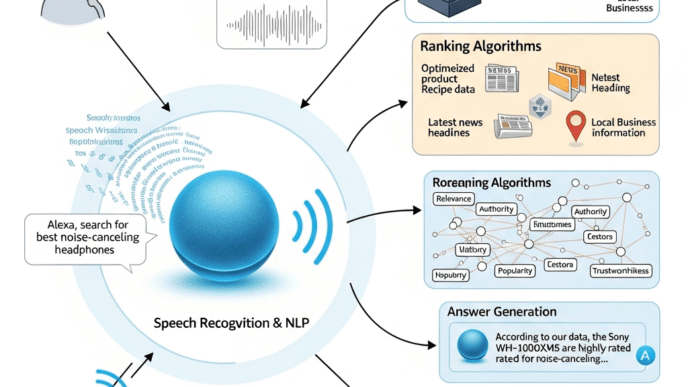
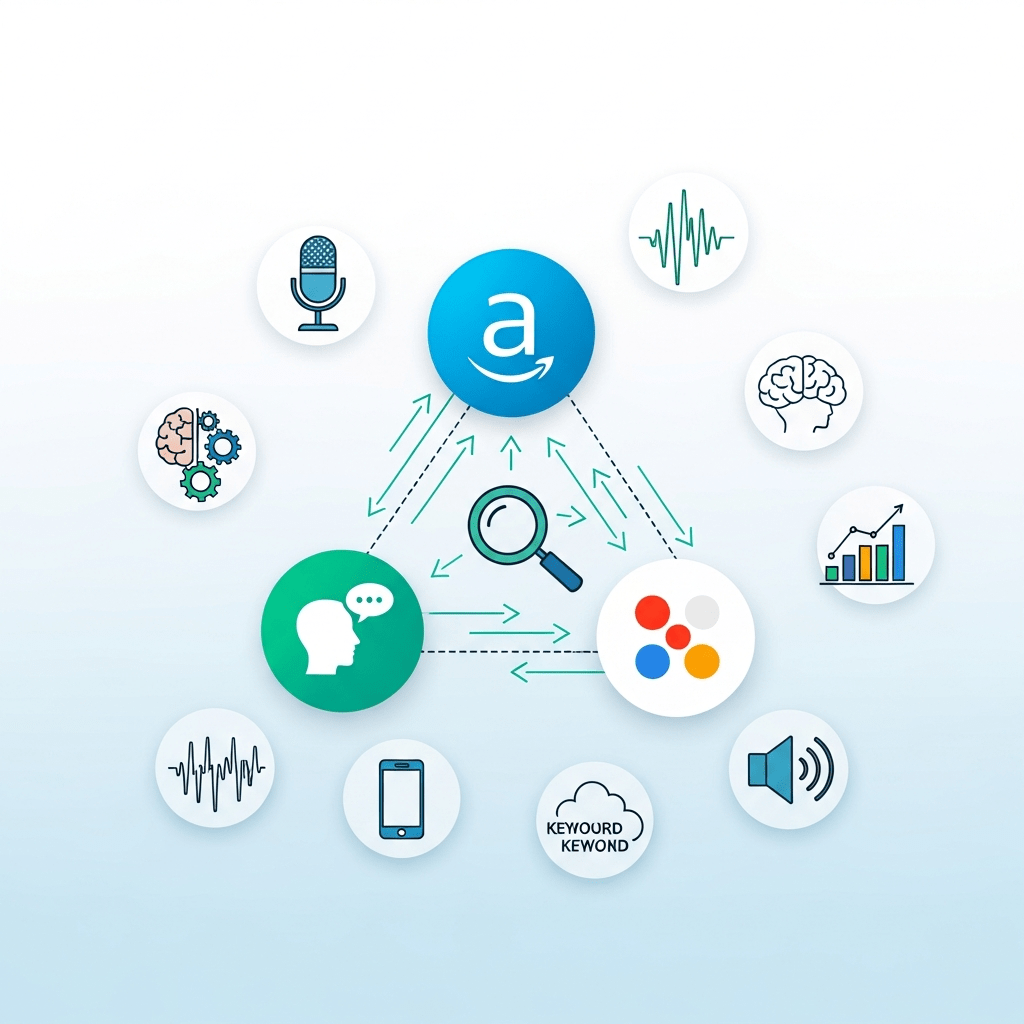
Behind every voice query sits sophisticated natural language processing (NLP) technology. When you ask Alexa a question, she converts your speech to text, interprets your intent, searches her knowledge base, and delivers an answer—all in milliseconds.
Each platform uses different data sources. Google Assistant pulls from Google’s search index and Knowledge Graph. Siri relies on a combination of Bing, Yelp, Apple Maps, and specialized databases. Alexa prioritizes Amazon’s ecosystem alongside Bing results.
This matters because optimizing for one assistant doesn’t automatically optimize for all three. Cross-platform voice SEO requires understanding each platform’s unique preferences and data sources.
Machine learning algorithms continuously improve how assistants understand context, accents, and follow-up questions. Google’s BERT and MUM updates specifically enhanced voice search capabilities by better understanding conversational context and nuance.
Why Voice Search Optimization Matters for Your Business Now
The numbers tell a compelling story. ComScore research indicates that 50% of all searches will be voice-based by 2024. Juniper Research projects voice-based ad revenue will reach $19 billion annually by 2025.
Voice commerce (v-commerce) represents massive opportunity. OC&C Strategy Consultants found that voice shopping is expected to jump to $40 billion in the US and $5 billion in the UK by 2025. Early optimizers will capture disproportionate market share.
Local businesses benefit most dramatically. BrightLocal data shows 58% of consumers used voice search to find local business information in 2023. “Near me” voice searches grew 900% over two years, according to Google.
Mobile dominance accelerates voice adoption. With 71% of consumers preferring to conduct queries by voice instead of typing (PwC), mobile-first businesses must prioritize voice SEO strategies immediately.
How Do You Optimize Content for Google Assistant?
Google Assistant dominates the voice assistant market with over 4.2 billion devices worldwide. Winning here means understanding Google’s unique ranking factors for voice.
Featured snippets are your golden ticket. Google Assistant reads featured snippet content for 40.7% of all voice search results, per a Stone Temple study. If you’re not in position zero, you’re barely in the game.
Structure your content to answer specific questions in 29-40 words. Google prefers concise, direct answers that can be read aloud naturally. Place these answers immediately after question-format headings.
<h2>What is voice search optimization?</h2>
<p>Voice search optimization is the process of optimizing your content to appear in voice search results on smart assistants like Alexa, Siri, and Google Assistant by using conversational keywords and structured data.</p>
Local SEO integration proves critical. Optimize your Google Business Profile completely—add photos, hours, services, posts, and respond to reviews. Google Assistant pulls heavily from Business Profile data for “near me” queries.
Implement speakable schema markup—Google’s specific structured data for voice-friendly content. This markup identifies which sections of your content are best suited for text-to-speech playback.
The Google Assistant Content Formula
Create FAQ pages targeting question keywords. Structure them with Schema.org FAQ markup to increase visibility in voice results.
Focus on long-tail conversational keywords like “how do I optimize my website for Google Assistant” instead of “Google Assistant optimization.” Tools like AnswerThePublic reveal exactly what questions people ask.
Build topic clusters around voice search themes. Create a comprehensive pillar page, then link to detailed cluster content answering specific sub-questions. This establishes topical authority that Google rewards.
What’s the Best Strategy for Amazon Alexa Optimization?
Alexa commands 69% of the US smart speaker market, making Amazon optimization essential for voice visibility. The platform operates differently from web-based assistants.
Alexa Skills represent one optimization path—custom voice apps that users enable. But organic optimization through Alexa Answers also drives discovery without custom development.
Amazon prioritizes its own ecosystem. Product searches default to Amazon’s catalog, making product schema markup crucial for e-commerce businesses. Include detailed product descriptions, specifications, pricing, and availability.
Alexa Answer Cards display business information when users ask general questions. To appear here, create detailed, authoritative content on your website that answers common industry questions comprehensively.
For local businesses, claim and optimize your Alexa Business Listing through Amazon’s Alexa for Business platform. This helps you appear when users ask Alexa for nearby services.
Voice Shopping Optimization for Alexa
Amazon shopping through voice reached $2.1 billion in 2023, according to eMarketer. Capturing this traffic requires specific tactics.
Earn the Amazon’s Choice badge by maintaining excellent seller metrics—fast shipping, high ratings, competitive pricing, and Prime eligibility. This badge dramatically increases voice shopping selection.
Optimize product titles for voice readability. Instead of “Men’s Blue Cotton T-Shirt XL,” use “Blue cotton t-shirt for men, size extra large.” The second version sounds natural when read aloud.
Write conversational product descriptions that answer likely voice queries: “Is this machine washable?” “What materials is this made from?” Include these Q&As directly in your listing.
How Should You Approach Siri Optimization?
Siri reaches 500 million active users monthly, particularly dominant in Apple’s affluent user base. The platform pulls data from multiple sources, requiring broader optimization.
Apple Maps integration matters enormously. Claim and optimize your Apple Maps business listing with complete information, categories, and high-quality photos. Siri defaults to Apple Maps for location queries.
Unlike Google and Alexa, Siri uses Bing’s search index for web results. This means Bing SEO directly impacts Siri visibility—an often-overlooked optimization channel.
For iOS apps, implement App Indexing through Apple’s APIs. This allows Siri to surface your app content in response to relevant queries, driving engagement beyond traditional web results.
Siri relies heavily on structured data from Yelp for restaurant and service business queries. Maintain an active, well-reviewed Yelp presence with complete business information and regular updates.
The Siri Ecosystem Advantage
Apple’s privacy-first approach means Siri uses on-device processing for many queries. Optimize for domain knowledge—Siri learns from user behavior and website engagement.
Build strong backlink profiles from authoritative Apple-focused tech sites. Siri appears to weight sources that Apple’s ecosystem already trusts more heavily.
Create iPhone-optimized content that loads quickly on iOS devices. Page speed on mobile directly correlates with Siri selection, according to SEMrush data showing 53% of mobile users abandon sites taking over 3 seconds to load.
What Keywords Actually Work for Voice Search?
Voice search keyword research requires completely different thinking. Forget short, generic keywords—think full sentences and questions.
Start with question modifiers: who, what, when, where, why, how. These trigger 14.1% of all Google searches (Moz) and dominate voice queries even more heavily.
Use tools like AnswerThePublic to discover real questions people ask. Type your core topic and extract hundreds of question-based long-tail variations.
AlsoAsked reveals the “People Also Ask” boxes that Google displays—these questions directly inform voice assistant responses. Target these aggressively.
Analyze Google Search Console data filtering for longer queries (7+ words). These likely represent voice searches and reveal natural language patterns to target.
Conversational Keyword Mapping
Create keyword clusters around conversational themes:
- Informational intent: “How do I optimize for voice search on Alexa
- Navigational intent: “Find voice SEO experts near me”
- Transactional intent: “Buy voice search optimization services”
Map user journey stages to question types. Early-stage researchers ask “what is” and “why” questions. Mid-funnel users ask “how to” and “best ways” questions. Bottom-funnel queries include “near me,” “buy,” “pricing,” and “compare.”
Layer in semantic keywords—related terms that demonstrate topical depth. For voice search optimization, include terms like smart speaker SEO, conversational AI optimization, and virtual assistant ranking.
Tools like SEMrush’s Keyword Magic Tool and Ahrefs’ Questions filter specifically identify voice-friendly question keywords with search volume data.
How Do You Structure Content for Voice Search Success?
Content structure makes or breaks voice optimization. Smart assistants need clear, scannable content they can extract and read aloud.
Start every page with a concise answer in the first 100 words. If someone asks your target question, they should get a usable answer immediately.
Use question-format H2 and H3 headings liberally:
- “How does voice search optimization work?”
- “What are the best practices for Alexa SEO?”
- Why should businesses optimize for voice search?”
Create dedicated FAQ sections on every page. Structure them with proper FAQ schema markup (more on this shortly). Answer 5-10 related questions that naturally branch from your main topic.
The Featured Snippet Formula
Featured snippets appear in 40.7% of voice search results. Winning them requires strategic formatting.
Paragraph snippets: Provide 40-50 word definitions or explanations directly after a question heading.
List snippets: Use numbered or bulleted lists for step-by-step instructions, rankings, or multiple items. Keep list items concise—one sentence each.
Table snippets: Create comparison tables for products, services, or concepts. Include columns for key differentiators like price, features, or ratings.
Implement proper heading hierarchy (H1 > H2 > H3) so search engines understand content relationships. Never skip heading levels or use multiple H1 tags.
Break long-form content into digestible chunks of 2-3 sentences per paragraph. Dense text blocks discourage both user engagement and voice assistant extraction.
What Technical SEO Elements Matter Most for Voice?
Technical optimization creates the foundation for voice search success. Without proper technical SEO, brilliant content never reaches smart assistants.
Schema markup tells search engines exactly what your content means. Implement these schema types for voice optimization:
Essential Schema Types for Voice Search
FAQ Schema: Marks up question-and-answer content for direct extraction:
{
  "@context": "https://schema.org",
  "@type": "FAQPage",
  "mainEntity": [{
    "@type": "Question",
    "name": "How do I optimize for voice search?",
    "acceptedAnswer": {
      "@type": "Answer",
      "text": "Optimize for voice search by using conversational keywords, implementing FAQ schema, creating featured snippet-friendly content, and optimizing for local search queries."
    }
  }]
}
Speakable Schema: Google’s proprietary markup identifying voice-friendly content sections:
{
  "@context": "https://schema.org/",
  "@type": "WebPage",
  "speakable": {
    "@type": "SpeakableSpecification",
    "cssSelector": [".summary", ".instructions"]
  }
}
LocalBusiness Schema: Critical for “near me” queries, includes NAP (name, address, phone), hours, services, and geo-coordinates.
HowTo Schema: Perfect for instructional content that voice assistants read step-by-step.
Product Schema: Essential for voice commerce, includes pricing, availability, ratings, and specifications.
Site Speed and Mobile Performance
Voice searches happen predominantly on mobile devices. Google’s data shows 71% of smartphone users perform voice searches.
Aim for sub-3-second load times. Google’s PageSpeed Insights should show green scores (90+) for mobile performance. Every second of delay reduces conversions by 20% (Portent).
Implement Accelerated Mobile Pages (AMP) for content-heavy pages. While AMP’s importance has diminished, voice assistants still favor fast-loading, mobile-optimized content.
- Largest Contentful Paint (LCP): Under 2.5 seconds
- First Input Delay (FID): Under 100 milliseconds
- Cumulative Layout Shift (CLS): Under 0.1
Use Google’s Mobile-Friendly Test to identify and fix mobile usability issues. Voice search assistants penalize sites with mobile rendering problems.
How Can Local Businesses Dominate Voice Search?
Local voice search creates immediate business impact. “Near me” searches grew 500% between 2019 and 2024, according to Search Engine Land.
Google Business Profile optimization is non-negotiable. Complete every section:
- Accurate business name, address, phone (NAP consistency)
- Primary and secondary categories
- Business hours including special holiday hours
- High-quality photos (exteriors, interiors, products, team)
- Service areas for businesses without physical locations
- Products/services with descriptions
- Regular Google Posts updates
- Response to all reviews within 48 hours
Implement local schema markup on your website matching your GBP information exactly. Inconsistent NAP data confuses smart assistants and hurts rankings.
Multi-Location Voice Optimization
Managing multiple locations requires systematic approaches. Create unique landing pages for each location with:
- Location-specific content (not duplicated)
- Embedded Google Maps
- Local testimonials and reviews
- Location-specific service offerings
- Area-specific keywords (“best pizza in Brooklyn Heights”)
- LocalBusiness schema for each location
Build local citations across directories like Yelp, Apple Maps, Bing Places, and industry-specific directories. Ensure NAP consistency across all platforms—even minor variations hurt voice search visibility.
Target neighborhood-level keywords beyond just city names. “Best pediatrician in Lincoln Park Chicago” performs better for voice than generic “Chicago pediatrician.”
Earn local backlinks from community websites, local news outlets, chambers of commerce, and complementary businesses. Local link authority signals geographic relevance to voice assistants.
What Role Does Featured Snippet Optimization Play?
Featured snippets represent the holy grail of voice search optimization. According to Ahrefs, ranking in a featured snippet increases CTR by 8% and dominates voice results.
Position Zero targeting requires understanding what triggers different snippet types:
Paragraph Snippets
Google extracts 40-60 word answers to definition or explanation queries. Format:
## What is schema markup?

Schema markup is structured data code that helps search engines understand your content's meaning and context. It enables rich results and voice search optimization by clearly defining entities, relationships, and attributes on your web pages.
List Snippets
Triggered by “how to,” “best,” “top,” or step queries. Use numbered lists for sequences, bullets for collections:
Steps to Optimize for Voice Search:
- Research conversational keywords and question queries
- Implement FAQ and speakable schema markup
- Create concise answers in the first paragraph
- Optimize for local search and mobile performance
- Build topical authority through cluster content
Table Snippets
Comparison queries like “Alexa vs Google Assistant vs Siri” trigger table snippets:
| Feature | Google Assistant | Amazon Alexa | Apple Siri |
|---|---|---|---|
| Market Share | 81% (mobile) | 69% (smart speaker) | 500M users |
| Primary Data Source | Google Search | Bing/Amazon | Bing/Yelp |
| Best For | General queries | Shopping/Smart home | Apple ecosystem |
| Voice Commerce | Google Shopping | Amazon Prime | Limited |
Structure tables with clear headers and comparable data points across columns.
How Should You Optimize for Voice Commerce?
Voice shopping exploded to $40 billion in annual US sales by 2024 (OC&C Strategy Consultants). V-commerce optimization requires product-specific strategies.
Product Listing Best Practices
Write voice-friendly product titles that sound natural when spoken aloud. Include key attributes shoppers ask about:
❌ Poor: “XYZ Bluetooth Speaker BT-500 Black” ✅ Better: “XYZ Portable Bluetooth Speaker in Black with 12-Hour Battery”
Create detailed product descriptions answering common voice queries:
- “Is this dishwasher safe?”
- “What’s this made of?”
- “Does this come in other colors?”
- “How long is the warranty?”
Implement comprehensive Product schema with every available field:
{
  "@type": "Product",
  "name": "Wireless Bluetooth Headphones",
  "description": "Premium noise-canceling wireless headphones",
  "brand": "AudioTech",
  "offers": {
    "@type": "Offer",
    "price": "199.99",
    "priceCurrency": "USD",
    "availability": "https://schema.org/InStock",
    "seller": { "@type": "Organization", "name": "AudioTech" }
  },
  "aggregateRating": {
    "@type": "AggregateRating",
    "ratingValue": "4.7",
    "reviewCount": "328"
  }
}
Amazon Voice Shopping Optimization
For Amazon sellers, voice optimization follows specific rules:
Earn Amazon’s Choice status through:
- High seller ratings (4.5+ stars)
- Fast, reliable shipping (Prime eligibility)
- Competitive pricing
- Strong conversion rates
- Low return rates
Optimize product listings with question-focused content. The “Customer Questions & Answers” section feeds directly into Alexa responses.
Use backend search terms strategically in Seller Central, including conversational phrases people might speak. You have 250 bytes—use them wisely.
How Do You Track and Measure Voice Search Performance?
Traditional analytics miss most voice search traffic. Sophisticated tracking requires specialized approaches.
Identifying Voice Queries in Google Search Console
Filter Search Console data for longer queries (7+ words) with question modifiers. These likely represent voice searches even though Google doesn’t explicitly label them.
Look for featured snippet impressions—these indicate voice search potential. Track keywords where you rank 1-5 but don’t own the snippet as optimization opportunities.
Monitor mobile vs desktop traffic splits. Dramatic mobile preference on specific keywords suggests voice search dominance.
Voice Search KPIs That Matter
Track these metrics specifically for voice optimization:
Featured Snippet Acquisition Rate: Percentage of target keywords where you own position zero Question Query Impressions: Volume of question-format keywords driving impressions Mobile Click-Through Rate: CTR on mobile devices for target keywords Local Pack Appearances: Visibility in local 3-pack for “near me” queries Average Query Length: Increasing query length suggests voice search growth Direct Traffic Spikes: Voice searches often appear as direct traffic in analytics
Use UTM parameters on URLs you share through voice-enabled platforms to track voice-driven traffic sources.
Tools for Voice SEO Analysis
SEMrush Position Tracking: Monitor featured snippet ownership and losses Ahrefs Rank Tracker: Track question keyword rankings BrightLocal: Monitor local search visibility across platforms AnswerThePublic: Discover voice-friendly question keywords Schema Markup Validator: Test structured data implementation Google’s Rich Results Test: Verify enhanced result eligibility
Create custom Google Data Studio dashboards combining Search Console, Analytics, and third-party data for comprehensive voice search reporting.
Voice Assistant Comparison: Which Platform Should You Prioritize?
Each platform offers distinct advantages. Strategic prioritization depends on your target audience and business model.
| Factor | Google Assistant | Amazon Alexa | Apple Siri |
|---|---|---|---|
| Global Reach | 4.2B devices | 500M users | 500M monthly users |
| Data Source | Google Search, Knowledge Graph | Bing, Amazon catalog | Bing, Yelp, Apple Maps |
| Best Use Case | General queries, local search | Shopping, smart home | Apple ecosystem users |
| Commerce Strength | Google Shopping | Amazon Prime ecosystem | Limited, Apple Pay |
| Developer Access | Actions on Google | Alexa Skills Kit | SiriKit, Shortcuts |
| Privacy Focus | Moderate | Low | High (on-device processing) |
| Market Position | Mobile dominant | Smart speaker leader | Premium user base |
Strategic Platform Selection
E-commerce businesses: Prioritize Alexa for direct shopping integration, Google for product discovery Local services: Focus on Google (dominant mobile share) and Siri (Apple Maps integration) B2B companies: Emphasize Google and Siri (professional user bases) Content publishers: Optimize for Google (traffic driver) and Alexa Skills (engagement)
Most businesses should implement cross-platform optimization covering universal best practices, then add platform-specific enhancements based on analytics data showing where traffic originates.
What Are the Most Common Voice Search Optimization Mistakes?
Even experienced SEOs stumble with voice optimization. Avoid these frequent pitfalls:
Writing for Robots, Not Humans
Voice search demands natural, conversational content. Keyword-stuffed, robotic copy fails completely.
❌ Wrong: “Voice search optimization voice SEO best practices voice search strategy implementation” ✅ Right: “How do you implement voice search optimization? Start by researching conversational keywords and creating FAQ-style content.
Ignoring Page Speed
Slow sites rarely win voice results. A site loading in 5+ seconds has nearly zero chance of voice selection, per Google’s research showing 53% mobile bounce rate at 3 seconds.
Neglecting Local Optimization
76% of voice search users look for local information (BrightLocal). Skipping local SEO means missing the majority of voice opportunity.
Forgetting Mobile-First Design
Voice searches happen on mobile. Desktop-optimized sites with poor mobile experiences won’t rank regardless of content quality.
Skipping Schema Markup
Unstructured content makes it difficult for voice assistants to extract answers. Implement FAQ, speakable, and relevant schema types consistently.
Overlooking Question Keywords
Focusing only on traditional keywords misses conversational queries. Research and target specific questions people ask voice assistants.
Creating Generic FAQ Sections
Cookie-cutter FAQs add no value. Create unique, detailed answers to real questions your audience asks.
Pro Tip: Review Google’s “People Also Ask” boxes for your target keywords monthly. These questions change based on trending user queries and reveal exactly what to optimize for.
Advanced Voice SEO Tactics for Competitive Industries
When basic optimization doesn’t cut through competition, employ these advanced strategies:
Topic Clustering for Voice Authority
Build comprehensive topic clusters establishing domain expertise:
- Create an ultimate pillar guide (3,000-6,000 words) on your core topic
- Develop 8-15 cluster articles targeting specific subtopic questions
- Interlink strategically with contextual anchor text
- Update regularly with fresh information and examples
This architecture signals topical authority to search engines, increasing voice selection likelihood across related queries.
Multi-Language Voice Optimization
Global voice search requires language-specific approaches. Implement hreflang tags for international content:
<link rel="alternate" hreflang="en-us" href="https://example.com/en-us/" />
<link rel="alternate" hreflang="es-mx" href="https://example.com/es-mx/" />
Research voice search behavior in target languages—cultural differences affect query patterns significantly. “Near me” equivalents vary across languages and regions.
Voice Search for B2B Companies
Business services require longer consideration cycles. Optimize for informational queries targeting research phases:
- “How does [industry solution] work?”
- “What are the benefits of [B2B service]?”
- “How much does [enterprise software] cost?”
- “What’s the difference between [solution A] and [solution B]?”
Create detailed, authoritative content answering complex industry questions. B2B voice searchers want depth, not surface-level answers.
Leveraging Voice Search in Content Distribution
Optimize podcasts and audio content for voice discovery:
- Include detailed show notes with timestamps
- Implement Podcast schema markup
- Transcribe episodes for text searchability
- Create episode-specific landing pages targeting question keywords
- Submit to voice assistant podcast directories
The Future of Voice Search: What’s Coming Next?
Voice technology evolves rapidly. Smart optimizers prepare for emerging trends:
Generative AI Integration
GPT-powered voice assistants fundamentally change search behavior. ChatGPT integration in Bing affects Alexa and Siri results.
Large Language Models (LLMs) enable more nuanced understanding of complex, multi-part queries. Optimize for conversational follow-ups and context-dependent questions.
Multimodal Search Experiences
Voice + visual search combinations are rising. Google Lens voice queries and Alexa Show devices blend modalities.
Optimize images with descriptive alt text and structured data. Voice assistants increasingly reference visual content when providing answers on screen-enabled devices.
Predictive Voice Search
AI learns user patterns and preferences. Voice assistants increasingly anticipate needs before users ask.
Build user behavior data through consistent engagement. Regular content updates and personalized responses improve predictive suggestion likelihood.
Privacy-First Voice Technologies
Apple’s on-device processing sets industry direction. Expect more local processing and less data collection.
Focus on first-party data collection and transparent privacy policies. Privacy-conscious users increasingly choose assistants respecting data ownership.
Wearable Device Voice Integration
Smartwatches, earbuds, and AR glasses expand voice endpoints. Each requires specific optimization considerations.
Prioritize ultra-concise answers for wearables with no screens. Structure content for audio-only consumption.
Expert Insight: “Voice search isn’t replacing traditional search—it’s fragmenting it across multiple modalities. The winners will optimize for intent, not just keywords.” – Rand Fishkin, SparkToro founder
Your 90-Day Voice Search Optimization Roadmap
Implementation overwhelms without clear priorities. Follow this phased approach:
Days 1-30: Foundation Building
Week 1: Audit Current State
- Check existing schema markup implementation
- Test mobile site speed and usability
- Analyze current featured snippet ownership
- Review Google Business Profile completeness
Week 2: Research & Strategy
- Conduct voice keyword research with AnswerThePublic
- Identify top 20 question keywords to target
- Map existing content to voice queries
- Prioritize quick-win optimization opportunities
Week 3: Technical Implementation
- Add FAQ schema to relevant pages
- Implement speakable schema on pillar content
- Fix mobile performance issues
- Optimize or create Google Business Profile
Week 4: Content Optimization
- Rewrite top 5 pages with conversational tone
- Add FAQ sections to priority pages
- Create concise answers in first paragraphs
- Structure content for featured snippet targeting
Days 31-60: Expansion & Enhancement
Weeks 5-6: Content Creation
- Publish 4-6 new FAQ-style articles
- Create comparison content triggering table snippets
- Develop how-to guides with list snippets
- Build topic cluster around core keyword
Weeks 7-8: Platform-Specific Optimization
- Claim/optimize Apple Maps listing
- Create Alexa Skill or optimize for Alexa Answers
- Build local citations across 20+ directories
- Implement platform-specific schema variations
Days 61-90: Measurement & Refinement
Weeks 9-10: Analytics Setup
- Configure voice search tracking in Analytics
- Create custom Search Console reports
- Set up automated ranking monitoring
- Build voice SEO dashboard
Weeks 11-12: Optimization & Scaling
- A/B test different answer formats
- Expand to secondary keyword targets
- Update underperforming content
- Document process for ongoing optimization
Frequently Asked Questions About Voice Search Optimization
How long does it take to rank for voice search?
Voice search rankings can appear within 2-4 weeks for low-competition question keywords with proper optimization. Competitive queries require 3-6 months of consistent effort building topical authority, earning backlinks, and optimizing technical elements. Featured snippet acquisition—critical for voice results—typically takes 30-90 days depending on current ranking position and competition levels.
Do I need separate content for each voice assistant?
No, you don’t need completely separate content for each platform. Focus on universal best practices—conversational content, FAQ sections, schema markup, and mobile optimization work across all assistants. Add platform-specific enhancements (Google Business Profile for Google, Yelp optimization for Siri, Amazon listings for Alexa) as layer on top of solid foundational optimization.
What’s the ideal word count for voice search content?
Voice search answers average 29-40 words, but supporting content should be comprehensive. Create detailed 1,500-3,000+ word articles demonstrating expertise, then extract concise answers for featured snippets. Smart assistants pull from authoritative, in-depth content more reliably than thin pages, even though they read only brief excerpts.
Can small businesses compete in voice search?
Absolutely—small businesses often have advantages in voice search, especially for local queries. Focus on hyper-local optimization, specific niche questions, and excellent Google Business Profile management. 76% of voice searches have local intent, favoring nearby businesses over distant competitors regardless of size.
How do I optimize for “near me” voice searches?
Optimize for “near me” queries through complete Google Business Profile optimization, consistent NAP citations across directories, location-based content with geo-specific keywords, local schema markup, mobile-friendly website design, and earning local backlinks. Ensure your city, neighborhood, and service area appear naturally in content.
Is voice search optimization different for B2B vs B2C?
Yes, B2B voice search focuses on informational queries during longer research cycles—”how does,” “what are the benefits,” “pricing for.” B2C emphasizes transactional and local intent—”near me,” “buy,” “open now.” B2B requires deeper, more technical content while B2C prioritizes quick answers and convenient actions.
Final Thoughts on Voice Search Optimization
Voice search isn’t future technology—it’s current reality reshaping how customers discover businesses. The 8.4 billion voice assistants in use worldwide represent 8.4 billion opportunities to connect with prospects at the exact moment they need your products or services.
Early adopters gain disproportionate advantages. Voice search remains less competitive than traditional SEO, creating windows for businesses willing to optimize now before saturation.
Start with quick wins: optimize Google Business Profile, add FAQ schema to existing content, and target 5-10 question keywords. These foundational steps deliver measurable results within weeks while you build comprehensive optimization.
Voice search optimization isn’t separate from SEO—it’s evolution of SEO. The same principles apply: understand user intent, create exceptional content, optimize technical elements, and build authority. Voice simply demands more conversational execution.
The businesses thriving in voice search share common traits: they answer questions directly, speak naturally, load quickly on mobile, and appear in the right places when customers need them. That’s not complicated—it’s customer-focused marketing at its finest.
Your customers are already asking questions. Make sure they’re asking you.
Citations & Data Sources
- Statista – “Number of digital voice assistants in use worldwide” (2024)
- Backlinko – “Voice Search SEO Study” analyzing 10,000 voice search results
- ComScore – “Voice Search Statistics and Trends” (2024)
- Juniper Research – “Voice Commerce Revenue Projections” (2025)
- OC&C Strategy Consultants – “Voice Shopping Report” ($40B projection)
- BrightLocal – “Voice Search for Local Business Study” (2023)
- PwC – “Consumer Voice Shopping Preferences” (71% preference stat)
- Stone Temple – “Featured Snippets in Voice Search Study” (40.7% stat)
- Search Engine Land – “Near Me Search Growth Analysis” (500% growth)
- SEMrush – “Mobile Page Speed Impact Study” (53% bounce rate)
- Ahrefs – “Featured Snippet CTR Research” (8% increase)
- Moz – “Question Keyword Research” (14.1% of searches)
- Google – Mobile search behavior and speed studies
- Portent – “Page Load Time Conversion Impact” (20% per second)
- eMarketer – “Voice Shopping Revenue Analysis” ($2.1B Amazon)
📊 Voice Search Optimization Statistics 2024-2025
Comprehensive Data Analysis of Smart Assistant Market Trends
aiseojournal.netVoice Assistant Device Growth (2020-2025)
Data Source: Statista Global Voice Assistant Market Analysis 2024
Smart Speaker Market Share 2024
Data Source: eMarketer & Strategy Analytics Q3 2024
Voice Search Query Types Distribution
Data Source: BrightLocal Voice Search Study 2024
Voice Commerce Revenue Projection (2020-2025)
Data Source: Juniper Research & OC&C Strategy Consultants 2024
🎯 Key Market Insights
Voice Search Adoption Timeline
Voice Search Accuracy by Platform (2024)
Data Source: Loup Ventures Voice Assistant IQ Test 2024
Visit aiseojournal.net for comprehensive SEO guides, AI search strategies, and latest industry insights.
All statistics sourced from: Statista, ComScore, PwC, OC&C Strategy Consultants, eMarketer, BrightLocal, Juniper Research, Backlinko, Stone Temple, Search Engine Land, and Loup Ventures (2023-2024 reports)