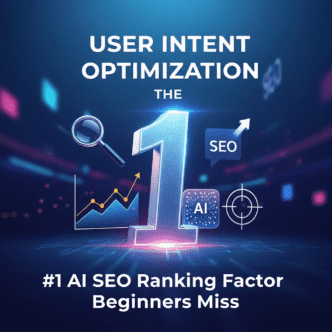
Here’s a painful truth most SEO beginners discover too late: You can have perfect technical SEO, comprehensive content, and dozens of backlinks—but if your content doesn’t match what the searcher actually wants, Google’s AI will bury you on page 5.
I see it constantly: A startup spends three months creating an exhaustive 5,000-word guide about “project management software,” perfectly optimized for keywords, loaded with information. It ranks #47. Meanwhile, a competitor’s simple comparison chart ranks #3. Why?
Intent mismatch.
The searcher typing “project management software” doesn’t want to learn what it is (they already know). They want to compare options and choose one. Your comprehensive guide answered a question they weren’t asking.
Google’s AI systems—RankBrain, BERT, neural matching—have one primary job: understand what users actually want when they search, then show them content that delivers it. Not content that’s “well-optimized.” Not content that’s “comprehensive.” Content that satisfies the specific intent behind the query.
User intent optimization is the bridge between what you create and what searchers need. Master it, and you’ll rank with less effort, convert at higher rates, and build sustainable organic visibility. Miss it, and you’ll wonder why your “perfect” content never performs.
Let me show you exactly how to identify intent, optimize for it, and stop wasting effort on content that Google’s AI will never reward.
Table of Contents
ToggleWhat Is User Intent Optimization? (And Why AI Cares So Much)
User intent optimization is the practice of aligning your content format, depth, and structure with the specific goal behind a search query.
It answers the question: “What does someone searching this phrase actually want to accomplish?”
The Four Core Search Intent Types
Every search query falls into one of four intent categories. Understanding these is foundational to search intent optimization.
1. Informational Intent: Learning & Understanding
What the user wants: Knowledge, explanation, how something works, definitions
Query patterns:
- “what is,” “how does,” “why,” “when”
- “guide to,” “tutorial,” “explained”
- “[topic] for beginners,” “learn about”
Content they expect: Educational articles, guides, tutorials, explainers, videos
Examples:
- “what is user intent in SEO”
- how does Google understand search queries”
- SEO basics for beginners
Optimization approach: Comprehensive educational content, clear explanations, examples, no aggressive sales pitch
2. Navigational Intent: Finding a Specific Site
What the user wants: To reach a particular website or page they already know about
Query patterns:
- Brand names or product names
- “[Brand] login,” “[Brand] website”
- Specific page titles or domains
Content they expect: The actual site/page they’re looking for, official sources
Examples:
- “Facebook login”
- “SEMrush pricing”
- “Google Analytics dashboard”
Optimization approach: Brand consistency, clear homepage/landing pages, site structure (mostly relevant for your own brand)
3. Commercial Investigation Intent: Research Before Buying
What the user wants: To evaluate options, compare alternatives, research before making a decision
Query patterns:
- “best,” “top,” “review,” “comparison”
- “[X] vs [Y],” “alternatives to”
- “affordable,” “[year],” “recommended”
Content they expect: Comparisons, reviews, buying guides, pros/cons, recommendations
Examples:
- “best email marketing software”
- “Mailchimp vs ConvertKit comparison”
- “affordable CRM for small business”
Optimization approach: Detailed comparisons, honest pros/cons, clear recommendations, affiliate disclosure
4. Transactional Intent: Ready to Take Action
What the user wants: To complete a transaction—buy, sign up, download, subscribe
Query patterns:
- “buy,” “purchase,” “order,” “price”
- “discount,” “coupon,” “deal”
- “download,” “sign up,” “free trial”
Content they expect: Product pages, pricing pages, checkout flows, clear CTAs
Examples:
- “buy running shoes online”
- “Shopify pricing plans”
- “download Canva free”
Optimization approach: Clear pricing, trust signals, strong CTAs, easy conversion path, minimal friction
Why Google’s AI Prioritizes Intent Matching
The fundamental problem Google solves: Billions of queries, trillions of pages. Which pages actually satisfy which queries?
Before AI intent understanding:
- Keyword matching: Does page contain query words?
- Result: Often wrong format, wrong depth, wrong goal
With AI intent understanding:
- Query analysis: What does the searcher want to accomplish?
- Content evaluation: Does this page deliver that outcome?
- Result: Better satisfaction, lower bounce rates, higher engagement
The AI systems involved:
RankBrain learns from user behavior:
- If searchers click result #3 and stay, but bounce from #1
- RankBrain adjusts: #3 better satisfies intent
- Over time, #3 moves up, #1 moves down
BERT understands query context:
- “can you get medicine for someone pharmacy”
- Old interpretation: Keywords about medicine and pharmacy
- BERT understanding: Can you pick up someone else’s prescription?
- Matches to content about pharmacy policies, not medicine types
Neural Matching connects concepts to intent:
- Query: “why does my laptop get super hot”
- Understands: Technical problem, needs solution
- Matches: Troubleshooting guides, not laptop buying guides
The ranking impact: Content that matches intent consistently:
- Gets clicked more (higher CTR from SERPs)
- Keeps users longer (lower bounce rate)
- Satisfies the query (engagement signals)
- Ranks higher (AI validates intent match)
Content that mismatches intent:
- Gets skipped in SERPs (low CTR)
- Users bounce immediately (wrong content type)
- Signals dissatisfaction (negative AI feedback)
- Drops in rankings (AI demotes poor matches)
Critical insight: You’re not optimizing for keywords anymore. You’re optimizing for satisfying specific user needs. AI algorithms measure satisfaction, not keyword presence.
For understanding how RankBrain evaluates user satisfaction signals, see RankBrain’s role in measuring content effectiveness.
How to Identify User Search Intent (The Practical Process)
Guessing at intent is a mistake. Here’s the systematic process to identify search intent accurately.
Step 1: Analyze the SERP (Let Google Show You)
Google already solved this problem. The top-ranking pages reveal what intent Google’s AI has determined for that query.
The SERP analysis process:
1. Google your target keyword in an incognito window (Avoid personalized results)
2. Examine the top 10 results
What to look for:
Content type patterns:
- 8+ articles = informational intent
- 5+ comparisons/reviews = commercial investigation
- Product pages dominating = transactional intent
- Brand names/official sites = navigational intent
Content format patterns:
- How-to guides and tutorials = informational
- “Best [X]” lists with multiple options = commercial investigation
- Pricing pages and product demos = transactional
- Company homepages = navigational
Content depth patterns:
- 3,000+ word comprehensive guides = deep informational
- 1,500-word comparisons with tables = commercial investigation
- 500-word product pages with clear CTAs = transactional
Example SERP analysis:
Query: “email marketing software”
Top 10 results:
- Position 1-3: Comparison articles (“Best Email Marketing Software 2025”)
- Position 4-6: Review roundups with pros/cons
- Position 7: Buying guide format
- Position 8-10: More comparisons and alternatives
Intent identified: Commercial Investigation Content needed: Comparison/review, not educational guide or product page
Example SERP analysis:
Query: “how to write email subject lines”
Top 10 results:
- Position 1-8: How-to guides and tutorials
- Position 9-10: Tip lists and examples
Intent identified: Informational Content needed: Educational guide with examples, not sales page
The rule: If 70%+ of top results share a format, that format matches intent. Don’t fight the SERP—learn from it.
Step 2: Examine SERP Features
SERP features reveal additional intent clues:
Featured Snippets present:
- Usually informational intent
- Direct answer expected
- Quick facts or definitions
“People Also Ask” boxes:
- Informational or commercial investigation
- Related questions signal exploration
- Users researching topic comprehensively
Shopping results/Product listings:
- Strong transactional or commercial investigation intent
- Visual product comparison expected
- Price and availability matter
Local pack (map + businesses):
- Local transactional intent
- “Near me” implicit or explicit
- Physical location matters
Video results prominent:
- Visual demonstration needed
- How-to or tutorial intent
- Process-based content
Reviews/ratings visible:
- Commercial investigation intent
- User experiences valued
- Trust and validation needed
Example:
Query: “change car oil”
SERP features:
- Featured snippet: Step-by-step process
- Videos: How-to demonstrations
- “People Also Ask”: Related how-to questions
Intent confirmed: Informational tutorial/how-to Format needed: Step-by-step guide with images/video
Step 3: Analyze Query Language Patterns
The words in the query signal intent.
Informational indicators:
- Question words (what, how, why, when, where, who)
- “Guide,” “tutorial,” “learn,” “understand”
- “Explain,” “meaning,” “definition”
- “Tips,” “ideas,” “examples”
Commercial investigation indicators:
- “Best,” “top,” “review,” “comparison”
- “Vs,” “versus,” “or,” “alternatives”
- Year indicators (2025, 2024)
- “Affordable,” “cheap,” “budget”
- “Recommended,” “should I”
Transactional indicators:
- “Buy,” “purchase,” “order,” “shop”
- “Price,” “cost,” “pricing,” “how much”
- “Discount,” “deal,” “coupon,” “sale”
- “Download,” “free trial,” “sign up”
- “Near me,” “delivery,” “shipping”
Navigational indicators:
- Brand names or product names
- Login,” “website,” “official site”
- Company-specific terms
Mixed intent signals:
Sometimes queries contain multiple intent signals:
“best running shoes”
- “Best” = commercial investigation
- “Running shoes” = product category
- Primary intent: Commercial investigation (comparing options)
“buy best running shoes”
- “Buy” = transactional
- “Best” = comparison
- Primary intent: Transactional (but comparisons still help decision)
When multiple signals present: Look to SERP dominance to determine primary intent.
Step 4: Consider User Journey Stage
Where is the user in their journey?
Awareness stage (early):
- Discovering problem exists
- Learning about solutions
- Intent: Informational
- Example: “why is my website traffic low”
Consideration stage (middle):
- Evaluating solution categories
- Comparing approaches
- Intent: Informational → Commercial investigation
- Example: “SEO vs PPC for small business
Decision stage (late):
- Choosing specific solution
- Comparing specific options
- Intent: Commercial investigation → Transactional
- Example: “SEMrush vs Ahrefs pricing”
Action stage (final):
- Ready to purchase/implement
- Intent: Transactional
- Example: “buy SEMrush subscription”
Strategic implication: Your content should match where users are in their journey. Early-stage users need education; late-stage users need comparisons and clear paths to action.
Step 5: Test Your Intent Hypothesis
Don’t just analyze—validate.
If you have existing content:
Check Google Search Console:
- What queries drive traffic to this page?
- Do query intents match your content format?
- High impressions but low CTR? (wrong intent)
- High bounce rate? (intent mismatch)
Check engagement metrics:
- Time on page: High = good intent match
- Scroll depth: Deep = satisfying content
- Pages per session: Multiple = user journey working
- Conversion rate: If low despite traffic, check intent alignment
If creating new content:
Publish and monitor:
- Track rankings after 30-60 days
- Monitor CTR from SERPs
- Watch bounce rate and engagement
- If poor performance, revisit intent match
Common Intent Identification Mistakes
❌ Mistake #1: Assuming intent based on your business goal
Wrong: “I want to sell, so all keywords are transactional” Right: Intent is what the USER wants, not what you want
❌ Mistake #2: Ignoring SERP evidence
Wrong: “I think users want X type of content” Right: “Google’s top results show users want Y format”
❌ Mistake #3: Creating one content type for all keywords
Wrong: Blog posts for every keyword regardless of intent Right: Match format to intent (guides, comparisons, pages)
❌ Mistake #4: Mixing intents in one piece
Wrong: Educational guide that becomes sales pitch halfway through Right: Commit to one primary intent per page
❌ Mistake #5: Optimizing for wrong intent gets traffic but no conversions
Ranking for informational queries when you need commercial investigation traffic results in visitors who aren’t ready to buy.
Optimizing Content for Each Intent Type
Knowing intent is step one. Intent-based SEO requires optimizing specifically for each intent category.
Optimizing for Informational Intent
Goal: Educate, explain, help users understand
Content structure:
1. Direct Answer First
- Answer the main question in first 100-150 words
- Then expand with detail
- Satisfies quick-answer seekers and featured snippets
Example: “What is user intent in SEO? User intent is the goal or purpose behind a search query—what the searcher wants to accomplish. Understanding and matching content to user intent is critical for rankings because Google’s AI prioritizes pages that satisfy the specific need behind each search.”
2. Comprehensive Coverage
- Cover topic thoroughly (2,000-4,000+ words typical)
- Address related questions proactively
- Include examples and practical applications
3. Clear Structure
- Descriptive headers (H2, H3) using question format
- Table of contents for long content
- Scannable formatting (short paragraphs, bullet points)
4. Educational Tone
- Helpful, not salesy
- Explain without assuming knowledge
- Define technical terms
5. Visual Aids
- Screenshots demonstrating concepts
- Diagrams explaining processes
- Videos for complex topics
- Infographics summarizing information
6. Soft CTAs Only
- Educational resources (ebooks, guides)
- Newsletter signup for more learning
- Related content links
- No aggressive product pitching
What to avoid:
- Heavy sales language
- Gated content for basic information
- Thin, surface-level coverage
- Missing the main question
Success metrics:
- Time on page (3-5+ minutes)
- Scroll depth (70%+ completion)
- Featured snippet wins
- Low bounce rate
- Return visitors (bookmarking)
Optimizing for Commercial Investigation Intent
Goal: Help users evaluate options and make informed decisions
Content structure:
1. Clear Comparison Framework
- Side-by-side tables
- Consistent evaluation criteria
- Visual comparison elements
Example structure:
Introduction (what we're comparing, who it's for)
Quick Comparison Table (at-a-glance)
Detailed Reviews:
  - Option 1: Pros, Cons, Best For, Pricing
  - Option 2: Pros, Cons, Best For, Pricing
  [etc.]
Final Recommendation
How to Choose (decision framework)
2. Honest Pros and Cons
- Real advantages (specific, not generic)
- Actual limitations (users want truth)
- Context for trade-offs
Bad: “Great features, user-friendly, affordable” Good: “Excellent email automation but limited CRM features. Best for solopreneurs focused on email marketing who don’t need complex sales pipeline management. Pricing starts at $15/month.”
3. Specific Recommendations
- “Best overall”
- “Best for [specific use case]”
- “Best value”
- “Best for beginners”
Context matters—no universal “best” exists.
4. Real User Evidence
- Cite actual reviews
- Reference user feedback
- Include usage statistics when available
- Expert opinions with credentials
5. Visual Comparisons
- Screenshots of actual interfaces
- Feature comparison tables
- Pricing comparison charts
- Before/after examples
6. Decision Support
- “How to choose” section
- Decision flowchart or framework
- Key questions to ask yourself
- Factors to consider
7. Clear Disclosure
- Affiliate relationships stated prominently
- Methodology explained (how you tested)
- Last updated date
- Bias transparency
8. Appropriate CTAs
- “Try [Product]” buttons with affiliate links
- “Learn more” linking to vendor sites
- Free trial sign-ups
- Pricing page links
What to avoid:
- Biased toward one option (loses trust)
- Superficial comparisons (generic pros/cons)
- Missing key options users want to see
- No real hands-on experience
Success metrics:
- Click-through to vendor sites
- Affiliate conversions
- Comments/questions from engaged users
- Return visitors (bookmarking for later decision)
- Lower bounce than informational (they found what they needed)
Optimizing for Transactional Intent
Goal: Convert visitors into customers, remove friction from action
Content structure:
1. Product/Service Above Fold
- Clear value proposition immediately
- Visual of product/service
- Primary CTA visible without scrolling
2. Essential Information Quickly
- Pricing (transparent, no hiding)
- Key features/benefits
- What’s included
- How to get started
3. Trust Signals
- Customer reviews/testimonials
- Trust badges (security, guarantees)
- Social proof (users, companies, results)
- Money-back guarantee
- Secure checkout indicators
4. Clear, Strong CTAs
- Action-oriented language
- Contrasting colors (visibility)
- Multiple placements (top, middle, bottom)
- Specific action (“Start Free Trial” not “Learn More”)
5. Minimal Friction
- Simple checkout process
- Guest checkout option
- Multiple payment methods
- Clear shipping/delivery info
- No surprise costs
6. FAQ Section
- Common objections addressed
- Pricing questions answered
- Return/refund policy clear
- Technical requirements explained
7. Urgency (If Genuine)
- Limited-time offers
- Stock availability
- Deadline for discounts
- Only if truthful—fake urgency backfires
8. Mobile Optimization Critical
- Large, tappable buttons
- Simple forms
- Fast loading
- One-click payment options
What to avoid:
- Hidden pricing (major trust killer)
- Complicated purchase process
- Unclear value proposition
- Missing trust signals
- Aggressive popups preventing browsing
Success metrics:
- Conversion rate (primary metric)
- Add-to-cart rate
- Cart abandonment rate
- Average order value
- Return customer rate
Optimizing for Mixed or Evolving Intent
Some queries have multiple valid intents or evolve over time.
Example: “project management software”
Possible intents:
- Informational: What is it? (minority)
- Commercial investigation: Best options? (majority)
- Transactional: Buy specific tool (minority)
Optimization approach: Hybrid content
Structure for mixed intent:
Quick Definition (informational, brief)
 ↓
Comparison Table (commercial investigation, main focus)
 ↓
Detailed Reviews (commercial investigation depth)
 ↓
How to Choose (decision support)
 ↓
Pricing & Where to Buy (transactional support)
The principle: Lead with dominant intent, support secondary intents briefly.
Evolving intent strategy:
Monitor how SERP changes:
- Seasonal shifts (e.g., “tax software” becomes transactional near deadlines)
- Product launch impacts (informational → commercial when new option launches)
- Market maturity (early: informational, later: commercial/transactional)
Update content to match current dominant intent.
Intent Matching at Scale: Strategic Approach
For individual pages: Manual intent analysis works.
For entire sites: Need systematic approach to search query intent optimization.
Building an Intent-Mapped Content Strategy
Step 1: Audit existing content for intent alignment
Spreadsheet columns:
- URL
- Target keyword
- Actual intent (SERP analysis)
- Current format
- Intent match? (Yes/No)
- Action needed
Example entries:
| URL | Keyword | Intent | Format | Match? | Action |
|---|---|---|---|---|---|
| /guide/email-marketing | email marketing software | Commercial Inv. | Educational guide | NO | Rewrite as comparison |
| /email-tips | email marketing tips | Informational | Tip list | YES | Expand depth |
| /pricing | [brand] pricing | Transactional | Pricing page | YES | Optimize CTAs |
Step 2: Prioritize intent fixes by impact
High priority (fix first):
- Pages ranking 11-20 (page 2) with intent mismatch
- High-traffic informational pages with low conversions (wrong intent for business goal)
- New content opportunities where competitors miss intent
Medium priority:
- Pages ranking 21-50 with fixable intent issues
- Supporting content strengthening topic clusters
Low priority:
- Correctly matched but needs quality improvements
- Low-volume keywords with correct intent
Step 3: Create intent-specific content templates
Standard templates speed up correct intent matching:
Informational guide template:
- Introduction with direct answer
- What you’ll learn section
- Comprehensive sections with headers
- Examples throughout
- Visual aids
- Summary
- Related resources
- Soft CTA
Commercial investigation template:
- Introduction stating comparison criteria
- Quick comparison table
- Detailed reviews (consistent structure per option)
- Pros/cons for each
- Best for [use case] recommendations
- How to choose section
- FAQ
- Affiliate disclosure
- CTAs to vendors
Transactional page template:
- Hero with value proposition + CTA
- Key features/benefits
- Pricing (transparent)
- Trust signals
- Customer testimonials
- FAQ
- Multiple CTAs
- Guarantee/return policy
Step 4: Map keywords to content types
Keyword → Intent → Content format decision tree:
Keyword identified
    ↓
SERP analysis
    ↓
Intent determined
    ↓
├─ Informational? → Blog post/guide (2000-4000 words)
├─ Commercial Investigation? → Comparison/review (1500-3000 words)
├─ Transactional? → Product/pricing page (500-1000 words)
└─ Navigational? → Homepage/brand page
Step 5: Monitor and iterate
Monthly review:
- Intent-matched content performance
- Changes in SERP intent signals
- Conversion rates by intent type
- Opportunities for intent optimization
Intent-Based Internal Linking Strategy
Link based on user journey and intent progression:
Natural intent flow:
Informational content
    ↓ (links to)
Commercial investigation content
    ↓ (links to)
Transactional content
Example for email marketing:
Informational: “Email Marketing Guide” article → Links to: “Best Email Marketing Software” (commercial investigation)
Commercial investigation: “Best Email Marketing Software” comparison → Links to: Vendor pricing pages, free trial CTAs (transactional)
Transactional: Your product page → Links to: Case studies (proof), implementation guides (reducing friction)
The principle: Guide users through intent stages naturally, not forcing jumps from informational straight to transactional (too aggressive).
How AI Algorithms Evaluate Intent Matching
Understanding how Google’s AI measures intent satisfaction helps you optimize effectively.
User Behavior Signals AI Tracks
Click-Through Rate (CTR) from SERP:
- High CTR = Title/description match intent expectation
- Low CTR = Users don’t think you’ll satisfy their need
- AI learns: High CTR pages likely match intent
Bounce Rate & Dwell Time:
- Immediate bounce = Wrong intent/poor match
- Long dwell time = Content satisfies intent
- AI learns: Pages that keep users satisfy queries
Pogosticking:
- User clicks result, returns to SERP, clicks different result
- Strong signal of dissatisfaction
- AI learns: This result doesn’t match intent for this query
Engagement Signals:
- Scroll depth (did they read it?)
- Clicks on internal links (exploring further?)
- Return visits (bookmarked for later?)
- AI learns: Deep engagement = intent satisfaction
Conversion Completion:
- For transactional queries, did user complete action?
- Add to cart, sign up, download, purchase
- AI learns: Conversion confirms transactional intent match
How RankBrain Uses Intent Signals
RankBrain’s role: Learn which results satisfy users for which queries
The process:
1. Initial rankings (based on traditional factors + AI understanding)
2. User interaction tracking:
- Which results get clicked?
- Which keep users engaged?
- Which get ignored?
3. Pattern recognition:
- Result #5 has higher engagement than #3
- Users prefer format/approach of #5
- Intent satisfaction is higher for #5
4. Ranking adjustment:
- Swap positions based on satisfaction
- Better intent matches rise
- Poor matches fall
5. Continuous learning:
- Patterns reinforce or change
- Intent understanding refines
- Rankings stabilize around best matches
The implication: You can have perfect “traditional SEO” but if users don’t engage, RankBrain downgrades you. Intent match drives engagement, engagement drives rankings.
For deep dive into RankBrain’s learning mechanisms, see how RankBrain adjusts rankings based on user behavior.
How BERT Understands Query Intent
BERT’s role: Understand natural language context in queries
Context understanding examples:
Query: “2019 brazil traveler to usa need a visa”
Without BERT:
- Keywords: brazil, usa, visa
- Returns: General visa information
With BERT:
- Context: Brazilian traveling TO usa
- Intent: Does Brazilian citizen need visa to enter US?
- Returns: Specific visa requirements for Brazilian travelers
Query: “can you get medicine for someone pharmacy”
Without BERT:
- Keywords: medicine, pharmacy
- Returns: General pharmacy information
With BERT:
- Context: Picking up someone else’s prescription
- Intent: Pharmacy policy on prescription pickup
- Returns: Information about picking up prescriptions for others
Query: “do estheticians stand a lot at work”
Without BERT:
- Keywords: estheticians, work
- Returns: What estheticians do generally
With BERT:
- Context: Physical demands of job
- Intent: Job involves standing? (considering career)
- Returns: Information about physical requirements of esthetician work
The impact on intent optimization:
BERT enables Google to understand nuanced intent from natural, conversational queries. Your content must address the actual intent, not just contain keywords.
Optimization approach:
- Think about why someone asks the query this specific way
- Address the underlying question/need
- Use natural language that matches query phrasing
Neural Matching and Intent
Neural Matching’s role: Connect conceptual intent across varied phrasings
Example:
Different queries, same intent:
- “why does my laptop overheat”
- “computer getting too hot”
- “laptop temperature problems”
- “excessive heat from notebook”
Neural matching recognizes: All express same intent (troubleshooting laptop heat issues)
One well-optimized page addressing this intent can rank for all variations.
The optimization advantage: Focus on comprehensively satisfying the core intent, not keyword variations. Neural matching connects intent across phrasings.
For understanding neural matching’s role in connecting intent across queries, see how neural matching enables semantic search.
Common Intent Optimization Mistakes (And Fixes)
Even marketers who understand intent make these errors:
Mistake #1: Creating Content You Want vs. Content Users Need
The error: You want to generate leads, so you create product-focused content for informational queries.
Example: Query: “what is content marketing” Your content: 300 words defining it, then 2,000 words about your content marketing service
Why it fails: Intent mismatch. User wants education, you’re selling. Bounce rate soars, rankings drop.
The fix: Separate content by intent:
- Informational query → Educational content (build trust, soft CTA)
- Commercial investigation → Comparisons (position yourself among options)
- Transactional → Service/product pages (conversion-optimized)
Lead users through journey naturally, don’t force it.
Mistake #2: One-Size-Fits-All Content Format
The error: Every keyword becomes a blog post because “that’s how we do content.
Example:
- “how to use Mailchimp” → Blog post ✓ (correct, informational)
- “Mailchimp vs ConvertKit” → Blog post ✗ (should be comparison format)
- “Mailchimp pricing” → Blog post ✗ (should be pricing page)
Why it fails: Wrong format for intent. Users expect specific formats for specific intents.
The fix: Format matching guide:
- Informational → Guides, tutorials, explainers
- Commercial investigation → Comparisons, reviews, roundups
- Transactional → Product pages, pricing pages, landing pages
- Navigational → Homepage, main pages, category pages
Match format to intent, not content type to your convenience.
Mistake #3: Wrong Depth for Intent
The error: 5,000-word comprehensive guide for transactional query, or 500-word surface article for informational query.
Examples:
Too deep for intent: Query: “buy Nike running shoes size 10” Content: 4,000-word guide to running shoe selection Problem: User just wants to purchase, not learn
Too shallow for intent: Query: “how to start email marketing from scratch” Content: 400-word article with generic tips Problem: User needs comprehensive guidance, not surface tips
The fix:
Match depth to intent:
Informational: Deep (2,000-4,000+ words)
- Users want to learn, need comprehensive coverage
- Surface content doesn’t satisfy
Commercial investigation: Moderate (1,500-3,000 words)
- Users want enough detail to decide
- Too brief lacks substance, too long overwhelms
Transactional: Concise (500-1,000 words)
- Users want clear information to act
- Long explanations create friction
Mistake #4: Ignoring SERP Intent Evidence
The error: “I think users want X” despite Google showing otherwise.
Example: Query: “email marketing software”
SERP shows: 9 of top 10 are comparisons/reviews
Your content: Educational guide explaining what email marketing software is
Why it fails: You’re fighting Google’s determined intent. Users clicking your result expected comparison, got education, bounced.
The fix: Always analyze SERP before creating content:
- What format dominates top 10?
- What depth do top results provide?
- What specific angle do they take?
If 70%+ share an approach, match it. Don’t fight the SERP.
Mistake #5: Intent Mismatch in Meta Title/Description
The error: Content matches intent, but title/description promises something else.
Example: Query: “best project management tools” Your title: “What Is Project Management Software? Complete Guide” Your content: Actually a comparison (correct intent)
Why it fails: Users don’t click because title suggests wrong intent (informational, not commercial investigation).
The fix: Align title/description with both intent AND content:
- Content is comparison? → Title says “Best [X]: Comparison”
- Content is guide? → Title says “How to [X]: Complete Guide”
- Content is transactional? → Title says “Buy [X]” or “[X] Pricing”
Promising what you deliver gets clicks.
Mistake #6: Mixing Intents Within Single Page
The error: Starting informational, becoming sales pitch halfway through.
Example: “What is CRM software?” article that explains CRM for 800 words, then pivots to “Why Our CRM Is Best” for 1,500 words.
Why it fails: Informational seekers feel betrayed by bait-and-switch. Bounce or stop reading.
The fix: Commit to one primary intent per page:
- Informational? Stay educational throughout (soft CTA only at end)
- Commercial investigation? Be comparison-focused entire time
- Transactional? Conversion-focused from start
Progression between pages, not within pages.
Mistake #7: Not Updating as Intent Evolves
The error: Creating intent-matched content in 2023, never revisiting as SERP evolves.
Example: 2023: “AI writing tools” was mostly informational (new concept) 2025: Same query now commercial investigation (market matured, users comparing options)
Your 2023 educational content now mismatches current intent.
The fix: Quarterly SERP audits for important keywords:
- Has dominant intent shifted?
- Have top result formats changed?
- Do you need to adjust approach?
Update content to match current intent, not historical.
Intent Optimization Checklist
Use this per-page audit to ensure intent alignment:
Pre-Creation (Planning): ☐ Target keyword identified ☐ SERP analyzed (top 10 results) ☐ Intent determined with confidence ☐ Appropriate content format selected ☐ Depth/length appropriate for intent ☐ Content structure planned for intent type
Content Creation: ☐ Format matches SERP expectations ☐ Depth satisfies intent need ☐ Tone appropriate (educational vs sales) ☐ CTAs match intent stage ☐ Title/description promise what content delivers ☐ Visual elements support intent ☐ Internal links guide natural intent progression
Technical Elements: ☐ Schema markup appropriate for content type ☐ Page speed optimized (especially for transactional) ☐ Mobile experience matches intent urgency ☐ Clear navigation for intent type
Post-Publication Monitoring: ☐ CTR from SERP acceptable (>3% minimum) ☐ Bounce rate appropriate for intent (<70% informational, <60% commercial, <50% transactional) ☐ Dwell time indicates satisfaction (3+ min informational, 2+ min commercial, varies for transactional) ☐ Conversions happening for commercial/transactional ☐ Rankings improving or stable ☐ Featured snippets won (if applicable)
Quarterly Review: ☐ SERP intent still matches content approach ☐ User behavior signals still positive ☐ Conversion performance acceptable ☐ Competitor content still similar approach ☐ Adjustments needed identified
Measuring Intent Optimization Success
Metrics that matter for intent-matched content:
Engagement Metrics by Intent Type
Informational content success indicators:
- Time on page: 3-5+ minutes (comprehensive reading)
- Scroll depth: 70%+ reach end (valuable enough to read fully)
- Pages per session: 2-3+ (exploring related topics)
- Return visitors: 15-25% (bookmarked for reference)
- Low bounce rate: <60% (found what they needed)
Commercial investigation success indicators:
- Time on page: 2-4 minutes (thorough evaluation)
- Scroll depth: 60%+ (reading comparisons)
- Click to vendors: 15-30% (taking next step)
- Return visitors: 30-40% (returning to make decision)
- Moderate bounce: 50-65% (some bouncing normal as they compare multiple sources)
Transactional content success indicators:
- Conversion rate: Primary metric (varies by industry)
- Add to cart rate: Significant %
- Time to conversion: Lower is often better
- Cart abandonment: <70%
- Pages per session: Lower can be good (direct path to conversion)
Ranking Signals Confirming Intent Match
Strong intent match indicators:
✅ Ranking in top 10 within 60-90 days
✅ CTR from SERP above average (position 1: 30%+, position 5: 8%+, position 10: 2.5%+)
✅ Featured snippet wins (especially informational content)
✅ “People Also Ask” inclusions (multiple related questions)
✅ Ranking stability (not fluctuating wildly)
✅ Keyword diversity (ranking for intent variations)
Intent mismatch warning signs:
⚠️ Stuck on page 2-3 (positions 11-30) for months
⚠️ CTR below average for position (users skip you)
⚠️ High impressions, low clicks (title/description don’t promise intent match)
⚠️ Ranking drops after initial spike (users bounced, AI demoted)
⚠️ High bounce rate (>75% for informational, >70% for commercial)
⚠️ Short dwell time (<1 minute for informational, <30 seconds for commercial)
Business Impact Metrics
The ultimate test: Does intent-matched content drive business results?
For informational content:
- Email signups (soft conversions)
- Resource downloads
- Social shares
- Brand awareness (branded search increases)
- Return traffic (building audience)
For commercial investigation:
- Affiliate revenue (if applicable)
- Lead generation (contact forms, trials)
- Sales-qualified leads (actual buyers)
- Revenue influence (assist conversions)
For transactional:
- Direct sales/revenue
- Cost per acquisition
- Average order value
- Customer lifetime value
The alignment check:
If traffic is high but business metrics are low, check intent alignment:
- Getting informational traffic when you need commercial investigation?
- Getting commercial investigation traffic when you need transactional?
- Right intent, wrong audience segment?
Example problem:
Scenario: Ranking #3 for “email marketing tips”
- Traffic: 5,000 monthly visitors
- Bounce rate: 45% (good)
- Time on page: 4:20 minutes (excellent)
- Conversions: 12 total, 0.24% rate (terrible)
Diagnosis: Intent mismatch with business goal
- Query intent: Informational (learn tips)
- Your business need: Commercial investigation or transactional (sell software)
- Problem: Right content for query, wrong query for business
Solution: Either:
- Accept this is top-of-funnel awareness content (adjust expectations)
- Create commercial investigation content for better conversion queries
- Improve nurture sequence from informational to commercial investigation
Advanced Intent Optimization Strategies
Once basics are mastered, these tactics amplify results:
Multi-Intent Content Funnels
Strategic approach: Create content for each intent stage, guide users through journey.
Example funnel for “email marketing”:
Stage 1 – Awareness (Informational):
- Content: “Email Marketing Guide: Complete Beginner Tutorial”
- Intent: Learning what email marketing is
- CTA: Download email marketing checklist
Stage 2 – Consideration (Commercial Investigation):
- Content: “Best Email Marketing Software: 2025 Comparison”
- Intent: Evaluating software options
- CTA: Start free trials, compare features
Stage 3 – Decision (Transactional):
- Content: Your product page with clear value prop
- Intent: Ready to purchase
- CTA: Start free trial, book demo, subscribe
The flow: Informational content → Email capture → Commercial investigation content → Product content
Each stage matches intent, natural progression increases conversion rates.
Intent-Based Keyword Clustering
Group keywords by intent, not just topic:
Traditional clustering:
- Group: “Email marketing” keywords
- Mix of informational, commercial, transactional
Intent-based clustering:
- Informational cluster: “what is email marketing,” “how email marketing works,” “email marketing benefits”
- Commercial investigation cluster: “best email marketing software,” “email marketing tools comparison,” “Mailchimp alternatives”
- Transactional cluster: “buy email marketing software,” “email marketing pricing,” “email marketing free trial”
Advantage: Clear content mapping, no intent confusion.
Seasonal Intent Shifts
Some queries change intent seasonally:
Example: “tax software”
- January-March: Transactional (need to file taxes NOW)
- April-December: Informational/Commercial investigation (learning for next year)
Strategy:
- Update content prominence seasonally
- Transactional content features prominently Jan-Mar
- Educational content featured Apr-Dec
- Adjust bidding (if running ads) by season
Intent Segmentation for Personalization
Advanced tactic: Show different content based on inferred intent.
Example on product page:
- First-time visitor: Educational content prominent, soft approach
- Return visitor: Comparison/decision content, stronger CTAs
- High-intent signals: Direct to pricing, trials, demos
Implementation: Requires personalization technology, worth it at scale.
The Future of Intent Optimization in AI Search
How intent optimization evolves as AI advances:
Conversational AI and Intent
Google’s Search Generative Experience (SGE) / AI Overviews:
- Directly answers queries (like ChatGPT)
- Intent matching even more critical
- Clear, direct answer format wins
Optimization for AI summaries:
- Structured data for easy extraction
- Clear, concise answers to specific questions
- Authoritative, citable content
- Still relevant: Your content feeds AI answers
Multimodal Intent Understanding
Future AI understands intent across formats:
- Voice queries (already here)
- Image searches (reverse image + intent)
- Video content understanding
- Combined signals (voice + visual)
Preparation: Create content in multiple formats, all intent-matched.
Predictive Intent
AI predicting intent before complete query:
- Autocomplete based on intent patterns
- Personalized intent interpretation
- Proactive answer serving
Impact: First-mover advantage in new intent spaces, comprehensive coverage matters more.
Hyper-Personalized Intent
Intent varies by user context:
- Location (local intent)
- Device (mobile urgency)
- Time (immediate vs research)
- History (returning vs new)
Future: AI serves different results for same query based on individual user intent signals.
Strategy: Create flexible content satisfying intent variations, not just primary intent.
Final Thoughts: Intent Is the #1 Ranking Factor Beginners Miss
Here’s what I need you to understand: Technical SEO, backlinks, content length, keyword optimization—all matter. But they’re table stakes.
The ranking factor that separates winners from losers in 2025: Intent matching.
You can have the “perfect” article with:
- 5,000 meticulously researched words
- 47 backlinks from authoritative domains
- Perfect technical SEO
- Comprehensive keyword coverage
And still rank #38 if you miss intent.
Why? Because Google’s AI doesn’t reward perfection. It rewards satisfaction. And satisfaction only happens when you deliver what the searcher actually wanted.
The mindset shift:
Stop asking: “How do I rank for this keyword?” Start asking: “What does someone searching this actually need?”
Stop creating: Content you want to create Start creating: Content that satisfies the specific intent
Stop measuring: Rankings alone Start measuring: Engagement + conversions + satisfaction
Your action plan:
This week:
- Pick your top 10 target keywords
- Analyze SERP for each
- Document actual intent
- Identify mismatches
This month:
- Fix your worst intent mismatches (highest traffic or opportunity)
- Create new content with intent-first approach
- Monitor engagement metrics
This quarter:
- Build intent-mapped content strategy
- Create content funnels by intent stage
- Track business impact by intent type
Long-term:
- Intent-first becomes your default approach
- Every piece of content starts with intent analysis
- You stop fighting Google’s SERP signals
The competitive advantage: Most SEOs still optimize for keywords, not intent. While they’re wondering why their “comprehensive content” doesn’t rank, you’ll be dominating with precisely intent-matched content that satisfies users and algorithms.
User intent optimization isn’t complicated. It just requires looking at search from the user’s perspective, not yours. Do that consistently, and you’ll wonder why ranking ever felt difficult.
For understanding the AI systems that evaluate intent matching, see how RankBrain measures satisfaction, how BERT understands query context, and the complete guide to AI-powered search.
Frequently Asked Questions (FAQs)
Q: What is user intent optimization and why does it matter? User intent optimization is aligning your content format, depth, and structure with the specific goal behind a search query—what the searcher wants to accomplish. It matters because Google’s AI systems prioritize pages that satisfy user intent over pages that simply contain keywords. Even perfectly optimized content will struggle to rank if it doesn’t match what searchers actually need.
Q: What are the four types of search intent? The four core types are: (1) Informational intent—users want to learn or understand something, (2) Navigational intent—users want to reach a specific website, (3) Commercial investigation intent—users are researching options before making a decision, (4) Transactional intent—users are ready to take action like buying, signing up, or downloading.
Q: How do I identify user intent for a keyword? Analyze the search results page (SERP) for that keyword. Look at the top 10 results: What content formats dominate? (guides vs comparisons vs product pages). What depth do they provide? If 70%+ share a format, that format matches Google’s determined intent. Also examine SERP features (featured snippets, shopping results, videos) and analyze query language patterns (question words = informational, “best” = commercial investigation, “buy” = transactional).
Q: Can one page satisfy multiple search intents? Yes, but it requires careful structure. Some queries have mixed intent—for example, “project management software” has both commercial investigation (comparing options) and informational (what is it?) elements. Structure content to address the dominant intent first and foremost, then briefly support secondary intents. However, trying to serve too many intents on one page often results in satisfying none effectively.
Q: What happens if my content doesn’t match user intent? Intent mismatch leads to poor user signals: high bounce rates, low dwell time, and users returning to search results (pogosticking). These negative signals tell Google’s AI (particularly RankBrain) that your content doesn’t satisfy the query. Result: Rankings drop or never improve despite otherwise good optimization. You might get traffic but see terrible conversion rates because visitors wanted something different than what you provided.
Q: How does Google’s AI determine search intent? Multiple AI systems work together: BERT understands natural language and context within queries to interpret what users actually mean. Neural matching connects conceptual intent across different phrasings. RankBrain learns from user behavior—tracking which results satisfy users through engagement signals like click-through rate, dwell time, and bounce rate. These systems analyze billions of searches to determine intent patterns and match queries to appropriate content.
Q: Should informational content include sales CTAs? Use soft CTAs only. Informational searchers aren’t ready to buy—they’re learning. Aggressive sales language or prominent product pitches create intent mismatch and trust issues. Instead, offer educational resources (downloadable guides, related articles), newsletter signups for continued learning, or mention how your product relates to the topic naturally. Save strong transactional CTAs for content targeting commercial investigation or transactional intent.
Q: How long does it take to see results from intent optimization? Initial improvements typically appear within 30-60 days: better engagement metrics (lower bounce rate, higher dwell time), improved click-through rates from SERPs. Ranking improvements usually manifest in 60-90 days for properly intent-matched content. Business impact (conversions, revenue) depends on whether you were targeting the right intent for your goals—sometimes immediate improvement, sometimes requires building full intent funnel (informational → commercial → transactional).
Q: What’s the difference between user intent and search intent? They’re the same thing—terms used interchangeably. “User intent,” “search intent,” and “query intent” all refer to the goal or purpose behind a search. Some prefer “user intent” to emphasize the human behind the query, while “search intent” focuses on the query itself. Regardless of terminology, the concept is identical: understanding what the searcher wants to accomplish
🎯 User Intent Optimization: The #1 AI SEO Factor
Match Content to What Users Actually Want
💡 What is User Intent Optimization?
User intent optimization aligns your content format, depth, and structure with the specific goal behind a search query. Google's AI systems (RankBrain, BERT, Neural Matching) prioritize pages that satisfy user intent over pages that simply contain keywords. Intent matching is the bridge between what you create and what searchers actually need.
The 4 Core Search Intent Types
Informational Intent
User wants: Knowledge, learning, understanding concepts
Content format: Guides, tutorials, explainers, educational articles
• "what is user intent"
• "how to optimize SEO"
• "SEO basics for beginners"
Navigational Intent
User wants: To reach a specific website or page they know
Content format: Brand pages, homepages, official sites
• "Facebook login"
• "SEMrush pricing"
• "Google Analytics dashboard"
Commercial Investigation
User wants: Research options, compare alternatives before buying
Content format: Comparisons, reviews, buying guides, "best" lists
• "best email marketing software"
• "Mailchimp vs ConvertKit"
• "affordable CRM tools 2025"
Transactional Intent
User wants: To take action—buy, sign up, download, subscribe
Content format: Product pages, pricing pages, checkout flows
• "buy running shoes online"
• "Shopify pricing plans"
• "download Canva free trial"
Intent Identification Process
Intent Matching Performance Impact
Optimization by Intent Type
| Intent Type | Optimal Length | CTA Style | Success Metric |
|---|---|---|---|
| Informational | 2,000-4,000+ words | Soft (resources, newsletter) | Time on page (3-5+ min) |
| Navigational | Varies (clear navigation) | Site structure focus | Direct access achieved |
| Commercial Investigation | 1,500-3,000 words | Moderate (try, compare) | Clicks to vendors (15-30%) |
| Transactional | 500-1,000 words | Strong (buy, sign up) | Conversion rate |
Common Intent Optimization Mistakes
❌ Mistake #1: Creating Content YOU Want vs Users Need
Error: You want leads, so you create product content for informational queries. User searches "what is email marketing" and gets a 2,000-word sales pitch.
Result: High bounce rate (89%), no rankings, zero conversions.
✅ The Fix: Separate Content by Intent
Create distinct content for each intent stage: Informational queries get educational content (build trust). Commercial investigation gets comparisons. Transactional gets product pages. Guide users through journey naturally, don't force it.
❌ Mistake #2: Ignoring SERP Evidence
Error: "I think users want educational content" despite 9 of top 10 results being comparisons. You create guide, rank #47, wonder why.
Result: Wasted effort creating wrong content format.
✅ The Fix: Let Google Show You Intent
Always analyze SERP before creating: If 70%+ results share format, match it. Don't fight Google's determined intent. SERP analysis reveals what actually satisfies users, not what you assume.
❌ Mistake #3: Wrong Depth for Intent
Error: 5,000-word comprehensive guide for "buy Nike shoes size 10" (transactional). Or 400-word surface article for "complete SEO guide" (informational).
Result: Intent-depth mismatch = poor engagement + no rankings.
✅ The Fix: Match Depth to Intent Stage
Informational = Deep (2,000-4,000+ words). Commercial Investigation = Moderate (1,500-3,000 words). Transactional = Concise (500-1,000 words). Users want different depths at different stages.
Intent Optimization Decision Tree
Keyword Identified
    │
    ├─→ Analyze Top 10 SERP Results
    │       │
    │       ├─→ 70%+ How-to Guides/Tutorials?
    │       │       └─→ INFORMATIONAL INTENT
    │       │           • Create: 2,000-4,000 word guide
    │       │           • Format: Educational, examples
    │       │           • CTA: Soft (resources, newsletter)
    │       │
    │       ├─→ 70%+ Comparisons/Reviews?
    │       │       └─→ COMMERCIAL INVESTIGATION
    │       │           • Create: 1,500-3,000 word comparison
    │       │           • Format: Pros/cons, tables
    │       │           • CTA: Try, compare options
    │       │
    │       ├─→ 70%+ Product/Pricing Pages?
    │       │       └─→ TRANSACTIONAL INTENT
    │       │           • Create: 500-1,000 word page
    │       │           • Format: Clear pricing, benefits
    │       │           • CTA: Strong (buy, sign up)
    │       │
    │       └─→ Brand/Company Pages Dominate?
    │               └─→ NAVIGATIONAL INTENT
    │                   • Optimize: Brand pages, homepage
    │                   • Focus: Clear site structure
    │
    └─→ Match format to dominant SERP pattern
Intent Optimization Checklist
✓ Pre-Publication Checklist
✓ Post-Publication Monitoring
Relative importance of user behavior signals in RankBrain's intent satisfaction evaluation
🎯 Start Optimizing for Intent Today
Stop guessing what users want. Analyze the SERP, identify dominant intent, match your content format accordingly. Intent optimization isn't complicated—it just requires seeing search from the user's perspective, not yours. Master this, and rankings become predictable.
Source: seoprojournal.com - User Intent Intelligence
Based on AI algorithm analysis, user behavior research, and intent optimization case studies (2023-2025)
Interactive guide to mastering the #1 AI SEO ranking factor