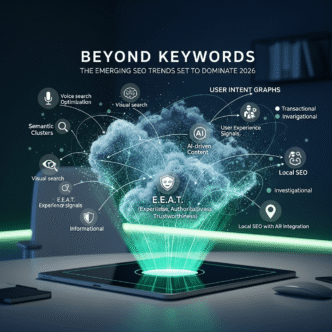

Beyond Keywords: The Emerging SEO Trends Set to Dominate 2026
A Comprehensive Analysis of the Strategic Shifts Redefining Search Optimization
Table of Contents
ToggleThe Fundamental Shift Nobody Saw Coming
Let me be blunt with you: if you're still optimizing for keywords the way you did in 2020, you're already behind. Not because keywords don't matter anymore—they absolutely do—but because the game has fundamentally changed in ways most marketers are only beginning to understand.
Here's what's really happening: SEO in 2026 isn't about abandoning the fundamentals. It's about expanding them into territories that didn't exist five years ago. We're witnessing the emergence of what industry leaders are calling "Search Everywhere Optimization," and it's forcing every serious marketer to rethink what visibility actually means.
— Marketer Milk, SEO Trends 2026
The State of SEO: What the Data Actually Tells Us
49% of SEO professionals plan to invest in E-E-A-T (Experience, Expertise, Authoritativeness, Trustworthiness) in 2026
Source: Search Engine Journal, State of SEO 2026 Report
86% of SEO professionals now use AI in their workflows
Source: TheeDigital, SEO Trends 2026
93% review AI-generated content before publishing, maintaining human oversight
Source: TheeDigital
78% of businesses increased their SEO budgets in 2025
Source: Mindbees, The Life of SEO in 2026
91% of enterprise marketers call SEO a "critical investment" for growth
Source: Mindbees
These aren't just numbers—they're a roadmap showing exactly where smart money is going. Despite all the noise about AI replacing SEO, the industry is doubling down. But they're not doubling down on the same strategies. They're investing in something deeper, more sustainable, and frankly more human than ever before.
Timeline: The Evolution from Keywords to Context
Traditional SEO reigns supreme. Keywords, backlinks, technical optimization, and on-page SEO dominate strategies. The formula is relatively straightforward: rank for keywords, get clicks, convert visitors.
Google's algorithm updates increasingly prioritize user experience and content quality. E-A-T becomes critical. Mobile-first indexing becomes standard. Core Web Vitals enter the ranking equation.
AI Overviews (formerly SGE) roll out globally. AI Overviews now appear in 25.8% of searches, climbing to 54.7% for long-tail queries of seven words or more (WebFX study of 2.37 million U.S. keywords).
Google's AI Overviews now serve 2 billion monthly users (TechCrunch, DesignRush).
Search Everywhere Optimization becomes the dominant strategy. E-E-A-T evolves into "E-E-A-T 2.0" where Experience trumps Expertise. Zero-click searches become the norm for informational queries. Topical authority and entity SEO replace keyword-centric approaches.
Predictions indicate organic CTR on Google will reach single digits by 2026, particularly where AI Overviews and AI Mode are active (Dot Com Infoway). Success metrics shift from clicks to citations, brand mentions, and conversion quality.
The Five Mega-Trends Reshaping SEO
1. E-E-A-T 2.0: Experience Over Everything
This isn't your 2023 E-A-T. The "Experience" component has taken center stage in a way that's reshaping how content ranks across the board.
Here's what's actually happening on the ground: Google is rewarding smaller blogs written by people with real lived experience over faceless corporate content. The June 2025 Core Update made this abundantly clear.
Critical Stat: According to Google's Search Quality Evaluator Guidelines, strong E-E-A-T is now "critical for topics affecting a person's life" but its importance extends to nearly every niche in 2026.
Source: That Agency, SEO Trends in 2026
💡 How to Build Authentic E-E-A-T Signals
- Show, don't just tell: Include original photos, videos, and screenshots of you actually using products or implementing strategies
- Document your journey: Share the lessons you learned, the mistakes you made, and the results you achieved
- Build authoritative bios: Link to social profiles, publications, and credentials that prove your expertise
- Create social proof: Participate in podcasts, webinars, and industry events
- Use structured author profiles: Include bio, photo, background, certifications, social links, and Schema.org Person markup
- Show editorial rigor: Create a "How we create content" page explaining fact-checking and peer review processes
2. AI Overviews and Zero-Click Search Reality
The numbers here are stark, and they're forcing a complete reimagining of what SEO success looks like.
58% of Google searches in the U.S. now result in zero clicks
Source: WebFX, SEO Trends 2026
92% of users who see AI summaries never click through, making brand visibility within AI results critical
Source: DesignRush, The Future of SEO in 2026
89% of queries triggering AI Overviews have informational intent
Only 8.69% are commercial queries, 1.76% transactional, and 1.43% navigational
Source: Elementor, 26 AI SEO Statistics for 2026
But here's the critical insight most people miss: while you get less traffic from AI search, the traffic you do get is exponentially better. According to Elementor's research, visitors arriving from AI search platforms are far more valuable from a conversion perspective than those from traditional search.
3. Topical Authority and Entity SEO
Keyword optimization is being superseded by something more sophisticated: proving you're the definitive source for an entire topic.
What does this mean practically? You need to build comprehensive content ecosystems around your core topics. Create detailed, interlinked articles. Use clear page hierarchies and schema markup. Showcase real-world expertise through case studies and original research.
Key Finding: Schema markup received 55+ mentions across 90+ sources in 2026 SEO research—it's that important.
Source: TheeDigital, SEO Trends 2026
4. The Hybrid Content Approach: AI + Human
The debate is over. The winning formula isn't choosing between AI and human content—it's strategically combining both.
86% of SEO professionals now use AI in their workflows
93% review AI content before publishing
17% of top search results now feature AI-written content
Source: TheeDigital
The hybrid model that's working: Use AI for heavy lifting—initial research, generating outlines, summarizing data, creating first drafts. Reserve human experts for adding unique insights, personal experiences, compelling examples, and strategic nuance.
Strategic Split: According to the State of SEO 2026 report, 58% of teams plan to create human-written content with AI support—quality over quantity, using AI to save time while maintaining human oversight.
Source: Search Engine Journal
5. Multi-Platform Visibility (Search Everywhere Optimization)
This is the trend that ties everything together. Discovery no longer happens in one place.
Consumers now start their research across multiple platforms, formats, and AI interfaces. In 2026, this fragmented behavior has become the norm, pushing businesses to show up consistently wherever their audiences search.
Reality Check: Over 8 billion visual searches are conducted on Google every month, and that number is growing rapidly (Statista, cited by That Agency).
Old SEO vs. Emerging SEO: The Side-by-Side Reality
| Dimension | Traditional SEO (2016-2023) | Emerging SEO (2026) |
|---|---|---|
| Primary Focus | Keyword rankings | AI citations & topical authority |
| Success Metric | Click-through rate & traffic | Brand mentions, citations, conversion quality |
| Content Strategy | Keyword-optimized articles | Topical clusters with entity relationships |
| Authority Building | Backlinks from any site | Brand mentions across trusted sources, E-E-A-T signals |
| Optimization Platform | Google only | Google + ChatGPT + Perplexity + TikTok + YouTube + Forums |
| Content Creation | 100% human written | Hybrid: AI-assisted with human oversight (58% of teams) |
| Expertise Demonstration | Credentials mentioned | Lived experience documented, original research, structured author profiles |
| Search Result Goal | Rank #1 on page 1 | Be cited in AI Overview or answer |
| Technical Approach | Basic schema markup | Comprehensive entity SEO, NLWeb schema, FAQ markup |
| User Journey | Linear: Search → Click → Convert | Multi-platform: Discovery across 5-7 touchpoints before conversion |
What Industry Leaders Are Actually Saying
Strategic Imperatives: What You Must Do Now
🎯 Priority #1: Strengthen Your E-E-A-T Signals
- Create structured author profiles with complete credentials and social proof
- Document real-world experiences and original research
- Add "How we create content" pages explaining your editorial process
- Build reviewer/editor attributions for expert content
- Establish author Knowledge Graphs linking to LinkedIn, Medium, ResearchGate
🎯 Priority #2: Optimize for AI Citations
- Use comprehensive schema markup (FAQ, Article, Organization, Person)
- Create modular FAQ sections with proper markup
- Structure content with clear headers and semantic entity tagging
- Focus on clarity and authority—AI favors direct, confident answers
- Create content worth quoting: original statistics, research, expert commentary
🎯 Priority #3: Build Topical Authority
- Create comprehensive content hubs around core topics
- Develop detailed, interlinked articles covering topics A to Z
- Use clear page hierarchies and internal linking strategies
- Showcase case studies and real-world expertise
- Refresh existing content regularly with new data and insights
🎯 Priority #4: Implement Hybrid Content Workflows
- Use AI for research, outlines, and first drafts
- Reserve humans for unique insights and strategic thinking
- Always review and enhance AI content before publishing (93% of pros do this)
- Combine AI efficiency with human creativity and expertise
- Train your team on AI tools while maintaining quality standards
🎯 Priority #5: Expand to Multi-Platform Visibility
- Optimize for YouTube search alongside written content
- Build presence on Reddit, Quora, and industry forums
- Create visual search-optimized content for Google Lens
- Develop conversational content for voice search
- Track performance across all platforms, not just Google
The Investment Reality: Where Smart Money Is Going
According to the State of SEO 2026 report, here's where successful teams are allocating resources:
- 49% investing in E-E-A-T improvements
- 42% training staff on AI tools
- 37% improving cross-department collaboration
- 36% teaching current best practices
- 33% building topical authority and content architecture
The data reveals three distinct strategies forming across the industry:
- AI-Heavy Adopters (22%): Betting on scale through automation
- Authority Builders (49%): Doubling down on E-E-A-T and human expertise
- Hybrid Strategists (58%): Creating human-written content with AI support
Critical Challenges to Navigate
59% cite algorithm changes as the top challenge
32% struggle with content workflow problems
28% face technical problems
26% struggle with leadership support
Source: Search Engine Journal, State of SEO 2026
But here's the interesting part: despite these challenges, teams aren't waiting around. They're preparing through AI training, better collaboration, and strategic investments in areas that AI can't replicate—authentic human experience.
Frequently Asked Questions
Yes, absolutely. Keywords remain fundamental to SEO. What's changed isn't whether keywords matter, but how you use them. Instead of stuffing keywords into content, you're now building comprehensive topical coverage around keyword themes. You're creating content that answers the intent behind keywords, not just the keywords themselves. As Marketer Milk puts it: "Keywords are still a thing. And so are backlinks. And so is technical SEO. Nothing has changed" in terms of fundamentals—only the sophistication of how you execute them.
Absolutely not. This is the biggest mistake companies are making. Traditional SEO remains the foundation for all other visibility strategies. 78% of businesses increased their SEO budgets in 2025, and 91% of enterprise marketers call it a "critical investment." The key is expanding your strategy to include AI optimization, not replacing traditional SEO with it. Optimize for Google first, and you'll naturally appear in ChatGPT and Perplexity as well.
Critical. 49% of SEO professionals plan to invest in E-E-A-T in 2026—it's the single biggest investment priority. According to Google's Search Quality Evaluator Guidelines, strong E-E-A-T is "critical for topics affecting a person's life," and its importance now extends to nearly every niche. The shift to "E-E-A-T 2.0" means Experience is now valued even more than Expertise. You need to prove you've "been there, done that" in ways AI cannot replicate.
Focus on these key areas:
- Use comprehensive schema markup (FAQ, Article, Organization, Person)
- Create clear, authoritative answers to specific questions
- Structure content with semantic entity tagging
- Build strong E-E-A-T signals through documented expertise
- Keep content fresh and updated (LLMs favor current information)
- Provide original research and statistics worth citing
Remember: AI Overviews appear in 25.8% of searches overall and 54.7% of long-tail queries. If your content targets informational queries (which 89% of AI Overviews do), optimization is essential.
Yes and no. While 58% of searches now result in zero clicks, and 92% of users who see AI summaries never click through, the traffic you do get from AI search is exponentially more valuable. These visitors arrive more qualified and ready to convert. Focus on being cited in AI answers for brand awareness, while maintaining strong traditional SEO for conversion-focused content. Optimize MOFU and BOFU content with strong E-E-A-T to drive revenue even as TOFU clicks decline.
Follow the hybrid model that 58% of successful teams use: Let AI handle research, outlines, data summarization, and first drafts. Reserve human experts for unique insights, personal experiences, strategic thinking, and quality control. 93% of professionals review AI content before publishing—this oversight is critical. AI is your assistant, not your replacement. Use tools like Jasper AI, Semrush, Writesonic, or SurferSEO to improve efficiency while maintaining human creativity and expertise.
Traditional metrics like traffic and rankings remain important, but add these:
- AI Citation Frequency: How often are you cited in AI Overviews?
- Brand Mention Frequency: How often is your brand referenced in AI responses?
- Citation Accuracy: Is your information represented correctly?
- Conversion Quality: Track conversion rates, not just traffic volume
- Impression Share: Your visibility across SERP features
- Sentiment Analysis: How is your brand portrayed in AI answers?
Remember: Click-through rates are declining but engagement-based KPIs are rising in importance.
No. This narrative is completely false. SEO isn't dying—it's evolving into something more sophisticated and more essential. The evidence:
- 78% of businesses increased SEO budgets in 2025
- 91% of enterprise marketers call SEO "critical for growth"
- 86% of SEO professionals now use AI in their workflows (not replacing, enhancing)
- SEO drives 1,000%+ more traffic than organic social media
What's changed is that SEO now requires more sophistication: combining technical excellence, genuine user value, and multi-platform visibility. AI hasn't replaced SEO—it's become an indispensable partner in the process.
Focus on building authentic E-E-A-T signals through documented real-world experience. This is the one thing AI cannot replicate and the area where 49% of professionals are investing. Create content that shows you've actually done what you're talking about. Include original photos, videos, case studies, and lessons learned. Build structured author profiles. Showcase your expertise through participation in podcasts, webinars, and industry events. This foundation will serve you well regardless of how algorithms change.
External Resources & Further Reading
- Search Engine Journal: The State of SEO 2026 Report
- WebFX: 12 Biggest SEO Trends in 2026
- Marketer Milk: 8 Top SEO Trends I'm Seeing in 2026
- Zero Gravity Marketing: 9 SEO Predictions for 2026
- WSI World: Marketing & AI Predictions That Will Shape 2026
- Techmagnate: Top AI SEO Trends for 2026
- TheeDigital: SEO Trends 2026
- Greenlane Marketing: SEO Trends for 2026
- That Agency: SEO Trends 2026
- DesignRush: The Future of SEO in 2026
- Elementor: 26 AI SEO Statistics for 2026
- Mindbees: The Life of SEO in 2026
Final Thoughts: Beyond the Hype to What Actually Works
Look, I get it. The SEO landscape in 2026 can feel overwhelming. AI Overviews, zero-click searches, E-E-A-T 2.0, topical authority, multi-platform optimization—it's a lot to digest.
But here's what you need to understand: the fundamentals haven't changed. What's changed is the sophistication required to execute them properly.
The winning teams in 2026 aren't doing anything revolutionary. They're doing the right things consistently:
- Building real brands with genuine authority
- Creating content from authentic human experience
- Using AI to enhance efficiency, not replace expertise
- Showing up across multiple platforms where their audience searches
- Focusing on being cited, not just ranked
- Measuring business impact, not just traffic
The data backs this up. Despite fears about AI replacing SEO, 78% of businesses increased their budgets and 91% of enterprise marketers call it critical for growth. That's not because they're stuck in the past—it's because they understand the future.
SEO in 2026 is about proving you're the most trustworthy, most knowledgeable, most experienced source in your niche. It's about creating value that AI can cite but not replicate. It's about meeting your audience wherever they search, whether that's Google, ChatGPT, YouTube, or Reddit.
The question isn't whether SEO still works. The question is whether you're willing to evolve your approach to match how search has evolved.
Start with E-E-A-T. Document your real-world experience. Build comprehensive topical coverage. Use AI strategically. Show up across platforms. Focus on being cited in AI answers while maintaining strong traditional SEO.
The teams that implement these strategies consistently—not perfectly, just consistently—will dominate their markets in 2026 and beyond.
The future of SEO isn't about abandoning keywords. It's about going beyond them to build something AI can't replicate: authentic expertise backed by real experience.
That's the trend that will dominate 2026. Everything else is just tactics.
Related posts:
- Schema Markup for AI Overviews: Structured Data That Increases Inclusion
- E-E-A-T for Generative Engines: Building Expertise AI Systems Trust
- Natural Language Patterns in Voice Search: Understanding How People Speak to Devices (Visualization)
- Paragraph Snippet Optimization: Winning Definition & Answer Snippets