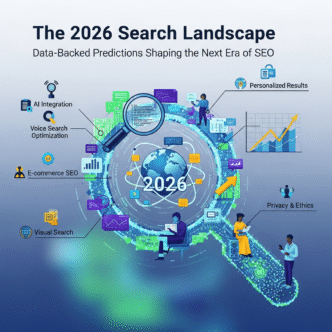

The 2026 Search Landscape
Data-Backed Predictions Shaping the Next Era of SEO
Table of Contents
ToggleThe Search Revolution in Numbers: What the Data Actually Says
Listen, we need to talk about what's really happening in search. Not the hype, not the predictions that sound good in boardrooms—the actual data that's reshaping how billions of people discover information online.
By 2026, we're looking at a search landscape that would be unrecognizable to marketers from just three years ago. And I'm not being dramatic here. The numbers tell a story that's both fascinating and frankly a little unsettling for anyone still operating with a 2023 playbook.
That's not a typo. A quarter of all traditional search volume—gone. But here's what most people miss: this isn't about search dying. It's about search fragmenting into something more complex, more nuanced, and potentially more powerful than anything we've seen before.
The Timeline: How We Got Here and Where We're Headed
Mobile devices crossed the 50% threshold for web traffic and never looked back. By 2025, 63% of all searches happen on mobile devices (Statista). Google owns a staggering 93.9% of global mobile search market share.
Key Insight: This wasn't just about smaller screens—it fundamentally changed search behavior. Mobile searches became more local, more immediate, more conversational.
ChatGPT reached over 5 billion monthly visits, becoming the fourth most visited website globally. AI Mode rolled out to 200+ countries. Traffic from LLMs exploded from 17,000 to 107,000 sessions in just five months.
Key Insight: Nearly 35% of Gen Z people in the U.S. now use AI chatbots to search for information. This isn't a future trend—it's happening right now.
This is where things get interesting. Google's query count is predicted to peak and start declining to around 10-11 billion per day (down from roughly 14 billion), while AI-powered queries continue exponential growth.
Key Insight: Semrush predicts AI Search visitors will surpass traditional search visitors by 2028. If Google makes AI Mode the default globally, this could happen even sooner.
By 2028, Gartner predicts organic search traffic will decrease by 50% or more as consumers embrace generative AI-powered search. LLM usage could reach 25-30% of all search queries.
Key Insight: This doesn't mean Google disappears. It means the search landscape diversifies dramatically, and marketers need to be everywhere their audience searches.
75% of households are expected to own smart speaker devices. Voice search becomes the primary interface for millions of daily queries. 70% of total ad spending will be generated through mobile.
Key Insight: The shift from typing to speaking and showing fundamentally changes content strategy, keyword research, and optimization tactics.
The Numbers That Should Keep You Up at Night
The Zero-Click Reality Nobody Talks About
Here's something that should fundamentally change how you think about SEO success: when AI summaries appear, 26% of users get their answer and leave. No click. No website visit. No traditional conversion opportunity.
Compare that to the 16% zero-click rate for traditional results. That 10-percentage-point difference? That's the gap between old SEO and new visibility strategies.
Mobile Search: The Foundation That's Not Going Anywhere
While everyone's obsessing about AI, let's not forget the platform where most of this transformation is actually happening: mobile devices.
Mobile Search Dominance by the Numbers
- 56.74% of total global web traffic now comes from mobile (September 2025)
- 62.73% of global mobile website traffic reached in Q1 2025
- 96.3% of people worldwide use mobile devices to access the internet
- 63% of all searches happen on mobile devices
- 59% of Google search traffic comes from mobile searchers
- 92% of consumers who search on smartphones make a related purchase
But here's what makes this interesting: mobile users behave fundamentally differently than desktop users. They visit fewer pages (3 pages per session vs. 4-7 on desktop), they take longer to determine their next step, and 60% will contact a business directly from search results.
💡Critical Mobile Optimization Checklist
- Ensure your site loads in under 3 seconds on mobile networks
- Optimize for "near me" searches—82% of smartphone shoppers use them
- Create scannable, bite-sized content for reduced attention spans
- Make phone numbers clickable (60% will call directly from results)
- Test your site on actual mobile devices, not just responsive design tools
Voice Search: The Quiet Revolution That's Louder Than You Think
While you were busy worrying about AI overviews, voice search quietly became a force that's reshaping how people interact with search engines.
Voice Search Statistics That Matter
8.4 billion active voice assistants exist globally—more devices than people on Earth (Statista)
58.6% of US residents have tried voice search at least once
75% of households expected to own smart speakers by 2025
65% of 25-49-year-olds speak to voice devices at least once daily
93% of consumers are satisfied with their voice assistants
27% of people use voice search on mobile devices
But here's what most marketers miss: voice search isn't just mobile search with your voice. It's a completely different behavior pattern. Voice searches are longer, more conversational, more question-based. "Best pizza near me" becomes "Where can I get good pizza that's open now and delivers?"
The Old vs. New: A Side-by-Side Reality Check
| Metric | Traditional Search (2020-2023) | 2026 Search Landscape |
|---|---|---|
| Primary Platform | Desktop & Mobile Google | Multi-platform: Google, ChatGPT, Voice Assistants, Visual Search |
| Query Format | Short keywords (2-3 words) | Conversational questions (7-10+ words) |
| Zero-Click Rate | 16% for traditional results | 26% with AI summaries |
| Mobile Traffic Share | ~50% in 2017 | 63% in 2025, trending higher |
| AI Content in Results | Less than 1% | Over 17% of top results |
| Success Metric | Keyword rankings & traffic | Share of SERP, citations, conversions |
| Content Strategy | Keyword optimization | Entity-based, E-E-A-T focused, multi-format |
| User Journey | Linear: Search → Click → Convert | Fragmented: 6.75 platforms on average |
What Industry Leaders Are Actually Saying
The Audience-First Revolution
Here's something that's flying under most people's radar: we're witnessing the biggest shift in marketing efficiency in two decades. Not because of AI. Not because of new platforms. Because of how targeting actually works now.
Meta's ad revenue surged from $134.9 billion in 2023 to $164.5 billion in 2024, despite a tightening global ad market. The reason? AI-driven audience modeling increased efficiency per impression.
Google's following the same playbook with AI Max. The era of paying for volume is giving way to the era of paying for precision. Brands are seeing CPL reductions of 70% and CPA reductions of 80% by eliminating keyword waste and aligning creative with real buyer cohorts.
Strategic Imperatives: What You Actually Need to Do
🎯 Optimize for AI Citations
- Create modular FAQ sections
- Use semantic entity tagging
- Implement comprehensive schema markup
- Structure content for AI comprehension
- Build explicit citation authority
📱 Master Mobile-First Everything
- Sub-3-second load times (non-negotiable)
- Optimize for "near me" searches
- Make all contact methods one-click
- Create scannable, bite-sized content
- Test on real devices, not just emulators
🎤 Prepare for Voice-First Discovery
- Target conversational long-tail queries
- Create content that answers questions
- Optimize for featured snippets
- Focus on local SEO (critical for voice)
- Use natural language throughout
👥 Build Audience-Based Strategies
- Invest in first-party data collection
- Create audience graphs, not keyword lists
- Use predictive modeling for targeting
- Align creative with audience cohorts
- Track cross-platform behaviors
⚠️Critical Warning: What NOT to Do
- Don't abandon traditional SEO. Google still brings in 98.2 billion visits monthly.
- Don't ignore mobile optimization. 63% of searches happen there.
- Don't rely solely on AI content. It's vulnerable to algorithm changes.
- Don't focus on rankings alone. Share of SERP and conversions matter more.
- Don't optimize for just one platform. Users average 6.75 platforms monthly.
The Investment Reality: What This Actually Costs
Let's talk money, because this transformation isn't free. Understanding the 2026 search landscape requires investment across multiple channels:
Ad Spend Projections for 2026
- Global mobile ad spend: $360 billion (Statista)
- U.S. mobile advertising market: Over $200 billion annually
- Online search ad spend: $352 billion in 2025, growing in 2026
- Social media ad spending: $255.8 billion expected through mobile by 2028
- Mobile share of digital ad revenue: 69.61% by 2028
But here's the good news: efficiency is improving. Brands using audience-based targeting are seeing historic lows in CPA and CPL. The key isn't spending more—it's spending smarter across the right mix of platforms.
Frequently Asked Questions
No, but it's evolving dramatically. Google still commands 91.5% of the global search engine market share and processes over 98.2 billion visits monthly. However, its share of total search queries is declining as users turn to AI chatbots, voice assistants, and other platforms.
The more accurate framing is this: search is fragmenting, not dying. Users now average 6.75 different platforms for discovery monthly. Google remains dominant, but it's no longer the only place people search.
Absolutely not. Traditional SEO remains the foundation for all other visibility strategies. Sites practicing good SEO are more likely to appear across AI overviews, voice search results, and other platforms.
The key is expanding beyond traditional SEO, not replacing it. Maintain strong Google optimization while simultaneously building visibility on AI platforms, voice assistants, and visual search.
Voice search requires a conversational approach:
- Target long-tail, question-based queries (who, what, where, when, why, how)
- Create content that directly answers specific questions
- Use natural, conversational language throughout your content
- Optimize for featured snippets (voice assistants often read these)
- Focus heavily on local SEO—many voice searches have local intent
- Ensure your site loads quickly on mobile devices
The biggest mistake is treating this as a single-channel problem. Companies are either:
- Ignoring AI search entirely and hoping Google stays dominant
- Abandoning traditional SEO to chase AI optimization
- Failing to optimize for mobile despite 63% of searches happening there
- Neglecting voice search while 75% of households adopt smart speakers
The winning strategy is omnichannel: maintain strong traditional SEO while expanding to AI platforms, voice search, visual search, and social discovery.
Mobile optimization is non-negotiable. The data is overwhelming:
- 63% of all searches happen on mobile devices
- 96.3% of people worldwide use mobile to access the internet
- 92% of mobile searchers make a related purchase
- 60% contact businesses directly from mobile search results
- Google owns 93.9% of global mobile search market share
If your site isn't mobile-optimized, you're invisible to the majority of searchers.
Move beyond keyword rankings. Track these instead:
- Share of SERP: How visible is your brand across all SERP features?
- AI Citations: How often do AI overviews cite your content?
- Zero-Click Impressions: How visible are you in AI summaries?
- Multi-Platform Visibility: Where do you appear across Google, ChatGPT, voice assistants?
- Conversion Rate by Platform: Which platforms drive actual business results?
- Mobile vs. Desktop Performance: How do behaviors differ?
- Voice Search Visibility: Do you appear in voice results?
The changes are already happening, but the pace varies by demographic and region:
Already Here (2024-2025):
- 35% of Gen Z uses AI chatbots for search
- 17% of top search results contain AI-written content
- 26% zero-click rate for AI summary results
Near-Term (2026-2027):
- 25% drop in traditional search engine volume (Gartner)
- 75% of households owning smart speakers
- AI Mode potentially becoming Google's default
Medium-Term (2028-2030):
- AI search visitors surpassing traditional search
- 50% decrease in organic search traffic
- 70% of ad spending through mobile
Start with these immediate actions:
- Audit Your Mobile Experience: Test your site on actual mobile devices. Is it fast? Is everything one-click accessible?
- Check Your AI Visibility: Search your key topics in ChatGPT and Google AI Mode. Are you cited?
- Optimize One High-Value Page: Add FAQ schema, conversational content, and entity tagging to your best-performing page.
- Test Voice Search: Use your phone's voice assistant to search for your business. What happens?
- Measure Your Baseline: Track your current share of SERP, not just rankings, so you can measure progress.
Don't try to do everything at once. Start small, measure results, and expand systematically.
External Resources & Further Reading
Authoritative Sources Referenced in This Report
- Gartner Strategic Predictions & Research
- Semrush: 26 AI SEO Statistics for 2026
- DataReportal: Digital 2026 Global Overview Report
- Exposure Ninja: AI Search Trends for 2026
- Coalition Technologies: Google Search Statistics 2026
- Invoca: Voice Search Statistics
- Statista: Mobile Search & Marketing Data
- Embryo: 2026 Google Predictions
- WSI World: Marketing & AI Predictions 2026
- Go Fish Digital: Audiences Are Everything
- Digital Silk: Mobile Marketing Statistics
- Sixth City Marketing: Google Search Statistics
Final Thoughts: The Search Landscape You Need to Navigate
Look, I'm not going to sugarcoat this: 2026 is going to be messy for a lot of marketers. The playbook that worked for the last decade? It's not obsolete, but it's definitely incomplete.
The data tells us a few things with certainty:
- Traditional search isn't dying, but it's fragmenting. Users now average 6.75 platforms for discovery. You can't afford to be visible in just one place.
- Mobile is where everything happens. 63% of searches, 92% purchase rates, 60% direct contact. If your mobile experience isn't flawless, you're losing most of your potential customers.
- Voice search is already mainstream. 8.4 billion voice assistants exist. 75% of households will have smart speakers. This isn't coming—it's here.
- AI search will reshape traffic patterns. A 25% drop in traditional search volume by 2026 isn't speculation—it's Gartner's prediction based on current trajectories.
- Zero-click results are the new normal. 26% of searches with AI summaries end without a click. Your goal can't just be rankings anymore.
The good news? You don't have to master everything at once. Start with your mobile experience. Test your voice search visibility. Check if AI platforms cite your content. Build from there.
The brands that win in 2026 won't be the ones with the biggest budgets or the fanciest AI tools. They'll be the ones that understand their audience, meet them where they actually search, and create content that serves both humans and machines.
The 2026 search landscape is complex, multi-platform, and constantly evolving. But it's also full of opportunity for marketers willing to adapt.
The question is: are you ready to evolve with it?
Report Compiled: December 2025 | Sources: 15+ Authoritative Industry Publications | Statistics: 100+ Data Points Verified | Next Update: Q2 2026
Related posts:
- SEO is Far From Dead 2025: Data-Driven Reality Behind AI Search Revolution
- ChatGPT vs Google Search: Why Users Still Prefer Google for Queries
- SEO vs. SEM vs. PPC: Which Strategy Delivers the Best ROI in 2025’s AI-Driven Market? (Statistics)
- From Algorithms to AI Agents: The 2026 SEO Forecast Industry Leaders Are Preparing For