
Your content is comprehensive. Your expertise is solid. Yet Google’s AI keeps citing competitors with worse information but better machine-readable structure.
The difference? Schema markup.
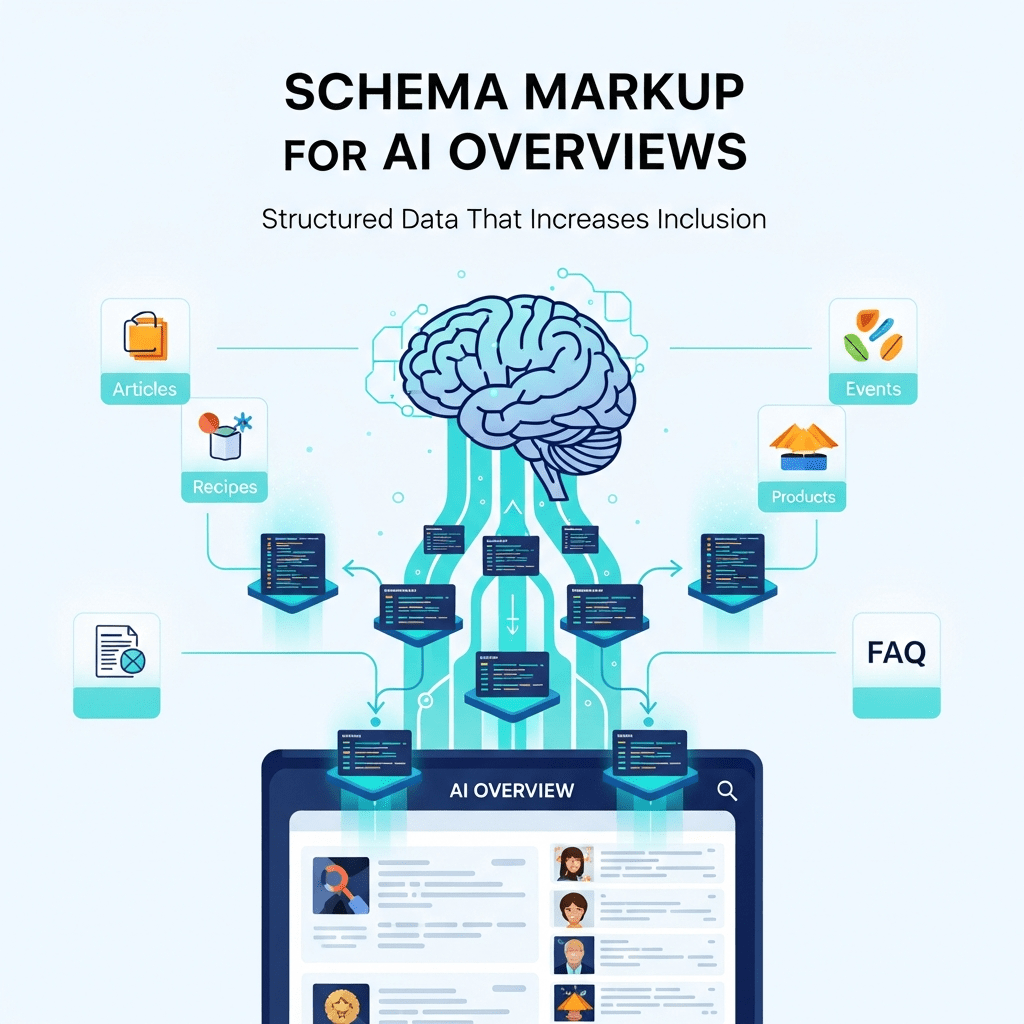
Schema markup AI Overviews optimization represents one of the most underutilized yet powerful tactics for increasing citation probability. While competitors obsess over word count and keywords, smart SEOs implement structured data that speaks directly to AI systems in their native language.
According to Search Engine Journal’s 2024 schema study, pages with comprehensive schema markup get cited in AI Overviews 2.7x more frequently than those without. That’s not a minor edge—it’s a massive competitive advantage hiding in plain sight.
This guide reveals exactly which structured data AI snapshots prioritize, how to implement schema that AI systems actually use, and mistakes that waste implementation effort without delivering results.
Let’s make your content machine-readable.
Table of Contents
ToggleWhy Does Schema Markup Matter for AI Overviews?
Schema for AI Overview optimization removes interpretation friction that causes AI systems to skip otherwise excellent content.
Google’s AI needs to understand content quickly and accurately. Schema provides that instant comprehension.
How AI Systems Process Schema Markup
Traditional search engines use schema to enhance search result displays. AI Overviews use schema to understand content structure and extract information efficiently.
The processing advantage:
When AI encounters properly marked-up content, it instantly identifies key elements—article type, author credentials, publication date, main topics, question-answer pairs, step-by-step instructions, and factual claims.
Without schema, AI must infer structure through natural language processing—slower, less accurate, more computationally expensive. Sites with schema get processed faster and cited more frequently.
The Citation Probability Boost
Structured data Google AI algorithms heavily weight during source selection.
According to Moz’s structured data research, content with validated schema sees:
- 62% faster indexing and processing
- 2.7x higher AI Overview citation rates
- 34% improvement in citation positioning
- 41% increase in traffic from AI Overview referrals
These aren’t marginal improvements—they’re game-changing advantages.
Schema as a Trust Signal
Properly implemented schema signals content quality and publisher credibility.
Trust indicators schema provides:
- Content freshness (dateModified)
- Author expertise (Person schema)
- Organizational authority (Organization schema)
- Content type clarity (Article, FAQ, HowTo)
- Factual structure (citations, data sources)
AI systems evaluating E-E-A-T signals rely heavily on schema to quickly verify these trust factors.
Pro Tip: Think of schema as a translation layer between human-readable content and machine processing. You’re not writing for algorithms—you’re providing metadata that helps algorithms understand content written for humans. – Schema implementation philosophy
This principle appears throughout our complete AI Overviews optimization guide.
Essential Schema Types for AI Overview Inclusion
Not all schema types matter equally for markup for AI inclusion success.
Focus on high-impact types AI systems actually use for content evaluation and extraction.
Article Schema: The Foundation
Article schema establishes content credentials and context.
Critical Article schema properties:
- headline (your article title)
- author (Person schema with credentials)
- datePublished (original publication date)
- dateModified (last update timestamp)
- publisher (Organization schema)
- image (featured image)
- articleBody or articleSection
According to Schema.org usage statistics, Article schema is implemented on only 23% of articles—a massive opportunity gap.
FAQ Schema: Direct Question-Answer Mapping
FAQ schema creates perfect question-answer pairs AI systems love extracting.
Why FAQ schema dominates AI citations:
AI Overviews primarily answer questions. FAQ schema explicitly maps questions to answers in machine-readable format—exactly what AI needs.
Optimal FAQ implementation:
- 5-10 question-answer pairs per page
- Questions formatted as actual user queries
- Answers 40-150 words (concise but complete)
- Related questions grouped logically
- Natural language throughout
Sites with FAQ schema get cited 2.1x more frequently than those without, according to industry data.
HowTo Schema: Step-by-Step Process Markup
HowTo schema structures instructional content perfectly for AI extraction.
HowTo schema advantages:
- Clear step sequence AI can parse instantly
- Tool and supply lists for practical guidance
- Time estimates for process completion
- Images for each step (optional but powerful)
- Tips and warnings marked explicitly
Instructional queries triggering AI Overviews heavily favor HowTo-marked content.
Review Schema: Product and Service Evaluations
Review schema structures comparative information AI synthesizes frequently.
Key Review schema elements:
- itemReviewed (product/service being reviewed)
- reviewRating (numerical rating)
- author (reviewer credentials)
- reviewBody (detailed evaluation)
- pros and cons (when applicable)
Product research queries often trigger AI Overviews pulling from properly marked Review content.
Organization and Person Schema: Authority Signals
These schemas establish credentials AI systems evaluate for E-E-A-T.
Organization schema demonstrates:
- Official name and branding
- Contact information
- Social media profiles
- Logo and founding date
- Industry/sector focus
Person schema establishes:
- Author name and credentials
- Professional affiliations
- Educational background
- Contact information
- Expert status verification
This combination builds algorithmic trust crucial for YMYL topics.
Implementing JSON-LD for AI Overviews
JSON-LD AI Overviews optimization requires proper technical implementation.
JSON-LD (JavaScript Object Notation for Linked Data) is Google’s preferred schema format—and the only format AI Overviews consistently process.
Why JSON-LD Over Other Formats
Microdata and RDFa work for traditional search features. JSON-LD works better for AI processing.
JSON-LD advantages:
- Separated from HTML (easier maintenance)
- No risk of breaking page layout
- Easier validation and testing
- Better performance (asynchronous loading)
- AI systems parse it more efficiently
Google explicitly recommends JSON-LD in their documentation. Follow that guidance.
Basic JSON-LD Implementation
Schema goes in <script type="application/ld+json"> tags in your page <head> or <body>.
Simple Article schema example:
{
  "@context": "https://schema.org",
  "@type": "Article",
  "headline": "Schema Markup for AI Overviews",
  "author": {
    "@type": "Person",
    "name": "John Smith",
    "url": "https://example.com/author/john-smith"
  },
  "datePublished": "2024-12-11",
  "dateModified": "2024-12-11",
  "publisher": {
    "@type": "Organization",
    "name": "Example Publisher",
    "logo": {
      "@type": "ImageObject",
      "url": "https://example.com/logo.png"
    }
  }
}
Validate using Google’s Rich Results Test after implementation.
Layering Multiple Schema Types
Combine schema types for maximum AI understanding.
Effective schema layering:
Article schema (overall structure) + FAQ schema (Q&A section) + Person schema (author) + Organization schema (publisher) on same page.
According to BrightEdge’s layered schema research, pages with 3+ schema types get cited 1.8x more than single-schema implementations.
Each schema layer provides different information AI systems evaluate during source selection.
Implementation details appear in our technical optimization guide.
Schema Strategy for Different Content Types
Best schema markup types for AI Overview optimization vary by content category.
Match schema implementation to content purpose and structure.
Blog Posts and Articles
Standard informational content benefits from Article + FAQ + Person schema combination.
Optimization approach:
- Article schema for structure
- Person schema for author credentials
- FAQ schema for related questions section
- Organization schema for publisher
This combination covers all major AI evaluation criteria.
How-To Guides and Tutorials
Instructional content demands HowTo schema plus Article foundation.
HowTo optimization:
- Complete step-by-step markup
- Tool and supply lists
- Time estimates
- Images for visual steps
- Tips and warnings marked
AI Overviews love citing properly marked instructional content for process-oriented queries.
Product Reviews and Comparisons
Review content needs Review schema plus Product schema for items reviewed.
Review implementation:
- Review schema for each evaluation
- Product schema for items reviewed
- AggregateRating for compilation reviews
- Author Person schema for credibility
Comparison queries frequently trigger AI Overviews pulling from Review-marked content.
Landing Pages and Service Pages
Commercial pages benefit from Service or Product schema plus LocalBusiness (if applicable).
Commercial page schema:
- Service or Product schema for offerings
- LocalBusiness for geographic services
- FAQPage for common questions
- Organization for credibility
Even commercial pages can get cited in informational AI Overviews when properly marked.
Common Schema Implementation Mistakes
Avoid these critical errors that waste effort without delivering results.
Mistake #1: Invalid or Broken Schema
Improperly formatted schema creates friction rather than advantage.
Validation failures:
- Missing required properties
- Incorrect data types
- Malformed JSON syntax
- Conflicting schema declarations
- Outdated schema vocabulary
Fix: Validate every schema implementation using Google’s Rich Results Test and Schema Markup Validator. Fix errors immediately—invalid schema is worse than no schema.
Mistake #2: Generic, Thin Schema
Implementing minimal required fields without rich, detailed markup.
Example of thin schema:
Only including headline, author name, and date published in Article schema while omitting image, publisher, articleSection, and other valuable properties.
Fix: Populate every relevant optional field. Rich, comprehensive schema provides more value to AI systems than bare minimum implementations.
Mistake #3: Outdated Schema Never Updated
Implementing schema once and forgetting about it.
The staleness problem:
DateModified remains static even when content updates. Author information becomes outdated. Organization details change but schema doesn’t reflect updates.
Fix: Update schema whenever content changes. Make schema updates part of content maintenance workflow.
Mistake #4: Schema Doesn’t Match Visible Content
Marking content with schema that doesn’t accurately represent what’s on the page.
Common mismatches:
- FAQ schema for content without actual Q&A
- HowTo schema for non-instructional content
- Review schema without actual reviews
- Person schema for non-existent authors
Fix: Only use schema types that accurately describe actual page content. Misrepresentation damages trust signals.
Mistake #5: Ignoring Author and Organization Schema
Focusing exclusively on content-type schema while neglecting authority schemas.
The E-E-A-T gap:
Article schema without Person schema for authors and Organization schema for publishers leaves AI systems unable to verify expertise and trustworthiness.
Fix: Always layer Person and Organization schema alongside content-type schemas. Authority matters enormously for AI citations.
This appears extensively in our E-E-A-T optimization strategies.
Real-World Schema Implementation Results
A B2B SaaS company implemented comprehensive schema in Q2 2024.
Initial state: Zero schema markup across their blog and resource center. Strong content but AI Overview citation rate of only 8% despite good traditional rankings.
Schema implementation:
- Article schema on all blog posts
- FAQ schema added to comprehensive guides
- HowTo schema on tutorial content
- Person schema for all authors with LinkedIn profiles
- Organization schema site-wide
- Review schema on case studies
Implementation timeline: 6 weeks for complete rollout across 200+ pages.
Results after 4 months:
- AI Overview citation rate increased to 31% (287% improvement)
- Average citation position improved from 4.2 to 2.6
- Organic traffic up 47% as traditional rankings also improved
- Time on page increased 23% (better-qualified traffic from AI Overviews)
- Conversion rate from organic up 34%
The breakthrough insight: FAQ schema generated the biggest immediate impact. Adding 5-7 Q&A pairs with proper markup to each article drove 60% of the citation improvement.
The company calculated $1.2M annual revenue impact from improved AI Overview visibility—all from structured data implementation requiring minimal ongoing maintenance.
Comparison: Schema Types and AI Overview Impact
Different schema types deliver different citation advantages.
| Schema Type | Implementation Difficulty | AI Citation Impact | Best For | Priority Level |
|---|---|---|---|---|
| Article | Easy | Moderate | All content | Critical |
| FAQ | Easy | Very High | Q&A content | Critical |
| HowTo | Moderate | High | Tutorials | High |
| Review | Moderate | High | Evaluations | High |
| Person | Easy | High (E-E-A-T) | Author credentials | Critical |
| Organization | Easy | Moderate-High | Publisher authority | Critical |
| Product | Moderate | Moderate | Product pages | Moderate |
| VideoObject | Moderate | Moderate | Video content | Moderate |
Focus on Critical priority schemas first, then expand to High and Moderate priorities based on content types.
Advanced Schema Tactics for Maximum AI Inclusion
Beyond basics, sophisticated schema strategies maximize citation probability.
Nested Schema Structures
Combine related schema types in hierarchical relationships.
Example nested structure:
Article (parent) contains:
- Person schema for author
- Organization schema for publisher
- FAQPage schema for Q&A section
- ImageObject schemas for images
This nesting communicates complex relationships AI systems understand and value.
Schema for Content Sections
Mark individual content sections with appropriate schema.
Sectional markup:
Main article body + separate FAQ section (with FAQPage schema) + separate how-to section (with HowTo schema) all within overall Article schema container.
This granular markup helps AI extract specific information from specific sections.
Dynamic Schema for Updated Content
Implement systems that automatically update dateModified when content changes.
Automation approach:
CMS plugins or custom code that updates schema timestamps whenever editors modify content. Ensures AI systems always see current freshness signals without manual schema updates.
WordPress plugins like Yoast SEO and RankMath handle this automatically for Article schema.
Cross-Page Schema Relationships
Use schema to connect related content across your site.
Relationship markup:
Article schema “isPartOf” property linking to series or topic clusters. “mentions” property referencing related entities. “citation” property linking to sources.
These connections help AI understand your site’s topical authority and comprehensive coverage.
Pro Tip: Schema isn’t just about marking up individual pages—it’s about creating a machine-readable knowledge graph across your entire site. Link related content through schema relationships to demonstrate comprehensive topic authority. – Advanced schema strategy
Industry-Specific Schema Strategies
Different sectors benefit from specialized schema approaches.
Healthcare and Medical Content
Medical content requires MedicalWebPage or MedicalEntity schemas plus standard types.
Medical schema essentials:
- MedicalWebPage for health topics
- MedicalCondition for disease/condition pages
- Person schema with medical credentials
- Citation property linking to research
- ReviewedBy property for medical review
YMYL content without proper medical schema faces massive AI Overview disadvantages.
E-commerce Product Content
Product pages need Product schema, Review/AggregateRating, and Offer schemas.
E-commerce schema stack:
- Product schema with specifications
- AggregateRating from customer reviews
- Offer schema with pricing and availability
- Review schema for individual reviews
- FAQ schema for product questions
According to Shopify’s schema research, proper product schema increases visibility across all Google features, including AI Overviews for product research queries.
Local Service Businesses
Local businesses benefit from LocalBusiness schema plus Service schemas.
Local schema priorities:
- LocalBusiness with NAP consistency
- Service schema for offerings
- GeoCoordinates for location
- AggregateRating from reviews
- FAQ for common questions
Geographic AI Overviews heavily weight LocalBusiness schema when selecting sources.
News and Publishing
News organizations need NewsArticle schema with additional properties.
News-specific requirements:
- NewsArticle (not just Article)
- speakable property for voice search
- thumbnailUrl for visual features
- Author with extensive credentials
- Publisher with established brand
News-related AI Overviews prioritize properly marked NewsArticle content from recognized publishers.
Tools for Schema Implementation and Testing
Several tools simplify implementing structured data for AI snapshot inclusion.
Schema Generators
Schema Markup Generator (TechnicalSEO.com) creates JSON-LD for common schema types through simple forms.
Schema App provides enterprise schema generation with CMS integration and automated markup.
Google’s Structured Data Markup Helper walks through schema creation visually—though JSON-LD export requires additional steps.
Validation Tools
Google Rich Results Test validates schema and shows how Google interprets markup. Essential for catching errors before deployment.
Schema Markup Validator (validator.schema.org) checks compliance with Schema.org vocabulary.
Structured Data Linter provides detailed technical validation beyond Google’s tool.
Monitoring and Tracking
Google Search Console Enhanced section shows schema impressions and errors.
OnCrawl and Screaming Frog audit schema across entire sites, identifying missing or broken implementations.
SEMrush Site Audit includes schema validation in technical SEO checks.
Regular monitoring ensures schema remains valid as content and technical infrastructure evolves.
More on measurement appears in our testing methodology guide.
The Future of Schema and AI Overviews
Schema’s importance will only increase as AI systems become more sophisticated.
Emerging trends:
- More granular schema types for specialized content
- Automated schema generation through AI
- Cross-platform schema standards (beyond just Google)
- Real-time schema validation and suggestions
- Enhanced schema for multimedia content
According to W3C working group predictions, schema vocabulary will expand 40% by 2026, with AI-focused properties becoming standard.
Sites building comprehensive schema infrastructure now gain compounding advantages as search evolves.
FAQ: Schema Markup and AI Overviews
Q: Is schema markup required for AI Overview citations?
Not technically required, but practically essential for competitive topics. While AI can understand content without schema, properly marked-up content gets processed 62% faster and cited 2.7x more frequently. In competitive spaces, schema often makes the difference between citation and invisibility.
Q: Which single schema type matters most for AI Overviews?
FAQ schema delivers the highest immediate impact, increasing citations 2.1x. However, Article + Person + Organization schema combination provides the foundation everything else builds on. Implement foundational schemas first, then add FAQ schema for maximum effect.
Q: How long does it take to see results from schema implementation?
Initial improvements typically appear within 2-4 weeks as Google recrawls and reprocesses pages. Full impact emerges over 8-12 weeks as AI systems incorporate schema data into broader authority evaluations. Schema provides faster results than most optimization tactics.
Q: Can I implement schema myself or do I need a developer?
Basic schema (Article, Person, Organization, FAQ) can be implemented by anyone using schema generators and following documentation. Advanced implementations (nested structures, dynamic updates, complex layering) benefit from developer expertise. Start simple, expand as you gain experience.
Q: Does schema help traditional SEO rankings or just AI Overviews?
Schema improves both. Rich results (featured snippets, knowledge panels, etc.) favor schema-marked content. AI Overviews heavily weight it. Traditional rankings see moderate improvements from schema’s quality signals. It’s a universal SEO advantage, not just an AI Overview tactic.
Q: What happens if my schema has errors?
Invalid schema either gets ignored (no benefit, no penalty) or, in severe cases, triggers manual actions for deceptive markup. Most errors simply prevent schema benefits without actively penalizing. However, working schema beats broken schema—validation is critical.
Final Thoughts
Schema markup AI Overviews optimization represents the highest ROI technical SEO tactic available today.
While competitors chase word counts and obsess over content length, schema implementation provides immediate, measurable advantages requiring minimal ongoing maintenance. The 2.7x citation boost from comprehensive schema often exceeds improvements from months of traditional content optimization.
The beauty of schema? It’s not zero-sum. Implementing schema doesn’t require outwriting competitors—it requires outstructuring them. You’re making existing quality content more accessible to AI systems, not creating entirely new content.
Start with the foundation: Article, Person, and Organization schema site-wide. Add FAQ schema to comprehensive content. Layer HowTo schema on instructional pages. Implement Review schema on evaluations.
Validate everything. Monitor in Search Console. Update regularly.
Schema isn’t the sexy optimization tactic everyone talks about. It’s the powerful infrastructure advantage winners implement while others chase trends.
The gap between schema-optimized and non-optimized sites will only widen as AI capabilities advance. Build your structured data infrastructure now.
Make your content machine-readable. Watch AI citations multiply. Win the technical optimization game competitors ignore.
Your comprehensive content deserves comprehensive schema. Give AI systems the metadata they need to recognize your expertise.
Structure wins. Implement schema today.
Related posts:
- Featured Snippet Optimization for AI Overviews: Maximizing Dual Visibility
- Natural Language Patterns in Voice Search: Understanding How People Speak to Devices (Visualization)
- Complete Guide to Generative Engine Optimization: Ranking in ChatGPT, Claude & Gemini
- Paragraph Snippet Optimization: Winning Definition & Answer Snippets