
Your CFO just asked you to justify next quarter’s SEO budget. You froze.
“We need $15K per month for SEO,” you said confidently. Then came the follow-up: “What exactly are we getting for that? How does it compare to paid ads? When will we see ROI?”
Crickets.
Here’s the uncomfortable truth about SaaS SEO budget: Most marketers either drastically underspend (expecting miracles with $2K/month) or overspend on the wrong things (paying agencies $20K/month for work worth $8K).
I’ve audited hundreds of SaaS companies’ SEO investments. The successful ones aren’t necessarily spending the most—they’re allocating strategically across the right activities at the right stages of growth.
Today, I’m breaking down exactly how much to spend on SEO for SaaS companies, where every dollar should go, and how to prove ROI to your executives. Whether you’re a bootstrap startup or a Series B company, you’ll know precisely how to budget for sustainable organic growth.
Table of Contents
ToggleWhy Is SEO Budget Planning Different for SaaS Companies?
Before we talk numbers, let’s address why SEO investment for B2B requires a completely different approach than e-commerce or local businesses.
SaaS economics demand patience and precision:
Your customer lifetime value is $50,000+. Your sales cycle is 3-6 months. Your buyers are sophisticated decision-makers who research extensively. This means your SEO strategy needs long-term commitment—not quick wins.
According to <a href=”https://openviewpartners.com/blog/saas-marketing-budget/” rel=”nofollow”>OpenView Partners’ SaaS benchmarks</a>, successful B2B SaaS companies allocate 20-40% of revenue to marketing, with SEO representing 15-25% of that marketing budget.
The SEO investment paradox:
Too little budget means you can’t compete for competitive keywords, can’t hire quality content creators, and waste time on tactics that don’t scale. Too much budget without strategy means you’re burning cash on vanity metrics.
Pro Tip: Don’t think about SEO budget as an expense—think of it as buying assets. Every piece of content you create, every backlink you earn, every ranking you achieve continues delivering value for years. Unlike paid ads that stop working when you stop paying, SEO compounds.
What Makes SaaS SEO Costs Unique
Higher content quality requirements: Your buyers are sophisticated. Generic “10 tips” blog posts won’t cut it. You need comprehensive guides, original research, and expert-level content.
Longer content production cycles: A quality comparison page takes 20-40 hours to research, write, and optimize—not 2 hours like a basic blog post.
Technical complexity: SaaS websites often have JavaScript frameworks, complex product pages, and authentication systems that require specialized technical SEO expertise.
Competitive landscapes: You’re competing against established players with 5+ years of SEO investment and domain authority scores of 70+. Winning requires sustained effort.
Understanding SaaS SEO fundamentals helps you see why budget allocation matters so much.
How Much Should SaaS Companies Actually Spend on SEO?
Let’s get specific with average SEO costs for SaaS startups and scaling companies.
Budget by Company Stage
| Company Stage | Monthly SEO Budget | Annual Investment | Expected Outcome |
|---|---|---|---|
| Pre-Seed/Bootstrap | $2,000-5,000 | $24K-60K | Foundation + initial traction |
| Seed Stage | $5,000-10,000 | $60K-120K | Competitive in niche keywords |
| Series A | $10,000-25,000 | $120K-300K | Multi-channel content machine |
| Series B+ | $25,000-75,000+ | $300K-900K+ | Category leadership positioning |
Reality check: These ranges assume you want SEO to become a primary growth channel within 12-18 months. If SEO is just a nice-to-have experiment, cut these numbers in half—and expect proportionally weaker results.
Budget as Percentage of Revenue
A more sophisticated approach bases SaaS marketing budget allocation on your current revenue.
Recommended SEO investment by ARR:
- Under \$1M ARR: 5-10% of revenue on total marketing, with 30-40% of marketing budget to SEO
- $1M-5M ARR: 15-25% of revenue on marketing, with 20-30% to SEO
- $5M-20M ARR: 20-30% of revenue on marketing, with 15-25% to SEO
- $20M+ ARR: 15-25% of revenue on marketing, with 15-20% to SEO
Why the percentage decreases as you scale: Larger companies have more channels, more brand recognition, and need proportionally less SEO as a percentage—but the absolute dollars increase significantly.
Real example: A $10M ARR SaaS company spending 25% on marketing ($2.5M) might allocate 20% to SEO ($500K annually). That’s $42K/month—substantial, but it positions SEO as a primary acquisition channel generating 30-40% of new customers.
Pro Tip: If you can’t afford the recommended budget for your stage, focus spending on bottom-funnel content (comparison pages, alternative pages) that drives immediate conversions rather than trying to do everything poorly. Better to dominate 10 high-intent keywords than barely rank for 1,000 informational terms.
Comparing SEO Investment vs Paid Ads Costs
Here’s the math that matters for SEO investment vs paid ads for SaaS.
Paid advertising costs (typical B2B SaaS):
- Google Ads CPC: $50-300+ per click for competitive terms
- LinkedIn Ads: $8-15 per click
- Cost per trial: $200-800
- Cost per customer: $2,000-10,000+
- Stops immediately when you pause spend
SEO investment returns:
- Cost per click: $0 (after initial investment)
- Cost per trial: Decreases over time as organic scales
- Cost per customer: 40-60% lower than paid after 12-18 months
- Compounds indefinitely—content from Year 1 still drives Year 3 revenue
According to <a href=”https://www.hubspot.com/marketing-statistics” rel=”nofollow”>HubSpot research</a>, organic leads cost 61% less than outbound leads while converting at equal or higher rates.
Break-even timeline: Most SaaS companies see SEO outperform paid acquisition costs by month 12-18 of consistent investment.
Learning about keyword research strategies helps you target terms that justify your SEO investment.
What’s the Ideal SEO Budget Breakdown for B2B Software?
Let’s get tactical about how to allocate SEO budget for software companies with a detailed breakdown.
The 40-30-20-10 Budget Allocation Framework
Here’s how to split your SEO budget breakdown for B2B software:
40% Content Creation ($4,000-12,000/month typical)
This is your engine. Quality content drives everything else.
Allocate to:
- Long-form blog posts and guides (2-4 per week)
- Comparison and alternative pages (1-2 per week)
- Case studies (1-2 per month)
- Video content and multimedia
- Content optimization and refreshes
Costs breakdown:
- Freelance writers: $0.25-0.75 per word ($500-1,500 per comprehensive post)
- In-house content manager salary allocation: $3,000-6,000/month
- Content tools (Clearscope, Surfer): $200-500/month
- Subject matter expert reviews: $500-1,000/month
30% Link Building and PR ($3,000-9,000/month typical)
Quality backlinks remain a top-3 ranking factor.
Allocate to:
- Digital PR campaigns and outreach
- Guest posting on authoritative sites
- Partner relationship development
- Original research production
- Broken link reclamation
- HARO and journalist relationship building
Costs breakdown:
- Link building specialist or agency: $2,000-5,000/month
- PR tools (Meltwater, Cision): $300-1,000/month
- Guest post placement (for high-DR sites): $500-2,000 per placement
- Original research production: $3,000-10,000 per study
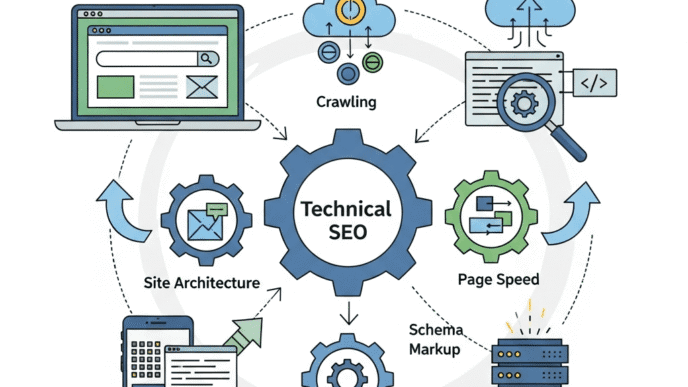
20% Technical SEO and Tools ($2,000-6,000/month typical)
Your technical foundation enables everything else.
Allocate to:
- SEO tools subscriptions
- Technical audits and fixes
- Site speed optimization
- Schema markup implementation
- Crawl budget optimization
Costs breakdown:
- Ahrefs or SEMrush: $200-1,000/month
- Technical SEO specialist: $1,000-3,000/month (freelance or agency)
- Developer time for implementations: $500-2,000/month
- Additional tools (Screaming Frog, etc.): $200-500/month
10% Strategy, Analytics, and Reporting ($1,000-3,000/month typical)
Measurement and optimization separate winners from everyone else.
Allocate to:
- SEO strategy development
- Competitive analysis
- Analytics setup and tracking
- Performance reporting
- Conversion rate optimization
Costs breakdown:
- SEO strategist time: $500-2,000/month
- Analytics tools (beyond GA4): $200-500/month
- Conversion optimization tools: $300-500/month
- Reporting dashboard development: Occasional costs
Understanding technical SEO requirements shows why this investment is non-negotiable.
Should You Build In-House, Hire an Agency, or Use Freelancers?
This is the million-dollar question about in-house SEO budget vs outsourcing.
In-House SEO Team Costs
What it costs to build internal SEO:
Early-stage SaaS (under $5M ARR):
- SEO Manager/Specialist: $80K-120K salary + 25% benefits = $100K-150K annually
- Content Marketing Manager: \$70K-100K + benefits = \$87K-125K annually
- Freelance writers: $2,000-5,000/month
- Tools and software: $500-1,000/month
- Total: $200K-300K annually ($17K-25K/month)
Growth-stage SaaS ($5M-20M ARR):
- SEO Director: $120K-160K + benefits
- SEO Manager: $80K-120K + benefits
- Content Manager: $70K-100K + benefits
- Content Writers (2): $60K-80K each + benefits
- Link Building Specialist: $60K-90K + benefits
- Tools and contractors: $2,000-5,000/month
- Total: $500K-800K annually ($42K-67K/month)
Pros of in-house:
- Deep product knowledge
- Aligned with company culture and goals
- Full control and flexibility
- Long-term retention of knowledge
Cons of in-house:
- High fixed costs
- Harder to scale up/down
- Recruiting and retention challenges
- May lack specialized expertise
SEO Agency Costs
What agencies actually cost:
Typical SEO agency costs by tier:
Small boutique agencies:
- $3,000-7,000/month
- 1-2 team members assigned
- Basic services (content + some link building)
- Good for early-stage companies
Mid-tier agencies:
- $7,000-15,000/month
- 3-5 team members assigned
- Comprehensive SEO services
- Proven track record with SaaS
Premium agencies:
- $15,000-50,000+/month
- Dedicated team of specialists
- Full-service SEO + content + PR
- Best for Series B+ companies
What you get for these costs:
- Strategy development and execution
- Content creation (volume varies widely)
- Link building campaigns
- Technical SEO audits and fixes
- Monthly reporting and optimization
Pros of agencies:
- Immediate access to specialized expertise
- Scalable resources
- Established processes and tools
- Faster ramp-up time
Cons of agencies:
- Less product knowledge initially
- Potential misalignment with goals
- Can be expensive for quality
- Risk of cookie-cutter approaches
Pro Tip: The agency price sweet spot for most SaaS companies in the $2M-10M ARR range is $8K-15K/month. Below $8K, you’re often getting junior resources and templated strategies. Above $15K, you need substantial revenue to justify the investment.
Freelancer and Contractor Costs
Typical freelancer rates:
- SEO Strategist: $150-300/hour ($3,000-8,000/month for ~20 hours)
- Content Writer (specialized): $0.30-1.00/word ($600-2,000 per comprehensive post)
- Link Building Specialist: $75-150/hour ($1,500-3,000/month)
- Technical SEO Expert: $150-300/hour (project-based, $2,000-10,000)
Pros of freelancers:
- Flexible scaling
- Access to specialists
- Lower overhead than full-time
- Pay for results, not time
Cons of freelancers:
- Coordination overhead
- Less availability
- Variable quality
- Knowledge transfer challenges
The Hybrid Approach (Recommended for Most)
What smart SaaS companies do:
In-house (strategic roles):
- 1 SEO Manager/Strategist (owns the program)
- Integration with product and sales teams
- Analytics and reporting
- Vendor management
Outsourced (specialized execution):
- Content production to freelance writers
- Link building to specialized agency or contractors
- Technical SEO to expert consultants (quarterly audits)
- Large projects (site migrations, redesigns)
Budget example for $5M ARR SaaS:
- In-house SEO Manager: $10K/month (fully loaded)
- Freelance content: $4K/month
- Link building agency: $3K/month
- Technical SEO consultant: $1K/month (amortized)
- Tools: $500/month
- Total: $18.5K/month
This hybrid delivers strategic control with execution flexibility—the best of both worlds.
Learning about content strategy helps you allocate content budget effectively.
What SEO Tools Are Actually Worth the Cost?
Let’s talk about SEO tools cost and what actually delivers ROI.
Essential Tools Stack (Minimum Viable)
For early-stage SaaS (under $2M ARR):
| Tool | Cost | Purpose | Worth It? |
|---|---|---|---|
| Google Search Console | Free | Rankings, indexation, performance | Absolutely |
| Google Analytics 4 | Free | Traffic, behavior, conversions | Absolutely |
| Ahrefs or SEMrush | $99-199/mo | Keyword research, competitor analysis | Yes, pick one |
| Screaming Frog | $259/yr | Technical audits | Yes |
| Grammarly | $12/mo | Content quality | Yes |
Total: $150-250/month
This covers your fundamental needs without breaking the bank.
Growth-Stage Tools Stack
For scaling SaaS ($2M-10M ARR):
Add these to the essential stack:
| Tool | Cost | Purpose | Worth It? |
|---|---|---|---|
| Clearscope or Surfer | $170-500/mo | Content optimization | Yes, if producing 10+ posts/month |
| Ahrefs + SEMrush | $298/mo | Both platforms together | Yes, different strengths |
| Hotjar or Microsoft Clarity | $0-80/mo | User behavior analysis | Yes |
| Zapier/Make | $20-50/mo | Workflow automation | Nice to have |
Total: $500-1,000/month
Enterprise Tools Stack
For established SaaS ($10M+ ARR):
| Tool | Cost | Purpose | Worth It? |
|---|---|---|---|
| Ahrefs Enterprise | $999/mo | Advanced SEO intelligence | Yes |
| SEMrush Business | $449/mo | Competitive tracking | Yes |
| Clearscope | $1,200/mo | Content optimization at scale | Yes |
| BrightEdge or Conductor | $2K-5K/mo | Enterprise SEO platform | Maybe |
| Marketing analytics platform | $1K-5K/mo | Attribution and reporting | Yes |
Total: $3,000-10,000+/month
Pro Tip: Don’t buy tools you won’t use consistently. I’ve seen companies spend $2K/month on enterprise SEO platforms that sit unused because no one had time to learn them. Start minimal and add tools only when they become bottlenecks.
How Do You Calculate Expected ROI from SEO Investment?
Let’s get into the actual math of SEO pricing for SaaS and expected returns.
The SEO ROI Formula
Basic calculation: ROI = (Revenue from SEO – Cost of SEO) / Cost of SEO × 100
Realistic SaaS SEO returns by timeline:
Months 1-6 (Investment Phase):
- Spending: $60K-90K total
- Expected revenue: $0-30K
- ROI: Negative to break-even
- Goal: Foundation building, not immediate returns
Months 7-12 (Traction Phase):
- Spending: $60K-90K total (months 7-12)
- Expected revenue: $100K-300K
- ROI: 50-200%
- Goal: Prove the channel works
Months 13-24 (Growth Phase):
- Spending: $120K-180K total (year 2)
- Expected revenue: $500K-1.5M
- ROI: 200-500%
- Goal: Scale what’s working
Months 25+ (Maturity Phase):
- Spending: $120K-180K annually
- Expected revenue: $1M-3M+ annually
- ROI: 400-1,000%+
- Goal: Maintain leadership position
Example ROI Calculation
Scenario: Series A SaaS ($3M ARR)
Monthly SEO Investment: $12,000
- Content: $5,000
- Link building: $3,000
- Technical + Tools: $2,500
- Strategy: $1,500
Year 1 Outcomes (Conservative):
- Organic traffic: 25,000 monthly visitors by month 12
- Conversion rate: 2.5% to trials
- Trial to paid: 20%
- Monthly new customers: 125
- Average ACV: $8,000
- Annual revenue from organic: $1.2M
ROI Calculation:
- Total investment: $144K
- Revenue generated: $1.2M
- Net return: $1.056M
- ROI: 633%
- Payback period: 1.4 months
Year 2 outcomes get even better as older content continues ranking and converting while new content adds incrementally.
Understanding SEO metrics helps you track ROI accurately.
What Are Red Flags in SEO Pricing and Proposals?
Let me save you from expensive mistakes in evaluating cost of SEO for software proposals.
Warning Signs of Bad SEO Investments
Red flag #1: “Guaranteed #1 rankings”
No legitimate SEO can guarantee specific rankings. Google’s algorithm has 200+ factors. Anyone promising guaranteed positions is either lying or using black-hat tactics that’ll get you penalized.
Red flag #2: “We’ll get you 1,000 backlinks for $500”
Quality backlinks from authoritative sites cost time and relationship-building. Cheap bulk backlinks are spam that hurts your rankings.
Red flag #3: Extremely low prices ($500-1,500/month for “full service”)
At these prices, you’re getting junior offshore resources following templates. Real SEO expertise costs money because it requires skill and time.
Red flag #4: No transparency about tactics
“We have proprietary methods we can’t disclose” usually means they’re using risky shortcuts. Legitimate SEO is transparent about strategies.
Red flag #5: Immediate results promises
“You’ll rank #1 within 30 days” is a lie. SEO takes 6-12+ months for meaningful results. Anyone promising instant success is selling snake oil.
Red flag #6: Focus on vanity metrics
Proposals emphasizing “we’ll get you 100,000 visitors!” without discussing conversion rates, qualified traffic, or revenue attribution are worthless.
Pro Tip: Ask any prospective agency or consultant: “Can you show me case studies of SaaS companies you’ve helped, including traffic, conversion, and revenue metrics over 12+ months?” If they can’t or won’t, walk away.
What Good SEO Proposals Include
Quality SEO proposals contain:
- Detailed competitive analysis of your space
- Specific keyword targets across all funnel stages
- Content plan with actual topics and timelines
- Technical audit findings and remediation roadmap
- Link building strategy with realistic targets
- Clear KPIs tied to business outcomes (not just traffic)
- Transparent pricing with itemized breakdowns
- Realistic timelines (6-12 months minimum)
- Case studies with verifiable results
- Monthly reporting format examples
How Should You Budget SEO by Growth Stage?
Let’s get specific about SEO budget allocation at each stage of SaaS growth.
Pre-Seed/Bootstrap Stage ($0-500K ARR)
Recommended monthly budget: $2,000-5,000
Allocation:
- 50% Content creation ($1,000-2,500)
- 20% Tools ($400-1,000)
- 20% Technical SEO ($400-1,000)
- 10% Link building ($200-500)
What to prioritize:
- Bottom-funnel comparison and alternative pages
- Technical foundation (site speed, crawlability)
- Essential tools only (Ahrefs OR SEMrush, not both)
- DIY link building through partnerships
Execution approach:
- Founder or early marketer manages strategy
- Hire freelance writers for execution
- Use contractors for technical implementations
- Focus on quick wins with low-competition keywords
Expected outcomes:
- 10-20 published pages by month 6
- 2,000-5,000 monthly organic visitors by month 6
- 5-15 trial signups from organic by month 6
Seed Stage ($500K-2M ARR)
Recommended monthly budget: $5,000-10,000
Allocation:
- 40% Content ($2,000-4,000)
- 30% Link building ($1,500-3,000)
- 20% Technical + Tools ($1,000-2,000)
- 10% Strategy ($500-1,000)
What to prioritize:
- Comprehensive content across all funnel stages
- Active link building campaigns
- Competitor displacement strategies
- Content optimization and refresh
Execution approach:
- Hire in-house SEO manager OR retain agency
- Build network of freelance writers
- Monthly technical audits
- Systematic link building
Expected outcomes:
- 40-60 new pages by month 12
- 10,000-25,000 monthly organic visitors
- 100-250 trial signups from organic monthly
Series A ($2M-10M ARR)
Recommended monthly budget: $10,000-25,000
Allocation:
- 40% Content ($4,000-10,000)
- 30% Link building ($3,000-7,500)
- 20% Technical + Tools ($2,000-5,000)
- 10% Strategy/Analytics ($1,000-2,500)
What to prioritize:
- High-volume content production (8-12 posts weekly)
- Original research and data studies
- Digital PR campaigns
- Advanced technical optimization
- International SEO if applicable
Execution approach:
- In-house SEO team (2-3 people) OR premium agency
- Network of specialized contractors
- Quarterly strategic reviews
- Multi-channel content distribution
Expected outcomes:
- 100+ new pages annually
- 50,000-150,000 monthly organic visitors
- 500-1,500 trial signups from organic monthly
- SEO driving 20-35% of new customer acquisition
Series B+ ($10M+ ARR)
Recommended monthly budget: $25,000-75,000+
Allocation:
- 35% Content ($8,750-26,250)
- 30% Link building/PR ($7,500-22,500)
- 20% Technical + Tools ($5,000-15,000)
- 15% Strategy/Analytics ($3,750-11,250)
What to prioritize:
- Category leadership positioning
- Thought leadership and executive visibility
- International expansion
- Advanced personalization
- Competitive moats
Execution approach:
- Full in-house SEO team (5-8 people)
- Specialized agencies for link building and PR
- Enterprise tools and platforms
- Executive involvement in content
Expected outcomes:
- 200+ new pages annually
- 200,000-500,000+ monthly organic visitors
- 2,000-5,000+ trial signups from organic monthly
- SEO driving 30-45% of new customer acquisition
Pro Tip: As you scale, resist the temptation to cut SEO budget when growth slows. Your competitors are waiting for that exact moment to outspend you and steal your hard-earned rankings. SEO requires consistent investment to maintain leadership.
Common Questions About SaaS SEO Budgets
Is SEO worth it for early-stage startups with limited budgets?
Yes, but be strategic. Focus 100% of limited budget on bottom-funnel content (comparison pages, alternative pages) that converts immediately. Skip broad educational content until you have budget to compete. $3K-5K/month minimum for meaningful results; below that, you’re better off focusing on other channels.
How long until we see ROI from SEO investment?
Realistic timeline: 6-12 months to break even, 12-18 months for substantial positive ROI. Early months are investment phase (negative ROI), but returns compound over time. By year 3, SEO typically delivers 400-1,000%+ ROI as past content continues converting.
Should we pause SEO during economic downturns?
Absolutely not. Downturns are when smart companies double down on SEO while competitors cut budgets. Your organic rankings improve, you capture more market share, and you’re positioned to dominate when the market recovers. SEO is one of the best recession-proof investments.
Can we start with a smaller budget and scale up?
Yes, this is actually smart. Start with \$3K-5K/month focusing on high-intent keywords and quick wins. Prove ROI over 6-9 months, then increase budget systematically. Better to underspend initially and scale with proven results than overspend without strategy.
What if our competitor spends 5x more on SEO?
Budget isn’t everything. Smart strategy beats big budgets. Focus on niches they ignore, create better content on topics they cover poorly, and build genuine relationships they overlook. I’ve seen $5K/month programs outperform $50K/month programs through superior strategy.
How do we know if we’re overpaying for SEO services?
Compare proposals from 3-5 providers. Industry average: $120-200/hour equivalent for quality SEO services. If paying $15K/month, you should get roughly 60-100 hours of skilled work. Request detailed breakdowns and compare hourly rates, deliverables, and track records.
Should SEO budget come from marketing or product budget?
Marketing budget typically. SEO drives customer acquisition like other marketing channels. However, technical SEO improvements (site speed, architecture) might come from product/engineering budget since they improve product experience beyond just SEO.
Your SEO Budget Action Plan
Ready to allocate your SaaS SEO budget strategically? Here’s your roadmap.
Step 1: Determine Total Available Budget (Week 1)
- Calculate recommended range based on ARR/stage
- Get executive alignment on SEO as growth channel
- Secure commitment for 12+ month investment
- Set expectations about timeline to results
Step 2: Decide Build vs Buy (Week 2)
- Evaluate in-house vs agency vs hybrid options
- Interview 3-5 agencies or candidates
- Check references and case studies
- Make hiring/contracting decisions
Step 3: Allocate Budget Across Categories (Week 3)
- Split budget using 40-30-20-10 framework
- Identify essential tools to purchase
- Set aside contingency budget (10%)
- Create quarterly spending plan
Step 4: Establish Measurement Framework (Week 4)
- Define success metrics tied to business outcomes
- Set up attribution tracking
- Create reporting dashboard
- Schedule monthly and quarterly reviews
Step 5: Execute and Optimize (Ongoing)
- Begin content production and link building
- Track spending vs budget monthly
- Measure ROI starting month 6
- Reallocate budget quarterly based on results
Pro Tip: Start with 80% of your planned budget and hold 20% in reserve. As you learn what works in your specific market, reallocate the reserve toward highest-performing tactics. This flexibility prevents waste on strategies that don’t fit your business.
Final Thoughts: Investing for Compounding Returns
SaaS SEO budget decisions determine whether organic search becomes your most profitable channel or a money pit.
The companies winning with SEO aren’t necessarily outspending competitors—they’re allocating strategically, measuring ruthlessly, and committing long-term.
Remember: SEO is buying assets, not renting attention. Every dollar invested in quality content, authoritative backlinks, and technical excellence continues delivering returns for years.
Most importantly, budget isn’t your constraint—strategy is. I’ve seen \$5K/month programs outperform \$50K/month programs because they focused on the right keywords, created genuinely valuable content, and played the long game.
Your competitors are either already investing heavily in SEO or they’re not. If they’re not, this is your window to build an unassailable advantage. If they are, you can’t afford to underfund or you’ll fall further behind every month.
Start with what you can afford, prove ROI, then scale systematically. The best time to start investing in SEO was two years ago. The second-best time is today.
Now stop reading and start budgeting. Your organic growth depends on it.
🎯 SaaS SEO Budget Calculator
Calculate Your Optimal SEO Investment & Get Detailed Budget Allocation
Calculate Your SEO Budget
📊 Budget Allocation Breakdown
💵 Detailed Cost Breakdown
• Content manager: $600
• Tools (Clearscope, etc.): $200
• SME reviews: $33
• PR tools: $300
• Guest post placements: $262
• SEO tools (Ahrefs): $200
• Developer time: $242
• Analytics tools: $100
• Reporting: $71
📅 Expected ROI Timeline
🔄 Approach Comparison
| Approach | Monthly Cost | Pros | Best For |
|---|---|---|---|
| In-House Team | $17K-25K | Full control, product knowledge | Series A+ companies |
| Agency | $7K-15K | Expertise, established processes | Seed to Series A |
| Hybrid | $10K-18K | Balance of control & expertise | Most SaaS companies |
| Freelancers | $3K-8K | Flexible, lower overhead | Bootstrapped startups |