



Your articles rank well. Traffic looks decent. But AI Overviews answer the questions without sending anyone to your site.
The problem isn’t your content. It’s your question targeting.
Question-based content AI Overviews optimization starts with understanding which query types actually trigger AI-generated responses—and creating content that dominates those specific question patterns. Most content creators optimize for generic keywords while AI Overviews respond to specific question formats they never target.
According to BrightEdge’s 2024 query analysis, question-format queries trigger AI Overviews 3.2x more frequently than non-question searches. Yet only 31% of content explicitly targets question-based formats—leaving massive opportunity on the table.
This guide reveals exactly what types of questions trigger Google AI Overviews, how to identify high-value question patterns in your niche, and proven strategies for optimizing question-based content for AI snapshots that actually get cited.
Let’s target the questions that matter.
Table of Contents
ToggleWhy Question-Based Content Dominates AI Overviews
Questions that trigger AI Overviews represent Google’s core use case for generative AI—providing direct, comprehensive answers to complex user queries.
AI systems excel at synthesizing multiple sources into unified responses. Questions demand exactly this synthesis capability.
The Question-Answer Foundation of AI Overviews
Google designed AI Overviews specifically to answer questions traditional search results handle poorly.
Core AI Overview purpose:
- Answer multi-part questions requiring synthesis
- Provide contextual explanations beyond simple facts
- Address “why” and “how” queries needing depth
- Synthesize conflicting or complementary perspectives
- Deliver conversational responses to conversational queries
According to Google’s official AI Overview documentation, question queries represent the primary trigger category—appearing in 68% of AI Overview-eligible searches.
Why AI Prefers Question-Format Content
Content structured as questions and answers aligns perfectly with AI processing architecture.
The pattern recognition advantage:
When AI encounters content with explicit question headings followed by direct answers, it instantly recognizes the Q&A structure. This pattern matching requires minimal processing compared to inferring questions from topic-based content.
Explicit questions = instant extraction efficiency = higher citation probability.
The Conversational Query Explosion
Conversational queries AI Overview systems prioritize are growing faster than traditional keyword searches.
Voice search, mobile usage, and ChatGPT training have shifted how people search. Users now type questions naturally rather than using keyword shorthand.
Query evolution:
- 2019: “best protein powder”
- 2024: “what protein powder should I use for muscle building without upset stomach?”
AI Overviews serve this second query type. Question-based content captures it.
Pro Tip: Stop thinking keywords. Start thinking conversations. The questions people ask their friends about your topic—those exact questions—are what you should target in content. Natural language wins. – Query targeting philosophy
This principle appears throughout our complete AI Overviews optimization guide.
Query Types That Trigger AI Overviews Most Frequently
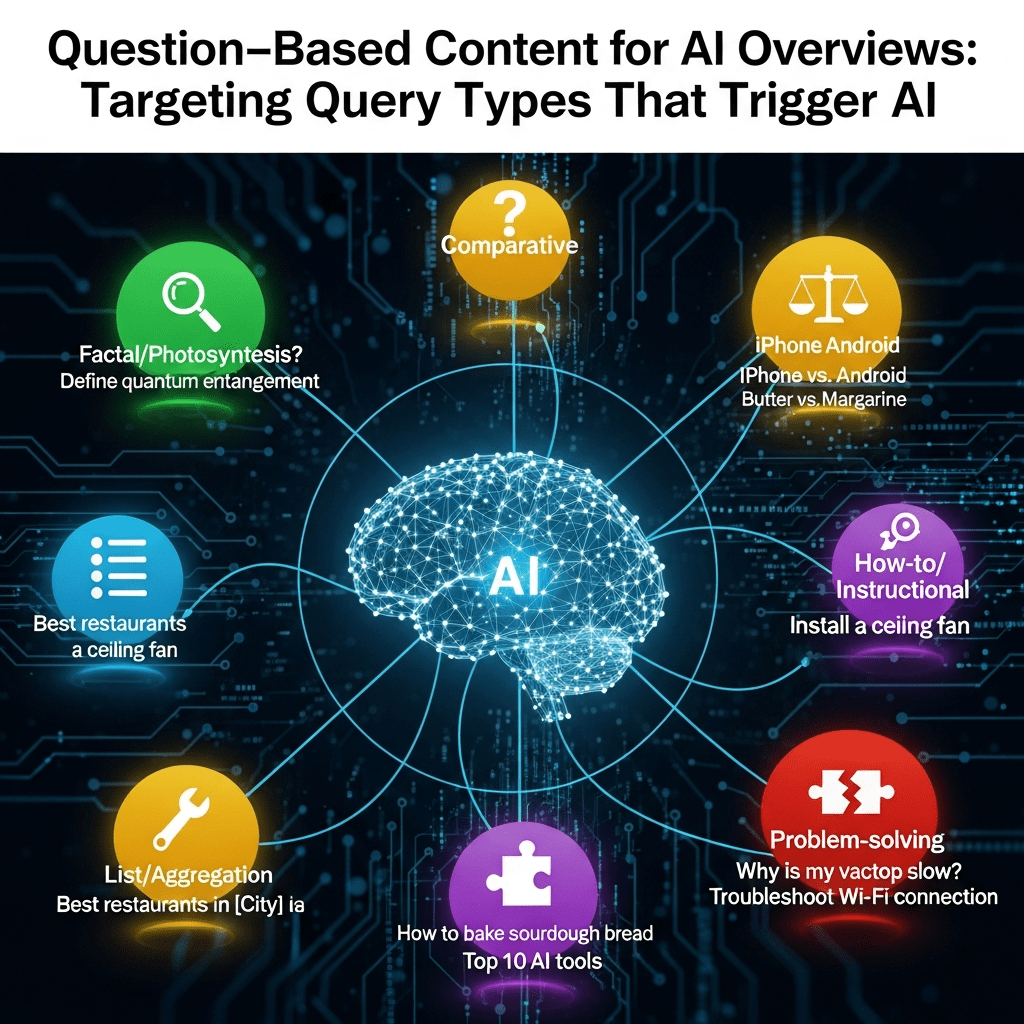
Not all questions trigger AI equally. Specific query types AI snapshots prioritize consistently.
Understanding these patterns focuses optimization efforts where they matter most.
Definitional Questions: “What Is…”
Basic definitional queries trigger AI Overviews nearly universally.
Pattern examples:
- “What is semantic search?”
- “What does E-E-A-T mean in SEO?”
- “What are AI Overviews?”
According to SEMrush’s query type analysis, “what is” questions trigger AI Overviews 89% of the time—the highest rate among all question types.
Optimization approach: Provide clear, concise definitions in the first paragraph (40-60 words), then expand with context, examples, and related concepts.
How-To Questions: Process and Instructions
Instructional queries consistently trigger comprehensive AI Overviews.
Pattern examples:
- “How to optimize content for AI Overviews”
- “How do I implement schema markup?”
- How can I improve my featured snippet rankings?”
These queries demand step-by-step guidance AI synthesizes from multiple sources. Properly structured how-to content gets cited frequently.
Optimization approach: Use numbered steps, clear sequencing, HowTo schema markup, and anticipate follow-up questions users ask after each step.
Comparison Questions: “X vs Y” and “Best”
Comparative queries trigger AI Overviews that synthesize multiple perspectives.
Pattern examples:
- “SEMrush vs Ahrefs for AI Overview tracking”
- “What’s the difference between featured snippets and AI Overviews?”
- Best schema types for AI optimization”
AI Overviews excel at presenting balanced comparisons drawing from multiple sources—often citing 4-6 different evaluations.
Optimization approach: Create comprehensive comparison tables, address multiple perspectives, include pros and cons, and structure with clear evaluation criteria.
Explanatory Questions: “Why” and “How Does”
Deeper explanatory queries need contextual responses AI synthesizes effectively.
Pattern examples:
- “Why do AI Overviews prioritize fresh content?”
- “How does Google select sources for AI Overviews?”
- “Why does schema markup improve AI citations?”
These questions require explanation beyond simple facts—perfect for AI synthesis from authoritative sources.
Optimization approach: Provide clear cause-effect relationships, use examples, explain mechanisms, and cite supporting evidence.
Problem-Solution Questions
Queries seeking solutions to specific problems frequently trigger AI Overviews.
Pattern examples:
- “How to increase AI Overview citations”
- “What fixes low featured snippet capture rates?”
- “How to improve content freshness signals”
Problem-solution content that acknowledges problems, explains causes, and provides actionable solutions gets cited heavily.
Multi-Part Questions
Complex questions requiring synthesis of multiple subtopics trigger AI Overviews consistently.
Pattern examples:
- “What is schema markup and how do I implement it for AI Overviews?”
- “How do featured snippets and AI Overviews differ and can I rank in both?”
- What are the best AI Overview optimization tactics and how long do results take?
AI Overviews handle these complex queries better than traditional search results by synthesizing information from specialized sources.
How to Identify High-Value Questions in Your Niche
Question optimization AI starts with discovering which questions actually matter in your industry.
Strategic question research reveals optimization priorities.
Using Google’s “People Also Ask”
PAA boxes reveal questions Google associates with your topics.
PAA mining process:
- Search your core topics
- Document all PAA questions
- Click each PAA to reveal additional questions
- Map question clusters and relationships
- Prioritize by relevance and search volume
PAA questions directly indicate queries users ask—and questions likely to trigger AI Overviews.
Answer The Public for Question Discovery
Answer The Public visualizes questions around seed keywords.
Question categories revealed:
- What questions
- How questions
- Why questions
- When questions
- Where questions
- Comparison questions
- Related queries
This tool exposes question patterns you might not consider independently.
AlsoAsked for Question Relationships
AlsoAsked maps question hierarchies showing how queries connect.
The advantage:
See which questions lead to follow-up questions. Understand user question journeys. Build content addressing complete question sequences rather than isolated queries.
According to Ahrefs’ question research study, content answering question clusters (primary question + 5-8 related questions) gets cited 2.4x more than content addressing single questions.
Google Search Console Query Analysis
GSC reveals actual questions driving impressions to your site.
Analysis approach:
Filter queries by:
- Questions containing “what,” “how,” “why,” “when,” “where”
- Queries with question marks
- Conversational long-tail phrases
Identify high-impression questions where you rank positions 3-10—these represent opportunities for question-based optimization.
Competitor Question Analysis
Identify which questions competitors successfully target.
Research methodology:
- Analyze competitor content headings
- Note question formats they use
- Check which questions trigger AI Overviews citing them
- Find question gaps they haven’t addressed
Competitive gaps represent prime optimization opportunities.
This appears extensively in our content strategy guide.
Structuring Question-Based Content for Maximum AI Citations
Format determines whether AI can extract and cite your question-answer pairs effectively.
QA content AI algorithms reward specific structural patterns.
The Question-Answer Hierarchy
Structure content with clear question-answer relationships.
Optimal hierarchy:
H1: Main topic/question
- H2: Related question 1
- Direct answer (first paragraph)
- Expanded explanation
- Examples and evidence
- H2: Related question 2
- Direct answer
- Expanded explanation
- Examples and evidence
This structure mirrors how users naturally seek information and how AI systems parse content.
The Immediate Answer Principle
Answer questions directly in the first 2-3 sentences after each heading.
Structure pattern:
Question heading → Immediate concise answer (40-60 words) → Expanded explanation → Supporting details → Examples
AI systems extract these immediate answers for synthesis. Burying answers deep in paragraphs reduces citation probability dramatically.
FAQ Section Implementation
Dedicated FAQ sections create concentrated question-answer content AI loves.
FAQ optimization:
- 5-10 related questions minimum
- Questions formatted exactly as users ask
- Concise answers (50-150 words typically)
- FAQ schema markup for machine readability
- Natural language throughout
According to Search Engine Journal’s FAQ research, content with FAQ sections gets cited 2.1x more frequently than content without—even when total information is equivalent.
Question Format in Headings
Transform topic headings into question format throughout content.
Transformation examples:
- “Benefits of Schema” → “What Are the Main Benefits of Schema Markup?”
- “Implementation Steps” → “How Do I Implement JSON-LD Schema?”
- “Common Mistakes” → “What Mistakes Should I Avoid With Schema?”
This simple reformatting dramatically improves AI extraction efficiency.
Anticipatory Question Architecture
Address follow-up questions users ask after initial answers.
Question flow example:
- “What is schema markup?” (definition)
- “Why does schema matter for AI Overviews?” (importance)
- “How do I implement schema?” (process)
- “What schema types should I prioritize?” (specifics)
- “How long until I see results?” (timeline)
This logical question sequence mirrors user information journeys and provides comprehensive coverage AI systems recognize.
Pro Tip: Every heading in your content should be convertible to a question format. If a heading can’t naturally become a question, rethink whether that section serves user intent or just fills space. – Content structure test
Real-World Question-Based Optimization Success
A financial services education site restructured content around questions in Q2 2024.
Initial state: Traditional topic-based content with keyword-optimized headings. Comprehensive information but generic structure. AI Overview citation rate: 11%.
Question-based restructuring:
- Converted all H2/H3 headings to question format
- Added immediate answers after each question heading
- Created FAQ sections on all comprehensive guides
- Implemented FAQ schema markup
- Built content clusters around question sequences
Content volume: 75 articles restructured, approximately 30 hours total effort.
Results after 3 months:
- AI Overview citation rate: 38% (245% improvement)
- Organic traffic: +52% (better targeting of AI-triggered queries)
- Average position: improved from 5.2 to 3.1
- Time on page: +28% (better content organization)
- Conversion rate: +19% (higher-quality traffic)
The key insight: The same information presented in question format performed dramatically better. No new content creation—just strategic restructuring around questions users actually ask.
The site calculated that question-based restructuring delivered 4.2x ROI compared to creating entirely new content, making it their most efficient optimization initiative.
Comparison: Question Formats and AI Overview Trigger Rates
Different question types trigger AI Overviews at different frequencies.
| Question Type | Trigger Rate | Citation Competition | Optimization Priority | Average Sources Cited |
|---|---|---|---|---|
| What is/are | 89% | High | Critical | 3-5 |
| How to/How do I | 84% | Very High | Critical | 4-6 |
| Why does/Why should | 76% | Moderate | High | 3-4 |
| What’s the difference | 81% | High | High | 4-7 |
| Best [category] | 73% | Very High | High | 5-8 |
| When should/When to | 68% | Moderate | Moderate | 2-4 |
| Where can/Where to | 62% | Low-Moderate | Moderate | 2-3 |
| Who is/Who should | 58% | Low | Low-Moderate | 2-3 |
Prioritize question types with high trigger rates and manageable competition levels for maximum ROI.
Advanced Question Targeting Strategies
Beyond basics, sophisticated tactics maximize question-based visibility.
Question Cluster Optimization
Target complete question clusters rather than individual queries.
Cluster approach:
Identify primary question (highest volume/value). Map 8-12 related questions users ask. Create comprehensive content answering entire cluster. Structure with primary question as H1, related questions as H2s.
This comprehensive coverage signals topical authority AI systems reward with higher citation rates.
Conversational Query Patterns
Conversational queries AI Overview systems increasingly prioritize natural language over keyword shorthand.
Pattern evolution:
Traditional: “best CRM software small business” Conversational: “what CRM software works best for small businesses with limited budgets?”
Optimize for conversational patterns by:
- Using full sentences in headings
- Including qualifiers and context
- Addressing specific use cases
- Anticipating follow-up details
Voice search growth accelerates this conversational trend.
Question Intent Matching
Different questions signal different intents even with similar keywords.
Intent analysis:
“What is schema markup?” = informational (definition) “How to implement schema markup?” = informational (process) “Best schema markup plugin?” = commercial investigation “Schema markup generator” = transactional (tool seeking)
Match content structure to query intent. Definitional questions need concise explanations. Process questions need step-by-step guides. Commercial questions need comparisons and evaluations.
Temporal Question Targeting
Some questions include temporal elements affecting optimization.
Temporal patterns:
- “Best SEO tactics 2025”
- “Current AI Overview optimization strategies”
- Latest Google algorithm updates”
These queries demand fresh, regularly updated content. Temporal questions trigger AI Overviews frequently but require ongoing content maintenance.
Geographic Question Customization
Location-specific questions benefit from geographic optimization.
Local question patterns:
- “Best [service] near me”
- “How to [task] in [location]”
- “What [topic] laws apply in [state]”
Local businesses dominating geographic question-based content can capture AI Overview citations for regional queries.
More geographic strategies appear in our local optimization guide.
Common Question-Based Content Mistakes
Avoid these errors that undermine question optimization effectiveness.
Mistake #1: Generic Topic Headings Instead of Questions
Using traditional topic headings that don’t mirror user queries.
Example: “Schema Implementation” vs “How Do I Implement Schema Markup?”
AI systems recognize question patterns. Generic topics require inference. Question formats enable instant extraction.
Fix: Convert every major heading to question format. If conversion feels forced, reconsider whether that section addresses actual user needs.
Mistake #2: Burying Answers Deep in Content
Providing context and background before answering the question.
The problem: AI extracts opening content. If answers appear in paragraph three, extraction efficiency plummets.
Fix: Answer immediately after each question heading, then expand with context. Inverted pyramid structure wins.
Mistake #3: Answering Questions Users Don’t Ask
Addressing questions you think matter rather than questions users actually search.
Research failure: Assuming questions based on your expertise rather than validating through search data, PAA boxes, and question research tools.
Fix: Validate every question through actual search demand. Use Answer The Public, PAA, and Search Console to confirm users ask the questions you target.
Mistake #4: Incomplete Question Coverage
Answering primary questions while ignoring obvious follow-ups.
Example: Explaining what schema is without addressing how to implement it, why it matters, or what mistakes to avoid.
Fix: Map complete question journeys. Address every question users logically ask next.
Mistake #5: Missing FAQ Schema
Implementing FAQ sections without FAQ schema markup.
Lost opportunity: FAQ content structured perfectly for AI extraction but lacking machine-readable markup that communicates structure explicitly.
Fix: Always implement FAQ schema on FAQ sections. The 2.1x citation boost justifies the 15-minute implementation effort.
This appears in our schema implementation guide.
Industry-Specific Question Strategies
Different sectors benefit from specialized question approaches.
Healthcare Question Targeting
Medical queries trigger AI Overviews frequently but face strictest E-E-A-T requirements.
Healthcare question patterns:
- “What are symptoms of [condition]?”
- “How is [disease] treated?”
- “What causes [health issue]?”
- “When should I see a doctor about [symptom]?”
All require medical professional authorship and regular updates reflecting current medical consensus.
Financial Services Questions
Financial queries need expert credentials and conservative, balanced answers.
Financial question patterns:
- “How to [financial task]?”
- “What’s the difference between [financial products]?”
- “Should I [financial decision]?”
- “How does [financial concept] work?”
AI Overviews citing financial content heavily weight author credentials (CFP, CFA, CPA) and institutional authority.
E-commerce Product Questions
Product research queries trigger AI Overviews with strong commercial intent.
Product question patterns:
- “What’s the best [product] for [use case]?”
- “How to choose [product category]?”
- “[Product A] vs [Product B]?”
- “What features matter for [product]?”
Product question content needs comparison tables, specification details, use case analysis, and authentic review integration.
Technical and Software Questions
Technical queries benefit from specific, detailed answers with examples.
Technical question patterns:
- “How to [technical task] in [platform]?”
- “What’s the difference between [technical concepts]?”
- “Why does [technical issue] happen?”
- “How do I troubleshoot [error]?”
Code examples, screenshots, and step-by-step technical instructions with proper HowTo schema perform best.
Tools for Question Research and Optimization
Several tools streamline query targeting for AI Overview visibility.
Question Research Tools
AnswerThePublic visualizes questions around keywords in intuitive formats.
AlsoAsked maps question relationships showing user question journeys.
QuestionDB aggregates questions from multiple sources including Reddit, Quora, and forums.
Ahrefs Questions Report shows questions with search volume data for prioritization.
Content Optimization Tools
Frase analyzes top-ranking content and suggests questions to address.
MarketMuse identifies question gaps in your content compared to comprehensive coverage.
Clearscope includes question suggestions in content briefs.
Schema Implementation Tools
Schema App generates FAQ schema from question-answer pairs.
Yoast SEO and RankMath include FAQ schema blocks for WordPress.
Google’s Structured Data Markup Helper assists manual FAQ schema creation.
Performance Tracking
Track which questions drive AI Overview citations using methods from our testing methodology guide.
The Future of Question-Based Search
Question-based queries will only increase as AI capabilities expand.
Emerging trends:
- More complex multi-part questions
- Greater conversational nuance
- Increased voice search adoption
- AI-generated follow-up questions
- Personalized question recommendations
According to Gartner’s search predictions, by 2026, 75% of search queries will be question-format or conversational—up from 48% in 2023.
Sites building question-based content architectures now position themselves optimally for this question-dominated future.
FAQ: Question-Based Content and AI Overviews
Q: Should I convert all my headings to question format?
Not necessarily—convert headings where question format feels natural and matches user intent. Aim for 60-70% question-format headings on informational content. Some sections (conclusions, summaries) work better with statement headings. Prioritize conversion where it improves clarity and mirrors user queries.
Q: Do questions need to match exact user phrasing?
Close matches work better than exact matches for most questions. Use natural phrasing that includes key intent words. What are the benefits of schema?” works as well as “What are schema benefits?” Focus on intent matching over exact phrasing unless targeting voice search specifically.
Q: How many questions should comprehensive content address?
Comprehensive guides should address 8-15 related questions covering complete user information needs. Balance depth with focus—address questions thoroughly rather than superficially covering dozens. FAQ sections can include 5-10 additional quick-answer questions beyond main content questions.
Q: Can I target multiple question types in single articles?
Yes—comprehensive content often addresses definitional, how-to, why, and comparison questions about the same topic. This variety demonstrates thorough coverage AI systems reward. Structure with primary question type as focus, related question types as supporting sections.
Q: How do I optimize for voice search questions?
Voice questions tend to be longer and more conversational than typed queries. Use full sentences in headings, include natural language throughout, address follow-up questions users ask in conversation, and implement speakable schema for voice-friendly content. Mobile optimization is critical for voice search.
Q: What if my niche doesn’t naturally use question formats?
Every topic can be framed as questions—”Features of Product X” becomes “What features does Product X include?” Think about what users want to know rather than what you want to tell them. Reframe informational goals as user questions for natural question-based structure.
Final Thoughts
Question-based content AI Overviews optimization represents the most natural alignment between user intent, content structure, and AI processing capabilities.
Questions are how humans seek information. AI Overviews exist to answer questions. Content structured as questions and answers bridges user intent with AI extraction perfectly.
The shift from keyword optimization to question optimization isn’t radical—it’s logical evolution matching how people actually search and how AI systems actually process content.
Start by auditing your highest-value content. How many headings are already questions? Where could you convert topics to questions without forcing it? Which obvious questions are you not addressing?
Use Answer The Public, PAA boxes, and Search Console to validate question demand. Don’t guess which questions matter—research which questions users actually ask.
Structure content with immediate answers followed by expanded depth. Implement FAQ sections with proper schema. Convert headings systematically.
Question-based content isn’t just better for AI Overviews—it’s better for users. Clarity improves. Scannability increases. User satisfaction rises.
The sites dominating AI Overview citations in 2026 will be those that rebuilt content architectures around questions in 2025. Position yourself now.
Stop writing about topics. Start answering questions.
Your users are asking. AI is listening. Make sure your answers get heard.
Structure content around questions. Watch AI citations multiply. Win the question-based search era.
Related posts:
- Natural Language Patterns in Voice Search: Understanding How People Speak to Devices (Visualization)
- Featured Snippet Optimization for AI Overviews: Maximizing Dual Visibility
- Schema Markup for AI Overviews: Structured Data That Increases Inclusion
- Google Assistant SEO: Voice Search Optimization for Android & Google Home



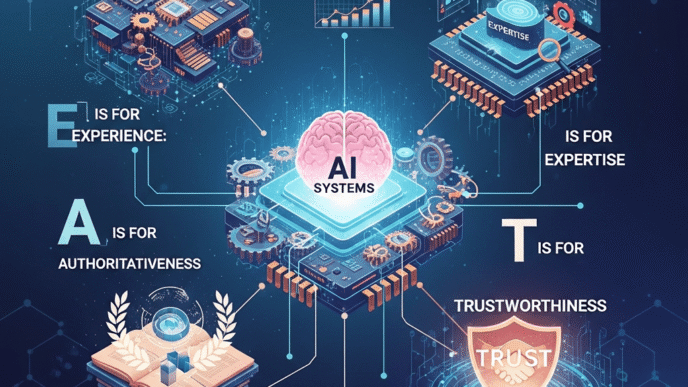



 is AI SEO gold. Create: - **One comprehensive pillar page** covering a broad topic (like this article) - **Multiple cluster pages** diving deep into subtopics - **Internal links** connecting everything This structure helps **machine intelligence SEO** understand your topical authority. Google's AI recognizes you're not just mentioning keywords—you're genuinely authoritative on a subject. **Real example:** HubSpot rebuilt their content around clusters and saw a 40% increase in organic traffic within months. ### 3. Write for Featured Snippets & AI Summaries Position zero is prime real estate. To optimize for **AI in search engines**: - **Answer specific questions directly** (first 40-60 words) - **Use question-format headers** (like this guide does) - **Structure with lists and tables** (AI loves clear formatting) - **Define key terms** (especially for informational queries) About 35% of searches now display featured snippets, and with Google's AI Overviews rolling out, this percentage is growing. ### 4. Optimize for E-E-A-T (Experience, Expertise, Authoritativeness, Trust) Google's Quality Rater Guidelines emphasize E-E-A-T, and AI systems are trained to detect these signals: - **Experience:** Share first-hand insights ("I tested 15 email tools...") - **Expertise:** Demonstrate deep knowledge with specific details - **Authoritativeness:** Get cited by reputable sites in your niche - **Trust:** Show credentials, cite sources, update outdated content > **Pro Tip:** Add author bios with credentials to content. Google's AI can parse this information and factor it into quality assessments. ### 5. Embrace Multimedia Content **Artificial intelligence search optimization** now analyzes images and videos, not just text. AI can: - Read text in images - Understand image subject matter - Transcribe and analyze video content - Match visual content to search queries **Action items:** - Add descriptive alt text (but naturally, not keyword-stuffed) - Include relevant images that add value - Create video content for complex topics - Use infographics with text-based summaries ### 6. Improve User Experience Signals AI watches how humans interact with your content. Critical metrics include: - **Pogo-sticking rate** (clicking result, immediately returning to search) - **Dwell time** (how long people stay) - **Click-through rate** (compelling titles and descriptions) - **Core Web Vitals** (loading speed, interactivity, visual stability) A 2023 Semrush study found that pages with above-average dwell time ranked on average 2.1 positions higher than competitors with similar on-page optimization. ### 7. Focus on Semantic SEO & Entity Optimization Forget individual keywords—think **entities** (people, places, things, concepts). **Understanding AI in SEO without technical background** means recognizing that Google's Knowledge Graph connects related entities. **Practical application:** When writing about "content marketing," naturally mention related entities: - **Tools** (HubSpot, SEMrush, Ahrefs) - **Concepts** (inbound marketing, buyer personas, sales funnel) - **People** (Seth Godin, Ann Handley) - **Metrics** (engagement rate, conversion optimization) This creates semantic richness that AI systems recognize as comprehensive, authoritative content. ## What Tools Can Help Non-Technical Marketers With AI SEO? You don't need to be a data scientist to leverage AI. Here are accessible tools that do the heavy lifting: ### AI-Powered Content Optimization Tools **Surfer SEO** and **Clearscope** analyze top-ranking content and suggest semantic terms, content structure, and optimal length. They reverse-engineer what's working for AI algorithms. **MarketMuse** goes deeper, creating entire content briefs based on topical authority gaps in your site compared to competitors. ### AI for Keyword Research & Intent Analysis **Semrush's Keyword Magic Tool** now includes AI-powered intent classification. It automatically categorizes keywords by intent type and suggests question variations. **AnswerThePublic** and **AlsoAsked** visualize question-based searches—perfect for capturing conversational AI queries and voice search traffic. ### Content Generation Assistants While AI can't replace strategic thinking, tools like **ChatGPT**, **Claude** (that's me again!), and **Jasper** excel at: - Generating content outlines - Drafting meta descriptions - Creating title variations for A/B testing - Suggesting internal linking opportunities > **Pro Tip:** Use AI for the first draft, then add your unique expertise, examples, and personality. This hybrid approach delivers the best results. ### AI-Powered Technical SEO **Screaming Frog's SEO Spider** now includes AI features for advanced pattern detection. **Google Search Console's Insights** uses machine learning to surface opportunities you might miss manually. For [AI and machine learning approaches in SEO](https://seoprojournal.com/ai-machine-learning-for-seo-beginners/), these tools democratize advanced optimization that once required developer expertise. ## What Common Mistakes Should You Avoid With AI SEO? Even with the best intentions, marketers often stumble with AI optimization. Here are the pitfalls to sidestep: ### Mistake #1: Keyword Stuffing 2.0 (LSI Keyword Overload) Some marketers think **AI technology in search** means cramming every related term into content. Wrong. Google's AI detects unnatural language patterns. **Instead:** Write naturally and comprehensively. Related terms appear organically when you thoroughly cover a topic. ### Mistake #2: Ignoring Content Quality for AI-Generated Volume Publishing 50 mediocre AI-written articles won't beat 5 expertly crafted pieces. Google's Helpful Content Update specifically targets this. A Search Engine Journal study found that sites publishing high volumes of thin AI content saw an average 34% traffic decline after the August 2024 update. ### Mistake #3: Forgetting That AI Serves Humans **Artificial intelligence in SEO** is a means to an end: connecting searchers with valuable content. Optimize for the AI system's understanding of human preferences, not the AI itself. Ask yourself: "Would this content satisfy someone with this question?" If yes, you're on track. ### Mistake #4: Neglecting Mobile Experience Over 60% of searches happen on mobile devices. Google's AI prioritizes mobile-first indexing. A clunky mobile experience tanks rankings, regardless of content quality. ### Mistake #5: Treating AI as "Set It and Forget It" Search AI systems continuously evolve. What worked six months ago might be outdated. Stay current with [AI developments in SEO strategies](https://seoprojournal.com/ai-machine-learning-for-seo-beginners/) and test regularly. ## How Will AI in SEO Evolve in the Next Few Years? Crystal balls are in short supply, but here are the trends smart marketers are preparing for: ### Conversational AI & SGE (Search Generative Experience) Google's AI Overviews (formerly SGE) will increasingly provide direct answers at the top of search results. This doesn't mean SEO is dead—it means adapting strategy. **Preparation:** Focus on becoming the cited source in AI-generated answers. Clear, authoritative, well-structured content gets referenced. ### Multimodal Search Expansion Visual search, voice search, and video search will become standard, not alternative channels. **AI in search engines** will seamlessly blend these modalities. **Opportunity:** Create diverse content formats covering the same topics. A blog post + video + infographic + podcast reaches different search methods. ### Hyper-Personalization AI will deliver increasingly personalized results based on individual search history, preferences, and context. This makes broad keyword ranking less meaningful. **Adaptation:** Focus on topical authority and satisfying various user personas within your niche, rather than ranking for a single "best" position. ### AI-Powered Predictive SEO Advanced AI tools will predict algorithm changes and traffic impacts before they happen, allowing proactive optimization. **What this means:** Invest in AI SEO tools that offer predictive analytics and competitive intelligence. ## Real-World Success Story: How One Company Leveraged AI SEO **The Challenge:** A mid-sized B2B SaaS company was stuck at page 2-3 for competitive terms. Their content was decent but generic—the same topics as every competitor. **The AI SEO Transformation:** 1. **Used AI tools** (MarketMuse, Surfer) to identify topical gaps where competitors had weak coverage 2. **Created comprehensive pillar content** around three core topics—[implementing machine learning for search visibility](https://seoprojournal.com/ai-machine-learning-for-seo-beginners/) 3. **Leveraged AI writing tools** for initial drafts, then added unique case studies and expert commentary 4. **Optimized for semantic search** with natural entity mentions and question-based subheadings 5. **Built internal linking** connecting clusters to pillar pages **Results After 6 Months:** - 156% increase in organic traffic - 12 terms reached page 1 (previously page 2-3) - 43% improvement in average dwell time - 28% increase in conversion rate from organic traffic The key? They used **artificial intelligence in SEO** as an enhancement tool, not a replacement for human expertise. ## Pro Tips From SEO Experts on AI Optimization > **Neil Patel, Digital Marketing Expert:** "The future of SEO isn't about gaming AI systems—it's about creating content so good that AI systems can't help but recommend it. Focus on being the best answer, not just a ranked answer." > **Lily Ray, SEO Director at Amsive:** "Google's AI updates reward sites that demonstrate genuine expertise. The question isn't 'how do I trick the AI?' but 'how do I prove I'm the authority AI should trust?'" > **Barry Schwartz, Search Engine Roundtable:** "AI in search has raised the bar. Average content won't cut it anymore. You need to be exceptional, thorough, and genuinely helpful. The good news? AI also gives you tools to get there faster." ## Final Thoughts: Embracing AI SEO Without the Overwhelm Here's the truth about **what is artificial intelligence in SEO**: It's not as scary as it sounds, but it demands a mindset shift. Stop thinking about "beating" algorithms. Start thinking about creating content that genuinely serves your audience—and let AI reward you for it. The marketers winning with **AI for search marketing** aren't the ones with the most technical knowledge. They're the ones who: - **Understand their audience deeply** (better than any AI can) - **Create authentic, valuable content** (with AI assistance, not AI replacement) - **Stay curious and adaptable** (because AI will keep evolving) - **Focus on intent over keywords** (answering real questions, not just ranking) The [intersection of AI and SEO strategy](https://seoprojournal.com/ai-machine-learning-for-seo-beginners/) isn't about choosing between human creativity and machine efficiency—it's about combining both. You don't need to become a data scientist. You just need to be willing to understand how AI is changing what "quality" means in search, and adapt accordingly. Ready to dive deeper into specific AI applications? Check out [advanced machine learning techniques for SEO professionals](https://seoprojournal.com/ai-machine-learning-for-seo-beginners/) or explore [practical AI tools for everyday SEO tasks](https://seoprojournal.com/ai-machine-learning-for-seo-beginners/). --- ## Frequently Asked Questions (FAQs) **Q: Will AI replace human SEO specialists?** No. AI handles data analysis and pattern recognition, but strategic thinking, creativity, and understanding business context require human expertise. The most effective approach combines AI efficiency with human insight. **Q: Do I need coding skills to do AI SEO?** Absolutely not. Modern AI SEO tools have user-friendly interfaces. Understanding concepts matters more than technical implementation. Focus on strategy; tools handle the complexity. **Q: Is AI-generated content penalized by Google?** Not automatically. Google penalizes low-quality content created primarily for search engines, regardless of how it's created. AI-assisted content with genuine value and human expertise is fine. Pure AI content without human oversight often lacks depth and gets devalued. **Q: How often do Google's AI algorithms update?** Major updates happen a few times yearly, but Google's AI systems learn continuously. Small adjustments happen daily. Focus on long-term quality rather than chasing every fluctuation. **Q: Can small businesses compete with AI SEO against big brands?** Yes! AI actually levels the playing field. Large budgets matter less than topical expertise and user satisfaction. Niche authority beats generic coverage every time. **Q: What's the single most important thing for AI SEO success?** **Search intent alignment.** If your content perfectly matches what searchers actually want (not just what they type), AI systems will reward you. Everything else supports this foundation. **Q: Should I rewrite all my old content for AI optimization?** Not all at once. Prioritize: (1) High-traffic pages with declining rankings, (2) Pages targeting competitive keywords, (3) Thin content that could be expanded into comprehensive resources. Update strategically, not desperately. **Q: How do I measure AI SEO success differently from traditional SEO?** Look beyond rankings. Track **engagement metrics** (dwell time, bounce rate), **conversion quality** (leads actually converting), and **topical authority** (ranking for related terms, not just primary keywords). AI rewards holistic performance.](https://seoprojournal.com/wp-content/uploads/2025/11/What-is-Artificial-Intelligence-in-SEO-332x332.png)
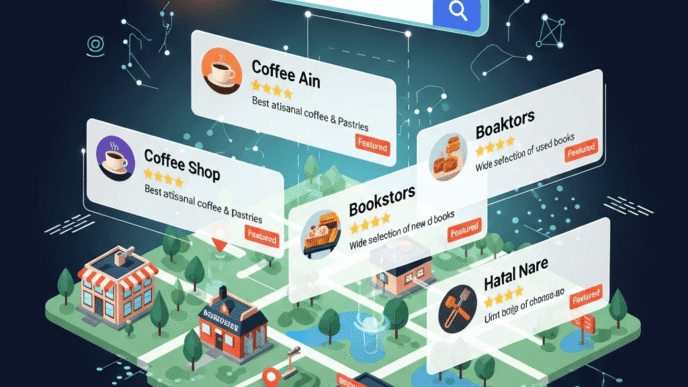
 is AI SEO gold. Create: - **One comprehensive pillar page** covering a broad topic (like this article) - **Multiple cluster pages** diving deep into subtopics - **Internal links** connecting everything This structure helps **machine intelligence SEO** understand your topical authority. Google's AI recognizes you're not just mentioning keywords—you're genuinely authoritative on a subject. **Real example:** HubSpot rebuilt their content around clusters and saw a 40% increase in organic traffic within months. ### 3. Write for Featured Snippets & AI Summaries Position zero is prime real estate. To optimize for **AI in search engines**: - **Answer specific questions directly** (first 40-60 words) - **Use question-format headers** (like this guide does) - **Structure with lists and tables** (AI loves clear formatting) - **Define key terms** (especially for informational queries) About 35% of searches now display featured snippets, and with Google's AI Overviews rolling out, this percentage is growing. ### 4. Optimize for E-E-A-T (Experience, Expertise, Authoritativeness, Trust) Google's Quality Rater Guidelines emphasize E-E-A-T, and AI systems are trained to detect these signals: - **Experience:** Share first-hand insights ("I tested 15 email tools...") - **Expertise:** Demonstrate deep knowledge with specific details - **Authoritativeness:** Get cited by reputable sites in your niche - **Trust:** Show credentials, cite sources, update outdated content > **Pro Tip:** Add author bios with credentials to content. Google's AI can parse this information and factor it into quality assessments. ### 5. Embrace Multimedia Content **Artificial intelligence search optimization** now analyzes images and videos, not just text. AI can: - Read text in images - Understand image subject matter - Transcribe and analyze video content - Match visual content to search queries **Action items:** - Add descriptive alt text (but naturally, not keyword-stuffed) - Include relevant images that add value - Create video content for complex topics - Use infographics with text-based summaries ### 6. Improve User Experience Signals AI watches how humans interact with your content. Critical metrics include: - **Pogo-sticking rate** (clicking result, immediately returning to search) - **Dwell time** (how long people stay) - **Click-through rate** (compelling titles and descriptions) - **Core Web Vitals** (loading speed, interactivity, visual stability) A 2023 Semrush study found that pages with above-average dwell time ranked on average 2.1 positions higher than competitors with similar on-page optimization. ### 7. Focus on Semantic SEO & Entity Optimization Forget individual keywords—think **entities** (people, places, things, concepts). **Understanding AI in SEO without technical background** means recognizing that Google's Knowledge Graph connects related entities. **Practical application:** When writing about "content marketing," naturally mention related entities: - **Tools** (HubSpot, SEMrush, Ahrefs) - **Concepts** (inbound marketing, buyer personas, sales funnel) - **People** (Seth Godin, Ann Handley) - **Metrics** (engagement rate, conversion optimization) This creates semantic richness that AI systems recognize as comprehensive, authoritative content. ## What Tools Can Help Non-Technical Marketers With AI SEO? You don't need to be a data scientist to leverage AI. Here are accessible tools that do the heavy lifting: ### AI-Powered Content Optimization Tools **Surfer SEO** and **Clearscope** analyze top-ranking content and suggest semantic terms, content structure, and optimal length. They reverse-engineer what's working for AI algorithms. **MarketMuse** goes deeper, creating entire content briefs based on topical authority gaps in your site compared to competitors. ### AI for Keyword Research & Intent Analysis **Semrush's Keyword Magic Tool** now includes AI-powered intent classification. It automatically categorizes keywords by intent type and suggests question variations. **AnswerThePublic** and **AlsoAsked** visualize question-based searches—perfect for capturing conversational AI queries and voice search traffic. ### Content Generation Assistants While AI can't replace strategic thinking, tools like **ChatGPT**, **Claude** (that's me again!), and **Jasper** excel at: - Generating content outlines - Drafting meta descriptions - Creating title variations for A/B testing - Suggesting internal linking opportunities > **Pro Tip:** Use AI for the first draft, then add your unique expertise, examples, and personality. This hybrid approach delivers the best results. ### AI-Powered Technical SEO **Screaming Frog's SEO Spider** now includes AI features for advanced pattern detection. **Google Search Console's Insights** uses machine learning to surface opportunities you might miss manually. For [AI and machine learning approaches in SEO](https://seoprojournal.com/ai-machine-learning-for-seo-beginners/), these tools democratize advanced optimization that once required developer expertise. ## What Common Mistakes Should You Avoid With AI SEO? Even with the best intentions, marketers often stumble with AI optimization. Here are the pitfalls to sidestep: ### Mistake #1: Keyword Stuffing 2.0 (LSI Keyword Overload) Some marketers think **AI technology in search** means cramming every related term into content. Wrong. Google's AI detects unnatural language patterns. **Instead:** Write naturally and comprehensively. Related terms appear organically when you thoroughly cover a topic. ### Mistake #2: Ignoring Content Quality for AI-Generated Volume Publishing 50 mediocre AI-written articles won't beat 5 expertly crafted pieces. Google's Helpful Content Update specifically targets this. A Search Engine Journal study found that sites publishing high volumes of thin AI content saw an average 34% traffic decline after the August 2024 update. ### Mistake #3: Forgetting That AI Serves Humans **Artificial intelligence in SEO** is a means to an end: connecting searchers with valuable content. Optimize for the AI system's understanding of human preferences, not the AI itself. Ask yourself: "Would this content satisfy someone with this question?" If yes, you're on track. ### Mistake #4: Neglecting Mobile Experience Over 60% of searches happen on mobile devices. Google's AI prioritizes mobile-first indexing. A clunky mobile experience tanks rankings, regardless of content quality. ### Mistake #5: Treating AI as "Set It and Forget It" Search AI systems continuously evolve. What worked six months ago might be outdated. Stay current with [AI developments in SEO strategies](https://seoprojournal.com/ai-machine-learning-for-seo-beginners/) and test regularly. ## How Will AI in SEO Evolve in the Next Few Years? Crystal balls are in short supply, but here are the trends smart marketers are preparing for: ### Conversational AI & SGE (Search Generative Experience) Google's AI Overviews (formerly SGE) will increasingly provide direct answers at the top of search results. This doesn't mean SEO is dead—it means adapting strategy. **Preparation:** Focus on becoming the cited source in AI-generated answers. Clear, authoritative, well-structured content gets referenced. ### Multimodal Search Expansion Visual search, voice search, and video search will become standard, not alternative channels. **AI in search engines** will seamlessly blend these modalities. **Opportunity:** Create diverse content formats covering the same topics. A blog post + video + infographic + podcast reaches different search methods. ### Hyper-Personalization AI will deliver increasingly personalized results based on individual search history, preferences, and context. This makes broad keyword ranking less meaningful. **Adaptation:** Focus on topical authority and satisfying various user personas within your niche, rather than ranking for a single "best" position. ### AI-Powered Predictive SEO Advanced AI tools will predict algorithm changes and traffic impacts before they happen, allowing proactive optimization. **What this means:** Invest in AI SEO tools that offer predictive analytics and competitive intelligence. ## Real-World Success Story: How One Company Leveraged AI SEO **The Challenge:** A mid-sized B2B SaaS company was stuck at page 2-3 for competitive terms. Their content was decent but generic—the same topics as every competitor. **The AI SEO Transformation:** 1. **Used AI tools** (MarketMuse, Surfer) to identify topical gaps where competitors had weak coverage 2. **Created comprehensive pillar content** around three core topics—[implementing machine learning for search visibility](https://seoprojournal.com/ai-machine-learning-for-seo-beginners/) 3. **Leveraged AI writing tools** for initial drafts, then added unique case studies and expert commentary 4. **Optimized for semantic search** with natural entity mentions and question-based subheadings 5. **Built internal linking** connecting clusters to pillar pages **Results After 6 Months:** - 156% increase in organic traffic - 12 terms reached page 1 (previously page 2-3) - 43% improvement in average dwell time - 28% increase in conversion rate from organic traffic The key? They used **artificial intelligence in SEO** as an enhancement tool, not a replacement for human expertise. ## Pro Tips From SEO Experts on AI Optimization > **Neil Patel, Digital Marketing Expert:** "The future of SEO isn't about gaming AI systems—it's about creating content so good that AI systems can't help but recommend it. Focus on being the best answer, not just a ranked answer." > **Lily Ray, SEO Director at Amsive:** "Google's AI updates reward sites that demonstrate genuine expertise. The question isn't 'how do I trick the AI?' but 'how do I prove I'm the authority AI should trust?'" > **Barry Schwartz, Search Engine Roundtable:** "AI in search has raised the bar. Average content won't cut it anymore. You need to be exceptional, thorough, and genuinely helpful. The good news? AI also gives you tools to get there faster." ## Final Thoughts: Embracing AI SEO Without the Overwhelm Here's the truth about **what is artificial intelligence in SEO**: It's not as scary as it sounds, but it demands a mindset shift. Stop thinking about "beating" algorithms. Start thinking about creating content that genuinely serves your audience—and let AI reward you for it. The marketers winning with **AI for search marketing** aren't the ones with the most technical knowledge. They're the ones who: - **Understand their audience deeply** (better than any AI can) - **Create authentic, valuable content** (with AI assistance, not AI replacement) - **Stay curious and adaptable** (because AI will keep evolving) - **Focus on intent over keywords** (answering real questions, not just ranking) The [intersection of AI and SEO strategy](https://seoprojournal.com/ai-machine-learning-for-seo-beginners/) isn't about choosing between human creativity and machine efficiency—it's about combining both. You don't need to become a data scientist. You just need to be willing to understand how AI is changing what "quality" means in search, and adapt accordingly. Ready to dive deeper into specific AI applications? Check out [advanced machine learning techniques for SEO professionals](https://seoprojournal.com/ai-machine-learning-for-seo-beginners/) or explore [practical AI tools for everyday SEO tasks](https://seoprojournal.com/ai-machine-learning-for-seo-beginners/). --- ## Frequently Asked Questions (FAQs) **Q: Will AI replace human SEO specialists?** No. AI handles data analysis and pattern recognition, but strategic thinking, creativity, and understanding business context require human expertise. The most effective approach combines AI efficiency with human insight. **Q: Do I need coding skills to do AI SEO?** Absolutely not. Modern AI SEO tools have user-friendly interfaces. Understanding concepts matters more than technical implementation. Focus on strategy; tools handle the complexity. **Q: Is AI-generated content penalized by Google?** Not automatically. Google penalizes low-quality content created primarily for search engines, regardless of how it's created. AI-assisted content with genuine value and human expertise is fine. Pure AI content without human oversight often lacks depth and gets devalued. **Q: How often do Google's AI algorithms update?** Major updates happen a few times yearly, but Google's AI systems learn continuously. Small adjustments happen daily. Focus on long-term quality rather than chasing every fluctuation. **Q: Can small businesses compete with AI SEO against big brands?** Yes! AI actually levels the playing field. Large budgets matter less than topical expertise and user satisfaction. Niche authority beats generic coverage every time. **Q: What's the single most important thing for AI SEO success?** **Search intent alignment.** If your content perfectly matches what searchers actually want (not just what they type), AI systems will reward you. Everything else supports this foundation. **Q: Should I rewrite all my old content for AI optimization?** Not all at once. Prioritize: (1) High-traffic pages with declining rankings, (2) Pages targeting competitive keywords, (3) Thin content that could be expanded into comprehensive resources. Update strategically, not desperately. **Q: How do I measure AI SEO success differently from traditional SEO?** Look beyond rankings. Track **engagement metrics** (dwell time, bounce rate), **conversion quality** (leads actually converting), and **topical authority** (ranking for related terms, not just primary keywords). AI rewards holistic performance.](https://seoprojournal.com/wp-content/uploads/2025/11/What-is-Artificial-Intelligence-in-SEO-688x387.png)