
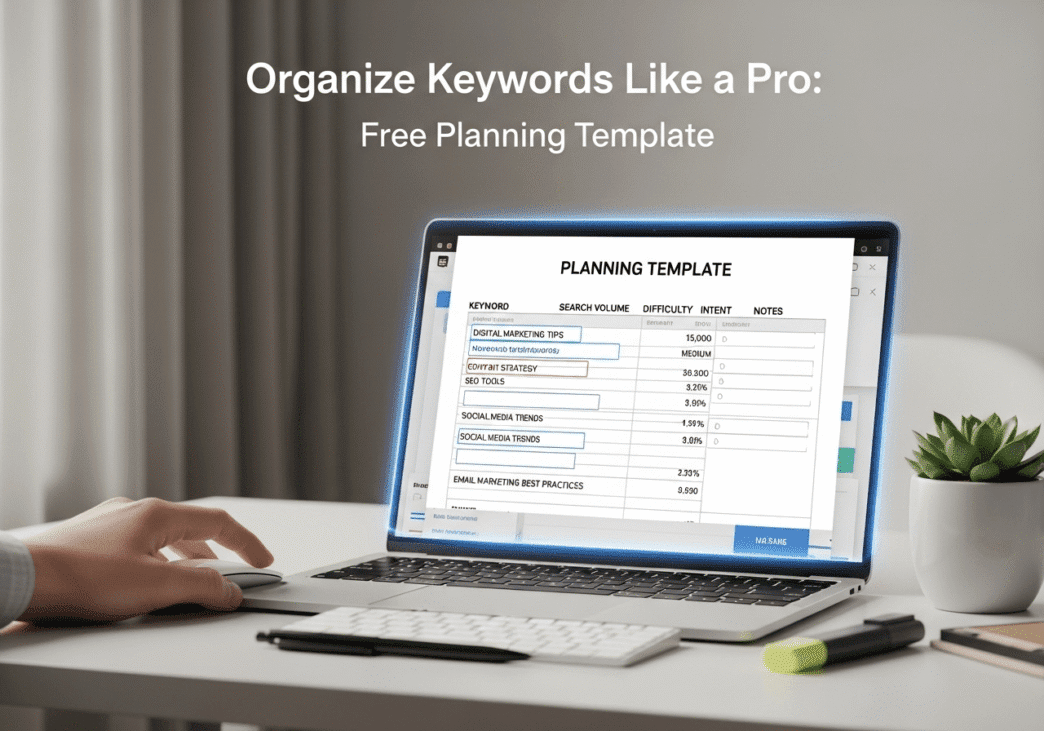
Ever feel like your keyword research is a digital tornado of chaos – spreadsheets everywhere, sticky notes covering your monitor, and a nagging suspicion you’re forgetting something crucial? You’re not alone! While most marketers can find keywords, effective keyword organization separates the SEO pros from the perpetually frustrated. It’s the difference between a strategic content machine and a random blog that hopes for the best.
Here’s the plot twist: the most successful content creators aren’t necessarily the best writers – they’re the best organizers. A solid keyword content planning system turns your research into a content roadmap that actually drives traffic and conversions.
Table of Contents
ToggleWhat Is Keyword Organization? (Your Content GPS System)
Keyword organization is the strategic process of categorizing, prioritizing, and mapping your researched keywords to specific content pieces and publication schedules. Think of it as building a GPS system for your content strategy instead of wandering around SEO-land hoping to stumble upon success.
According to Content Marketing Institute research, 63% of successful content marketers use documented content strategies with organized keyword systems, compared to only 16% of less successful marketers.
Without proper keyword mapping, you’re essentially playing content roulette – sometimes you win, but mostly you’re burning time and resources on keywords that don’t align with your business goals.
Pro Tip: A well-organized keyword system reduces content creation time by 40% because you eliminate decision paralysis and always know exactly what to create next!
“Content without keyword organization is like cooking without a recipe – you might create something edible, but you’ll never consistently produce five-star results.” – Content Strategy Expert
Why Do You Need a Keyword Management System? (The Chaos Prevention Plan)
The Cost of Keyword Chaos:
Time Waste: Recreating research you’ve already done Missed Opportunities: Forgetting high-value keywords Content Overlap: Accidentally targeting the same keywords multiple times Strategy Gaps: Missing crucial topics your audience searches for Resource Drain: Creating content without clear performance goals
Real-World Disaster Example:
A SaaS startup spent 6 months creating 47 blog posts before realizing they had:
- Targeted “project management software” 8 different times
- Completely ignored their most profitable keyword cluster
- Created amazing content for keywords their audience never searched
- Built zero topical authority because content was scattered
The Turnaround: They implemented a keyword strategy organization system and saw 280% traffic growth in the next 6 months with half the content creation effort.
Benefits of Proper SEO Content Planning:
📊 Eliminates Content Duplication – Never target the same keyword twice 📊 Maximizes Topic Authority – Build clusters around core themes
📊 Improves Content ROI – Focus on keywords that actually convert 📊 Accelerates Creation Speed – Always know what to write next 📊 Enables Performance Tracking – Monitor keyword success systematically
For foundational keyword research before organization, start with our comprehensive keyword research guide.
How to Organize Keywords for Content Planning (The Master System)
Phase 1: The Great Keyword Gathering
Before organizing, you need a complete keyword inventory:
Sources to Compile:
- Previous keyword research spreadsheets
- Google Search Console data
- Competitor analysis results
- Customer service frequently asked questions
- Sales team common objections and questions
Data Points to Collect:
- Keyword phrase
- Monthly search volume
- Keyword difficulty score
- Search intent type
- Current ranking position (if any)
- Priority level (high/medium/low)
Phase 2: The Categorization Framework
Primary Categories by Business Function:
| Category | Purpose | Example Keywords |
|---|---|---|
| Brand Awareness | Top-of-funnel education | “What is email marketing”, “Email marketing benefits” |
| Problem Solution | Middle-funnel consideration | “Best email marketing software”, “Email marketing vs social media” |
| Product Features | Bottom-funnel decision | “Mailchimp pricing”, “ConvertKit vs ActiveCampaign” |
| Customer Support | Post-purchase retention | “How to set up email automation”, “Email deliverability issues” |
Phase 3: Intent-Based Organization
The AIDA Keyword Framework:
Awareness Stage Keywords:
- “How to” questions
- “What is” definitions
- Industry education content
- Problem identification
Interest Stage Keywords:
- “Best” comparisons
- “Types of” content
- Solution exploration
- Feature explanations
Desire Stage Keywords:
- “Review” content
- “Vs” comparisons
- Case studies
- Pricing information
Action Stage Keywords:
- “Buy” searches
- “Sign up” queries
- “Free trial” requests
- Product-specific terms
Pro Tip: According to Conductor’s research, organizing keywords by buyer journey stage increases conversion rates by 73% because content perfectly matches user intent at each stage!
Keyword Organization Template and System (Your Free Framework)
The Ultimate Keyword Organization Spreadsheet Structure:
| Column | Purpose | Example |
|---|---|---|
| Keyword | Primary target phrase | “email marketing for small business” |
| Search Volume | Monthly searches | 2,400 |
| Difficulty | Competition level (1-100) | 32 |
| Intent | Search purpose | Commercial |
| Funnel Stage | AIDA position | Interest |
| Topic Cluster | Content grouping | Email Marketing |
| Content Type | Format planned | Blog post |
| Priority | Creation order | High |
| Assigned To | Content creator | Sarah |
| Target Date | Publication goal | March 15 |
| Status | Progress tracking | In progress |
| URL | Published location | /email-marketing-guide |
Color-Coding System for Visual Management:
🔴 High Priority – Business-critical keywords, quick wins 🟡 Medium Priority – Important but not urgent 🟢 Low Priority – Nice-to-have, future consideration 🔵 Seasonal – Time-sensitive opportunities ⚫ Complete – Published and optimized
The Topic Cluster Approach:
Instead of random keyword targeting, organize around content planning template clusters:
Main Pillar: “Complete Guide to Email Marketing” Supporting Clusters:
- Email marketing automation
- Email marketing design
- Email marketing analytics
- Email marketing compliance
- Email marketing integration
Each cluster gets its own tab in your keyword workflow spreadsheet with 10-20 related keywords organized by priority and search intent.
For advanced clustering strategies, check our keyword research and content strategy guide.
Content Planning with Keyword Research Data (Strategic Implementation)
The Monthly Planning Process:
Week 1: Research and Discovery
- Conduct new keyword research
- Update existing keyword database
- Analyze competitor content gaps
- Review performance of existing content
Week 2: Organization and Prioritization
- Categorize new keywords by intent
- Assign priority levels based on business goals
- Update topic cluster assignments
- Plan content calendar integration
Week 3: Content Assignment and Scheduling
- Assign keywords to content creators
- Set realistic publication deadlines
- Plan internal linking opportunities
- Coordinate with marketing calendar events
Week 4: Creation and Optimization
- Begin content creation for prioritized keywords
- Optimize existing content for new opportunities
- Track progress against monthly goals
- Plan next month’s keyword targets
Keyword-to-Content Mapping Strategy:
Blog Posts: Target 1 primary keyword + 2-3 supporting terms Landing Pages: Focus on high-intent commercial keywords Product Pages: Optimize for transactional search terms FAQ Sections: Target question-based long-tail keywords Resource Pages: Capture informational search queries
The Content Gap Analysis Method:
- Audit Current Content – What keywords do you already target?
- Competitor Comparison – What topics do competitors cover that you don’t?
- Customer Question Mining – What do sales/support teams hear repeatedly?
- Seasonal Opportunity Identification – What keywords trend at specific times?
- Priority Gap Ranking – Which missing keywords have highest business impact?
Pro Tip: Use Google Search Console to identify keywords where you rank on page 2-3. These are perfect optimization opportunities that often require minimal effort for maximum ranking gains!
Organizing Keywords for SEO Content Strategy (Advanced Techniques)
The Difficulty-Impact Matrix:
| High Impact + Low Difficulty | High Impact + High Difficulty |
|---|---|
| Quick Wins – Target immediately | Big Projects – Plan for later |
| Low Impact + Low Difficulty | Low Impact + High Difficulty |
| Fill-In Content – Use for consistency | Avoid – Waste of resources |
Seasonal Keyword Organization:
Q1 Keywords: New Year resolution content Q2 Keywords: Spring/summer preparation topics
Q3 Keywords: Back-to-school and preparation content Q4 Keywords: Holiday and year-end planning
Geographic Keyword Segmentation:
For businesses serving multiple locations:
- National Keywords – Broad, high-volume terms
- Regional Keywords – State or multi-city targeting
- Local Keywords – City-specific, “near me” searches
- Neighborhood Keywords – Hyper-local community terms
Device and Platform Organization:
Mobile-First Keywords: “Near me”, voice search queries Desktop Keywords: Research-heavy, comparison content Voice Search: Question-based, conversational phrases Visual Search: Product-focused, image-optimized terms
For location-specific organization strategies, explore our local keyword research guide.
Keyword Mapping and Content Planning Workflow (Step-by-Step System)
Daily Keyword Management Tasks (5 minutes):
✅ Update keyword tracking spreadsheet ✅ Note any ranking changes in Search Console
✅ Add new keyword ideas to research queue ✅ Check content performance metrics
Weekly Keyword Management Tasks (30 minutes):
✅ Review and prioritize new keyword opportunities ✅ Update content calendar with keyword assignments ✅ Analyze competitor keyword movements ✅ Plan internal linking for published content
Monthly Keyword Management Tasks (2 hours):
✅ Comprehensive keyword performance review ✅ Content gap analysis and opportunity identification ✅ Keyword difficulty reassessment for struggling content ✅ Strategy adjustment based on performance data
The Content Brief Template:
For each keyword target, create a standardized brief:
Target Keyword: Primary focus term Supporting Keywords: 2-3 related variations Search Intent: What the searcher wants to accomplish Content Format: Blog post, landing page, guide, etc. Target Length: Word count goal based on competition Internal Link Opportunities: Related content to link to Call-to-Action: Desired user action after reading Success Metrics: How you’ll measure performance
Collaboration Tools for Team Organization:
| Tool | Best For | Price | Keyword Management System Features |
|---|---|---|---|
| Google Sheets | Small teams | Free | Real-time collaboration, comment system |
| Airtable | Visual organization | Free/Paid | Database views, automation |
| Notion | All-in-one workspace | Free/Paid | Wiki-style organization |
| Trello | Kanban workflow | Free/Paid | Card-based content planning |
| Asana | Project management | Free/Paid | Task assignment, deadlines |
Pro Tip: Start with Google Sheets for simplicity, then upgrade to more sophisticated tools as your team and needs grow. The best system is the one your team actually uses consistently!
Real-World Case Study: From Keyword Chaos to Content Success
The Challenge: E-learning Platform Overhaul
Initial Situation:
- 200+ keywords in random spreadsheets
- No clear content strategy
- Duplicate content targeting same keywords
- Zero topical authority in competitive education market
The Organization Implementation:
Month 1: Audit and Cleanup
- Consolidated all keyword research into master spreadsheet
- Eliminated duplicate targets (found 47 overlapping keywords!)
- Categorized by learning stage (beginner, intermediate, advanced)
- Organized by subject matter (programming, design, marketing)
Month 2: Strategic Clustering
- Created 12 topic clusters around core subjects
- Mapped keywords to specific funnel stages
- Assigned priority levels based on business goals
- Developed content calendar template
Month 3: Content Calendar Keywords Implementation
- Launched systematic content creation
- Implemented internal linking strategy
- Set up performance tracking system
- Began measuring keyword success
The Results After 6 Months:
📈 Organic Traffic: 23,000 → 89,000 monthly visitors (+287%) 📈 Keyword Rankings: 45 → 234 first-page keywords
📈 Content Efficiency: 40% reduction in content creation time 📈 Conversion Rate: 2.1% → 4.7% (better-targeted traffic) 📈 Business Impact: $180,000 additional course sales
Key Success Factors:
- Eliminated Waste – No more duplicate keyword targeting
- Strategic Focus – Concentrated on high-business-value terms
- Topic Authority – Built comprehensive coverage in core areas
- Systematic Approach – Consistent, measurable progress
- Team Alignment – Everyone knew exactly what to create
For detailed implementation strategies, reference our comprehensive keyword strategy guide.
Free Keyword Organization Tools and Templates
Essential Free Tools:
Google Sheets Templates:
- Keyword research tracker
- Content calendar planner
- Topic cluster organizer
- Performance monitoring dashboard
Google Search Console:
- Current keyword performance data
- Click-through rate analysis
- Ranking position tracking
- Search query discovery
Google Analytics:
- Content performance metrics
- User behavior analysis
- Conversion tracking by keyword
- Audience insight data
Tool Comparison for Advanced Organization:
| Feature | Google Sheets | Airtable | Notion | Specialized SEO Tools |
|---|---|---|---|---|
| Cost | Free | Free/Paid | Free/Paid | $99+/month |
| Learning Curve | Easy | Medium | Medium | Hard |
| Collaboration | Excellent | Excellent | Good | Limited |
| Automation | Limited | Good | Medium | Excellent |
| Customization | High | Very High | Very High | Medium |
Template Categories to Create:
Research Phase:
- Keyword discovery template
- Competitor analysis tracker
- Search volume compilation sheet
Organization Phase:
- Topic cluster mapping template
- Priority assessment matrix
- Content type assignment sheet
Planning Phase:
- Content calendar template
- Content brief template
- Performance tracking dashboard
Pro Tip: Start with basic Google Sheets templates and gradually add complexity as your needs grow. The perfect system is less important than having a system you actually use consistently!
Your 30-Day Keyword Organization Challenge
Week 1: Foundation Building
- Gather all existing keyword research
- Create master keyword database
- Set up basic organization structure
- Establish priority criteria
Week 2: Categorization and Clustering
- Group keywords by search intent
- Create topic clusters
- Assign priority levels
- Identify quick-win opportunities
Week 3: Content Mapping and Planning
- Map keywords to content types
- Create content brief templates
- Set up performance tracking
- Plan internal linking strategy
Week 4: Implementation and Optimization
- Begin creating organized content
- Track initial performance metrics
- Refine organization system
- Plan month 2 expansion
Success Metrics to Track:
📊 Organization Efficiency – Time saved in content planning 📊 Content Quality – Improved keyword targeting accuracy 📊 Team Productivity – Faster content creation cycles 📊 SEO Performance – Better keyword ranking progress 📊 Business Impact – Increased traffic and conversions
“A organized keyword system isn’t just about SEO efficiency – it’s about transforming your content from random acts of blogging into a strategic business asset that consistently drives growth.” – Content Marketing Director
Final Thoughts: Your Organized Content Empire Awaits
Keyword organization isn’t just about pretty spreadsheets and color-coded systems – it’s about transforming your content strategy from chaotic hope to systematic success. When you organize your keywords strategically, you’re not just planning content; you’re building a traffic-generating machine that works while you sleep.
The most successful content creators understand that organization isn’t about perfection – it’s about progress. Your keyword management system doesn’t need to be flawless from day one. It needs to be functional, consistent, and gradually improving.
Remember: every minute spent organizing your keywords saves five minutes in content creation confusion. Every keyword properly categorized is a step toward topical authority. Every cluster organized is a foundation for sustainable organic growth.
Your competition is still playing keyword roulette, hoping their random content efforts eventually pay off. You’re building a systematic approach that compounds success over time. That’s not just an advantage – it’s a superpower.
Start with the basic framework today. Refine it next week. Perfect it next month. But start it today, because organized keyword systems create compounding returns that transform mediocre content strategies into traffic-generating empires.
Your future self will thank you for bringing order to the keyword chaos. Your analytics will reflect the difference. Your business will feel the impact.
Ready to transform your keyword chaos into strategic clarity? Your organized content empire begins with the first keyword you categorize today.
For complete implementation support, don’t miss our master keyword research strategy guide that turns research into results.
Frequently Asked Questions
Q: How many keywords should I organize at once when starting? A: Start with 50-100 keywords maximum for your first organization system. This is enough to establish patterns and processes without becoming overwhelming. You can always expand once the system is working smoothly.
Q: Should I organize keywords by search volume or business value? A: Prioritize by business value first, then consider search volume. A 500-search keyword that drives qualified leads is more valuable than a 5,000-search keyword that brings unqualified traffic.
Q: How often should I reorganize my keyword system? A: Review and update monthly, with major reorganization quarterly. Your business priorities and market conditions change, so your keyword organization should evolve accordingly.
Q: Can I use the same keyword in multiple topic clusters? A: Generally avoid this to prevent content cannibalization. If a keyword genuinely fits multiple clusters, choose the most relevant primary cluster and reference it secondarily in others.
Q: What’s the biggest mistake in keyword organization? A: Over-complicating the system. The best keyword organization is simple enough for your team to use consistently. Complex systems often get abandoned, while simple systems get refined over time.
Q: How do I organize keywords for multiple websites or clients? A: Create separate tabs or sheets for each domain, but maintain consistent organization principles across all properties. Use naming conventions that clearly identify which keywords belong to which site.
🎯 Keyword Organization Workflow
- Google Keyword Planner
- Competitor analysis
- Customer questions
- Google Autocomplete
- Search volume analysis
- Keyword difficulty scores
- Search intent classification
- Competition assessment
- Spreadsheet setup
- Data standardization
- Duplicate removal
- Initial categorization
- Informational keywords
- Commercial keywords
- Transactional keywords
- Navigational keywords
- Pillar topic identification
- Supporting subtopics
- Content cluster mapping
- Internal linking planning
- Business impact scoring
- Difficulty vs opportunity
- Quick wins identification
- Long-term goal setting
- Blog post assignments
- Landing page targeting
- Product page optimization
- FAQ content planning
- Monthly content planning
- Seasonal opportunities
- Resource allocation
- Deadline setting
- Target keyword specification
- Content format guidelines
- Internal linking strategy
- Success metrics definition
- SEO-optimized writing
- Keyword integration
- Internal linking implementation
- Meta tag optimization
- Content publishing
- Google Search Console submission
- Sitemap updates
- Social media promotion
- Ranking position tracking
- Traffic analysis
- Conversion monitoring
- Continuous optimization