Report Date: November 1, 2025
Market Analysis Period: Q1 2025 – Q4 2025
Prepared For: Executive Leadership, Investors, Strategic Planning Teams
Table of Contents
ToggleExecutive Summary
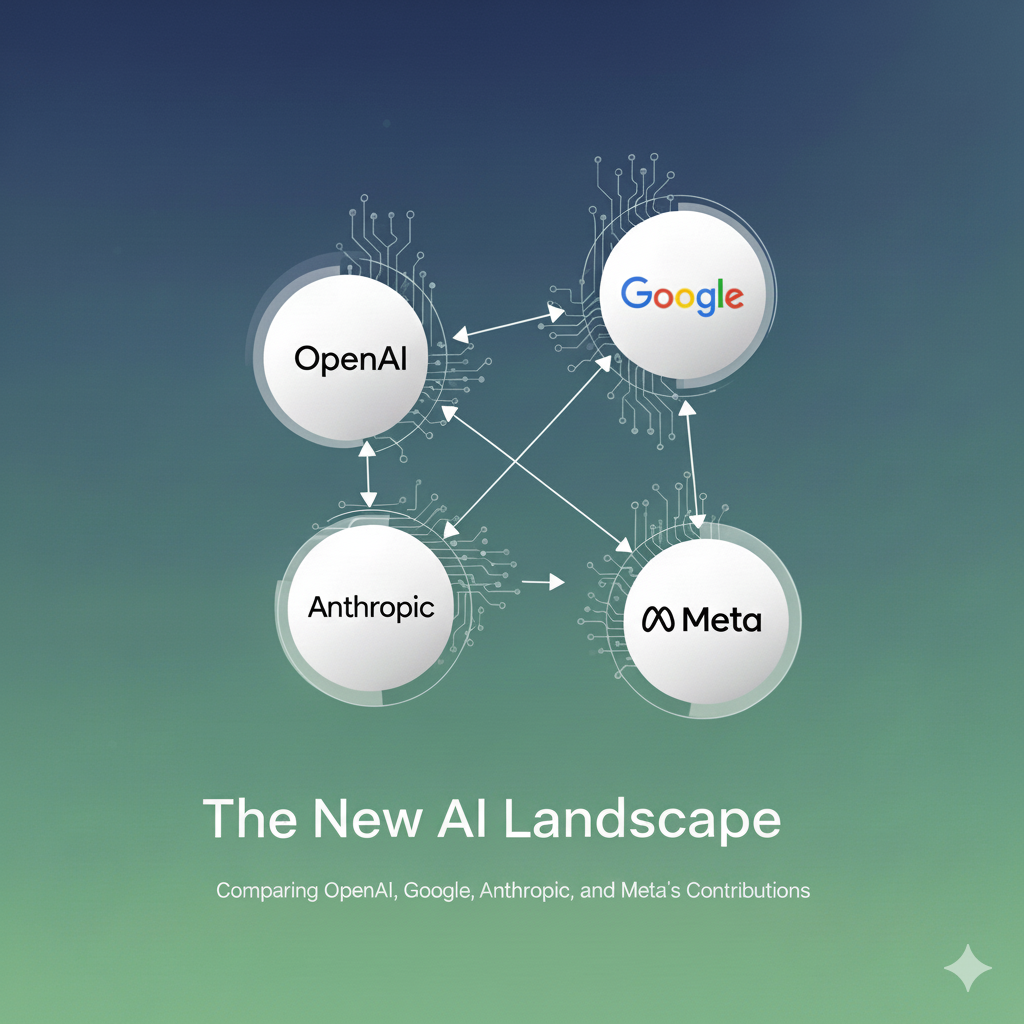
The AI market has reached an unprecedented inflection point in 2025, with four dominant players—OpenAI, Google (via DeepMind/Gemini), Anthropic, and Meta—collectively driving over $380 billion in infrastructure investment and commanding distinct strategic positions in the rapidly evolving landscape. This market intelligence report analyzes revenue trajectories, enterprise adoption patterns, competitive dynamics, and investment strategies shaping the future of artificial intelligence.
Market Snapshot Q4 2025
$12 billion ARR – OpenAI’s annualized recurring revenue (July 2025)
$5 billion ARR – Anthropic’s annualized recurring revenue (October 2025)
$324 billion – OpenAI’s private market valuation (Forge Global)
$178 billion – Anthropic’s valuation (Q4 2025 funding)
$380 billion+ – Combined 2025 AI infrastructure spending by major tech companies
Key Market Findings
OpenAI maintains consumer dominance with 800M weekly users but faces enterprise market share erosion from 50% to 34%
Anthropic emerges as enterprise leader capturing 32% enterprise market share, doubling from 12% in 12 months
Google (Alphabet) leads in infrastructure investment with $75-93B capex in 2025, up 2.3x from 2023
Meta pivots to open-source strategy investing $66-72B in AI infrastructure while releasing free Llama models
Enterprise AI spending surges from $3.5B (late 2024) to $8.4B (mid-2025), representing 140% growth
Timeline of Market-Defining Events
Q1 2025: Foundation Setting
January 2025
- OpenAI maintains 74% consumer chatbot market share but sees enterprise erosion begin
- Anthropic begins rapid enterprise penetration in regulated industries
February 2025
- Anthropic launches Claude 3.7 Sonnet with hybrid reasoning
- Meta announces plans for $66-72B AI infrastructure investment
- Enterprise LLM market shows OpenAI at 50%, Anthropic at 12%, Google at 18%
March 2025
- OpenAI closes $40B funding round at $300B valuation (largest private tech deal on record)
- Google releases Gemini 2.5 Pro Experimental, debuting #1 on LMArena
- Anthropic secures $3.5B funding at $61.5B valuation
Q2 2025: Competitive Intensification
April 2025
- Meta releases Llama 4 models, achieving 40% performance parity with GPT-4o
- OpenAI introduces GPT-4.1 family with 1M token context
- Anthropic revenue quadruples to $4B ARR (from $1B in December 2024)
May 2025
- Anthropic launches Claude 4 family, capturing coding market leadership
- Google unveils major Gemini 2.5 updates at I/O conference
- Enterprise market share shifts: Anthropic reaches 24%, OpenAI drops to 34%
June 2025
- Anthropic hits $4B ARR milestone, representing 40% of OpenAI’s scale
- Google releases stable Gemini 2.5 Pro and Flash
- Meta acquires Scale AI for \\\$14.3B to strengthen data annotation capabilities
Q3 2025: Market Leadership Transitions
July 2025
- OpenAI reaches $12B ARR with $1B monthly revenue (first time)
- Google raises capex forecast to $91-93B for 2025
- Anthropic secures $2.5B revolving credit facility from major banks
- Meta announces $66-72B infrastructure spend, up $30B YoY
August 2025
- OpenAI launches GPT-5, achieves 100% revenue growth in 7 months ($500M to $1B monthly)
- Anthropic releases Claude Opus 4.1, advancing to 74.5% SWE-bench
- OpenAI sells $6B secondary stock at ~$500B valuation
- Meta’s AI infrastructure revenue indirect impact shows in ad performance
September 2025
- Anthropic becomes #1 in enterprise market with 32% share (OpenAI 20%, Google 20%)
- Claude Sonnet 4.5 launches, cementing coding leadership position
- Forge Global values AI startup basket at $1.3T (quadrupled since late 2022)
- OpenAI weekly active users reach 700M (up from 500M in March)
Q4 2025: Scaling and Consolidation
October 2025
- Anthropic hits $5B ARR (October), 250% growth from June
- Anthropic releases Claude Haiku 4.5 at industry-leading $1/$5 pricing
- OpenAI launches ChatGPT Atlas browser with Agent Mode
- Meta confirms 2026 capex will be “notably larger” than $72B in 2025
- Google introduces Gemini 2.5 Computer Use model
- Tech giants collectively announce $380B+ 2025 AI spending
November 2025
- Microsoft announces fiscal 2026 capex acceleration (spent $34.9B in Q1)
- Amazon confirms $125B capex for 2025 (up from $118B forecast)
- Market consolidation evident: 92% of Fortune 500 using consumer AI, only 5% using enterprise-grade solutions
Company-by-Company Market Analysis
1. OpenAI – The Consumer Giant with Enterprise Challenges
Revenue & Financial Performance
2025 Revenue Trajectory:
| Period | Monthly Revenue | ARR | YoY Growth |
|---|---|---|---|
| Jan 2025 | $500M | $6.0B | 225% |
| July 2025 | $1.0B | $12.0B | 243% |
| Oct 2025 (est.) | $1.1B | $13.2B | ~250% |
Revenue Composition (Projected 2025):
- Consumer Subscriptions: $5.5B (42%)
- API Revenue: $2.9B (22%)
- Business/Partnerships: $3.6B (28%)
- Other: $1.0B (8%)
- Total: $13.0B (estimated)
800 million – Weekly active users (July 2025)
3 million – Paying business users (up from 2M in February)
2.2 billion – Daily API calls in 2025 (up from 1.3B in 2024)
2.1 million – Developers on OpenAI platform
Market Position
Consumer Market:
- 74-82.7% market share (depending on measurement methodology)
- Dominant brand recognition: “ChatGPT” synonymous with AI
- First-mover advantage with viral adoption curve
- 89% retention for ChatGPT Plus after one quarter
- 74% retention beyond nine months
Enterprise Market:
- 34% share (down from 50% in early 2024)
- Lost ground to Anthropic in regulated industries
- Strong in general business applications
- Premium pricing: $60/seat/month for Enterprise tier
Traffic & Engagement:
- 1.2 billion monthly visits to OpenAI.com
- 5 billion monthly visits to ChatGPT.com
- 5th most-visited site globally (July 2025)
- 122.6 million daily active users
Valuation & Funding
Valuation History:
| Date | Valuation | Event |
|---|---|---|
| March 2025 | $300B | $40B funding round (largest private tech deal) |
| August 2025 | $500B | Secondary stock sale (~$6B) |
| October 2025 | $324B | Forge Global private market assessment |
Funding Details:
- $40B March 2025 round: Only $10B wired, $20B contingent on for-profit conversion
- $8.3B additional raise in 2025
- $4B revolving credit facility from major banks
- $13B investment from Microsoft (cumulative)
Strategic Positioning
Strengths:
- Unmatched brand recognition – ChatGPT is the category-defining product
- Massive user base – 700M+ weekly actives provide network effects
- Developer ecosystem – 2.1M+ developers building on platform
- Multimodal capabilities – Text, image, code, audio integration
- Strategic Microsoft partnership – Distribution through Azure, Office, Bing
Challenges:
- Enterprise market erosion – Lost 16 percentage points to Anthropic
- Profitability concerns – $5B+ losses in 2024 despite $3.7B revenue
- Valuation sustainability – Sam Altman calls current valuations “insane”
- Operational costs – ChatGPT unlimited usage model creates margin pressure
- Organizational turmoil – Staff burnout, legal disputes, leadership transitions
Competitive Moats:
- Consumer brand equity and first-mover advantage
- Microsoft partnership providing enterprise distribution
- Extensive third-party integrations and plugin ecosystem
- Scale advantages in data and compute
- Strong developer community and API adoption
Business Model Evolution
Current Revenue Streams:
Consumer Subscriptions ($20-60/month tiers)
- ChatGPT Plus: $20/month (~5% conversion from free users)
- ChatGPT Pro: Higher-tier pricing (exploring $2,000+/month for PhD-level agents)
- ~$5.5B projected for 2025
Enterprise Solutions ($60/seat/month)
- 3M paying business users
- Custom deployment options
- Enhanced security and admin controls
API Business (~50% gross margins per estimates)
- $2.9B projected for 2025
- Pricing: $2-8/M tokens (GPT-4.1)
- High-margin developer monetization
Strategic Partnerships
- Microsoft Azure AI integration
- Apple Intelligence partnership
- Third-party distribution deals
Price Increase Strategy:
- Currently $20/month for Plus tier
- Exploring increase to $22/month (2025)
- Potential $44/month by 2027
- $2,000-20,000/month for specialized agents
Market Outlook & Risks
Growth Drivers:
- Increasing enterprise adoption of agents
- API revenue expansion with developer ecosystem
- Price increases as model capabilities improve
- New product launches (ChatGPT Atlas browser)
- Reasoning model adoption (o-series)
Risk Factors:
- Competitive pressure: Anthropic taking enterprise share, Google pricing pressure
- Cost structure: Inference costs may not decline fast enough
- Regulatory scrutiny: Antitrust concerns, AI safety regulations
- Execution risk: Converting valuation to sustainable business
- Margin compression: Unlimited usage model vs. reasoning model costs
2. Anthropic – The Enterprise Disruptor
Revenue & Financial Performance
Rapid Growth Trajectory:
| Period | Revenue | ARR | Growth Rate |
|---|---|---|---|
| 2022 | $10M | – | – |
| 2023 | ~$100M | – | 900% |
| Dec 2024 | – | $1.0B | 1000% |
| April 2025 | – | $4.0B | 300% (4 months) |
| June 2025 | – | $4.0B | – |
| Oct 2025 | – | $5.0B | 400% YoY |
| 2025 (proj.) | $2.2B actual | – | 220% |
$5 billion ARR – Annualized recurring revenue (October 2025)
40% – Scale relative to OpenAI (despite 5% of consumer user base)
220x growth – Revenue expansion from 2022 to 2025
$115M/month – Monthly revenue run rate (mid-2025)
Revenue Composition (2025 Projected):
- API Revenue: $3.1B (65%) – Highest API monetization in industry
- Business/Enterprise: $0.9B (19%)
- Consumer Subscriptions: $0.7B (14%)
- Claude Code: $0.4B (8%)
- Total: $4.8B (estimated actual 2025)
Key Differentiators:
- API-first strategy: 65% vs. OpenAI’s 22%
- ~$1.4B from Cursor and GitHub Copilot integrations alone
- 5.5x Claude Code revenue increase since Claude 4 launch
- Higher enterprise ARPU despite smaller user base
Market Position
Enterprise Market Leadership:
| Company | Q1 2024 | Q4 2024 | Q3 2025 | Change |
|---|---|---|---|---|
| OpenAI | 50% | 42% | 34% | -16pts |
| Anthropic | 12% | 18% | 32% | +20pts |
| 18% | 20% | 20% | +2pts | |
| Meta Llama | 9% | 9% | 9% | – |
32% – Enterprise market share (Q3 2025) – MARKET LEADER
42% – Coding market share (more than double OpenAI’s 21%)
46% – Organizations cite security/safety as primary reason for switching to Anthropic
Consumer Market:
- 18.9M monthly active users (vs. ChatGPT’s 800M weekly)
- 2.9M mobile app users
- 3.91% generative AI market share overall
- 8.03% AI chatbot market share
- 769.6M app downloads
Traffic & Adoption:
- ChatGPT traffic 50x Claude’s in April 2025
- Yet Anthropic generates 40% of OpenAI’s revenue
- Demonstrates enterprise > consumer monetization
Valuation & Funding
Valuation Progression:
| Date | Valuation | Round | Amount |
|---|---|---|---|
| 2023 | $5B | Series C | – |
| 2024 | $18.4B | Series D | – |
| March 2025 | $61.5B | Series E | $3.5B |
| Q4 2025 | $170-178B | Funding pursuit | $5B (reported) |
Total Funding: $14.3B raised to date
Financial Backing:
- $2.5B revolving credit facility (Morgan Stanley, Goldman Sachs, JPMorgan)
- Viewed as creditworthy by traditional finance institutions
- $8B from Amazon Web Services
- Google Cloud partnership and strategic investment
Strategic Positioning
Core Strengths:
- Enterprise trust & safety focus – Constitutional AI methodology
- Regulated industry penetration – Healthcare, finance, government
- Developer-first approach – API excellence and integration
- Technical differentiation – Leading coding and agent capabilities
- Strategic cloud partnerships – Amazon, Google distribution
Competitive Advantages:
- Safety-first positioning contrasts with OpenAI’s “secretive approach”
- Transparent development and clear model limitation communication
- Enterprise reliability built for business-critical applications
- Alignment leadership – Most aligned models (Haiku 4.5)
- Academic credibility – Higher Education Advisory Board, research focus
Market Positioning:
- “The Safe Choice” for enterprises in regulated industries
- Quality over quantity – Smaller user base, higher ARPU
- B2B-focused with stickier, more predictable revenue
- Premium pricing justified by performance and safety
Business Model Excellence
API-First Strategy Success:
- 65% of revenue from API vs. 22% for OpenAI
- ~$1.4B from two integrations (Cursor, GitHub Copilot)
- Enterprise integration as primary distribution
- Cloud partnerships drive adoption (AWS, Google Cloud)
Subscription Model:
- Claude Pro: $20/month (industry standard)
- ~$620M H1 2025 from subscriptions
- Lower conversion rate but higher-value customers
- Free tier drives enterprise evaluation
Enterprise & Government:
- $60/seat/month enterprise pricing (competitive with OpenAI)
- Government contracts: $200M Pentagon contracts (summer 2025)
- Academic programs: Higher Education Advisory Board
- Regulated sector focus: Healthcare, finance, legal
Growth Trajectory Analysis
Historic Growth Rates:
- 2022-2023: 900% growth ($10M to ~$100M)
- 2023-2024: 1000% growth (~$100M to $1B ARR)
- 2024-2025 (proj): 400% growth ($1B to $5B ARR)
Market Share Momentum:
- Enterprise share doubled in 12 months (12% to 32%)
- Coding market leadership established (42% share)
- Enterprise-first strategy validation
Expert Analysis:
“We’ve looked at the IPOs of over 200 public software companies, and this growth rate has never happened.” – Alex Clayton, Meritech Capital
Narrowing Gap with OpenAI:
- Started 2024 at 15x difference in scale
- Ended year at 5x difference
- Currently at ~2.5x difference (ARR basis)
- Compression suggests continued convergence
Market Outlook & Strategy
Growth Catalysts:
- Enterprise adoption surge – Only 5% penetration, massive opportunity
- Coding dominance – AI’s first killer app, 42% share
- Agent-first positioning – Leading the “year of agents”
- Cloud partnerships – AWS, Google distribution leverage
- Safety reputation – Increasing importance in regulated contexts
Strategic Focus:
- Not trying to “catch” OpenAI – Different market positioning
- Enterprise quality > consumer quantity
- API integration > direct user acquisition
- Safety & reliability > speed to market
- B2B partnerships > B2C marketing
Competitive Positioning:
“Anthropic doesn’t need to ‘catch’ OpenAI to succeed. The company has built a $5B ARR business while operating largely in the shadows of consumer consciousness.”
Risk Assessment
Challenges:
- Consumer brand awareness gap – 5% of OpenAI’s user base
- Cash burn rate – $6.5B burned in 2024 vs. $1B revenue
- Valuation sustainability – $170B+ seeking may be aggressive
- Competitive pressure – OpenAI, Google pricing and capability advances
- Talent war – Competition from established tech giants
Mitigating Factors:
- Strong institutional backing and creditworthiness
- Proven enterprise monetization model
- Technical leadership in key categories
- Strategic partnerships with cloud giants
- First-mover advantage in enterprise safety positioning
3. Google (Alphabet) – The Infrastructure Titan
Financial & Investment Position
2025 Capital Expenditure:
| Company | 2023 Capex | 2025 Capex | Growth |
|---|---|---|---|
| $32.3B | $75-93B | 2.3-2.9x | |
| Microsoft | $41.2B | $80B | 1.9x |
| Meta | $37B | $66-72B | 1.8-1.9x |
| Amazon | $48.2B | $125B | 2.6x |
$91-93 billion – Updated 2025 capex forecast (raised from $75-85B)
$102.3 billion – Q3 2025 revenue (first $100B+ quarter)
34% – Google Cloud revenue growth (to \$15.15B in Q3)
AI Infrastructure Investment Strategy:
- Data center construction and expansion
- Custom AI chip development (TPUs)
- Global compute capacity buildout
- Power infrastructure for AI workloads
- 1 million+ TPU reservation by Anthropic ($10B+ deal value)
Market Position & Revenue
Cloud Market Standing:
- Google Cloud: #3 position behind AWS and Azure
- 34% revenue growth in Q3 2025
- $15.15B quarterly revenue (Cloud segment)
- Growing faster than AWS (20%) but slower than Azure (40%)
AI Products & Services:
- Gemini AI across Google Workspace
- Vertex AI for enterprise developers
- Google AI Studio for model access
- DeepMind research driving innovation
Consumer AI Integration:
- Gemini in Google Search (billions of queries)
- Workspace AI features (Gmail, Docs, Sheets)
- Android AI capabilities
- YouTube AI recommendations and creation tools
Strategic Market Positioning
Core Advantages:
- Scale & Infrastructure – Unmatched global compute footprint
- Distribution channels – Search, Android, Chrome, Workspace
- Enterprise relationships – Existing cloud customer base
- Research leadership – DeepMind’s technical breakthroughs
- Data advantages – Massive proprietary datasets
Market Share:
- 20% enterprise LLM market (tied with OpenAI)
- Strong growth momentum from lower base
- Competitive pricing – Gemini at $1.25/$10/M tokens
- Technical leadership – Largest context windows, multimodal excellence
Business Model:
- Cloud services – Primary monetization vehicle
- Advertising enhancement – AI-improved targeting and delivery
- Enterprise AI – Vertex AI platform revenue
- Consumer subscription – Gemini Advanced tier
Competitive Strategy
Differentiation:
- Context window leadership – 1M-2M tokens industry-leading
- Multimodal excellence – Native video, audio, text, image
- Cost efficiency – Most affordable frontier model pricing
- Enterprise integration – Workspace, Cloud Platform
- Research depth – DeepMind academic contributions
Partnership Approach:
- Anthropic strategic partnership – $8B investment, cloud hosting
- Enterprise cloud customers – Distribution advantage
- Android ecosystem – Mobile AI distribution
- Open-source support – Backing multiple AI frameworks
Investment Thesis & Returns
Capital Allocation:
- Predictable earnings compared to Meta (per analysts)
- Clear ROI path through cloud and advertising
- Diversified revenue – Not dependent on AI alone
- Investor confidence – Stock up despite capex increase
Market Reaction:
- Initial 10% stock decline on capex announcement
- Recovered as investors assess long-term potential
- $3.8 trillion market cap (Microsoft)
- Viewed as necessary investment for competitive position
Growth Outlook
Opportunities:
- Enterprise cloud expansion – Faster growth than AWS
- AI agent market – Gemini Computer Use model
- Workspace AI monetization – Premium tier adoption
- Search enhancement – Maintaining dominant position
- Developer ecosystem – Vertex AI platform growth
Challenges:
- Cloud market share – #3 position requires investment
- OpenAI competition – Enterprise AI services overlap
- Margin pressure – Heavy infrastructure investment
- Regulatory risk – Antitrust scrutiny on multiple fronts
- Monetization uncertainty – AI ROI timeline unclear
4. Meta – The Open-Source Strategist
Financial Performance & Investment
2025 AI Infrastructure Investment:
$66-72 billion – 2025 capex (up $30B YoY at midpoint)
$47.5 billion – Q2 2025 revenue
10% – Stock surge after Q2 earnings (investor confidence)
Investment Breakdown:
- Data centers – Global capacity expansion
- GPUs – Primarily Nvidia H100s (100,000+ cluster)
- Power infrastructure – Supporting AI workloads
- Open Compute Project – Efficiency optimization
- Research & development – Llama model training
2026 Outlook:
- “Notably larger” capex than 2025’s $72B
- Expense growth rate above 2025 levels
- Continued GPU acquisition (primarily Nvidia)
- Training Llama 4 on 100,000+ H100 cluster
Market Position & Strategy
Open-Source Leadership:
- 1 billion+ Llama downloads (as of March 2025)
- 9% enterprise market share (stable)
- Free access model – No direct LLM monetization
- Developer ecosystem – Broad open-source adoption
Strategic Differentiation:
- Contrast to closed models – Full open-source approach
- Democratization narrative – AI access for everyone
- Cost disruption – Forcing competitors to lower prices
- Innovation acceleration – Community-driven development
Meta AI Integration:
- Available across – WhatsApp, Messenger, Instagram, Meta.ai
- 40 countries worldwide deployment
- Powered by Llama 4 models
- Standalone app expected Q2 2026
Business Model & Monetization
Indirect AI Monetization:
Advertising enhancement – AI-improved targeting
- Better ad performance = higher CPMs
- Increased advertiser ROI
- Enhanced content recommendations
User engagement – AI-driven feeds and features
- Increased time on platform
- Improved retention metrics
- Better content discovery
Efficiency gains – AI for internal operations
- Reduced operational costs
- Automated content moderation
- Optimized infrastructure
Reality Labs:
- $4.4-4.5B quarterly operating loss
- $470M quarterly revenue
- Ray-Ban Meta glasses success
- Long-term metaverse investment
- AR/VR integration with AI
Competitive Positioning
Strategic Advantages:
- Scale of deployment – Billions of users across apps
- Zero AI revenue pressure – Not dependent on LLM sales
- Infrastructure control – Own data centers and compute
- User data advantage – Massive training datasets
- Distribution power – Multiple high-engagement platforms
Market Positioning:
- “AI for Everyone” – Open-source champion
- Long-term play – Not focused on immediate AI ROI
- Platform enhancement – AI as feature, not product
- Ecosystem builder – Enabling others to innovate
Competitive Impact:
- Pricing pressure on commercial models
- Talent recruitment – Hiring from OpenAI, competitors
- Technical benchmarking – Open models approaching closed
- Democratization pressure – Forcing industry transparency
Investment Strategy & Rationale
Zuckerberg’s Vision:
“We’re making all these investments because we have conviction that superintelligence is going to improve every aspect of what we do.”
Strategic Imperatives:
- Not underinvesting – Avoiding competitive disadvantage
- Infrastructure advantage – Proprietary compute as moat
- AI-first transformation – Every product enhanced by AI
- Open ecosystem – Community innovation multiplier
Capital Efficiency:
- Open Compute Project – 20% infrastructure cost reduction
- Open-source benefits – Community optimization
- Efficiency through AI – Self-improving operations
- ROI confidence – Historical ad targeting success
Market Analysis & Outlook
Investor Concerns:
- No direct AI revenue – Unlike cloud competitors
- “Unknown revenue opportunity” in superintelligence
- Reality Labs losses – Ongoing $4B+/quarter burn
- Oppenheimer downgrade – “Aggressive growth offset by high spending”
Investor Confidence Factors:
- Ad business strength – AI-driven efficiency showing results
- 12% stock surge post-Q2 earnings
- Long-term track record – Previous successful pivots
- Scale advantages – Unique position among competitors
Growth Outlook:
- Ad monetization – AI improving targeting and delivery
- User engagement – AI features driving time spent
- New experiences – Vibes (AI-generated video app)
- Meta AI adoption – Potential future monetization
Strategic Risks:
- No clear AI ROI – Investment without direct return
- Competitive positioning – Open-source vs. commercial models
- Regulatory pressure – AI governance, content moderation
- Talent retention – Competition from OpenAI, others
- Market valuation – Justifying massive spending
Market Impact Assessment
Industry Influence:
- Benchmark pressure – Open models force transparency
- Cost disruption – Free models pressure pricing
- Innovation acceleration – Community contributions
- Talent market – Competitive hiring dynamics
Strategic Value:
- Platform protection – Ensuring AI doesn’t disintermediate Meta
- Future optionality – Positioning for AI-first world
- Ecosystem control – Influence over open-source direction
- Competitive moat – Infrastructure and scale advantages
Cross-Company Market Comparison
Revenue & Scale Comparison (2025)
| Company | Revenue/ARR | User Base | Market Position |
|---|---|---|---|
| OpenAI | $12-13B ARR | 800M weekly (consumer) | Consumer leader, enterprise challenged |
| Anthropic | $5B ARR | 18.9M monthly (consumer) | Enterprise leader, niche consumer |
| $102B+ (total)* | Billions (integrated) | Infrastructure leader, cloud #3 | |
| Meta | $190B+ (total)** | 3.9B (Facebook/apps) | Open-source leader, indirect AI monetization |
*Google Cloud ~$60B annual
**Meta total revenue, AI contribution indirect
Enterprise Market Share Evolution
Enterprise LLM Market Share Trajectory:
| Period | OpenAI | Anthropic | Meta Llama | |
|---|---|---|---|---|
| Q1 2024 | 50% | 12% | 18% | 9% |
| Q2 2024 | 45% | 16% | 19% | 9% |
| Q3 2024 | 42% | 20% | 19% | 9% |
| Q4 2024 | 38% | 24% | 19% | 9% |
| Q1 2025 | 36% | 28% | 20% | 9% |
| Q2 2025 | 34% | 30% | 20% | 9% |
| Q3 2025 | 34% | 32% | 20% | 9% |
Anthropic gained 20 percentage points while OpenAI lost 16 points in 18 months
Coding Market Share (Critical Segment)
| Provider | Market Share | Positioning |
|---|---|---|
| Anthropic (Claude) | 42% | Market leader |
| OpenAI | 21% | Strong but #2 |
| Others | 37% | Fragmented |
Significance: Code generation is AI’s first killer app, making this the most monetizable segment
Capital Expenditure Battle (2025)
| Company | 2025 Capex | Primary Focus |
|---|---|---|
| Amazon | $125B | AWS infrastructure, Trainium chips |
| $91-93B | Data centers, TPUs, global compute | |
| Microsoft | $80B | Azure infrastructure, OpenAI partnership |
| Meta | $66-72B | GPUs, data centers (no cloud revenue) |
$380+ billion – Combined 2025 AI infrastructure investment
Investment Density:
- Amazon: $125B (has cloud revenue to support)
- Google: $91-93B (has cloud revenue to support)
- Microsoft: $80B (has cloud revenue to support)
- Meta: $66-72B (NO direct cloud/AI revenue)
Valuation Comparison
| Company | Valuation | Type | Revenue Multiple |
|---|---|---|---|
| OpenAI | $324-500B | Private | 25-38x ARR |
| Anthropic | $178B | Private | 35x ARR |
| Google (Alphabet) | $2.5T | Public | 6x revenue |
| Meta | $1.5T | Public | 7.9x revenue |
Private Market Premium: AI-focused private companies trade at 4-6x revenue multiples of public tech giants
Profitability & Burn Rates
| Company | 2024 Revenue | 2024 Losses | Burn Rate |
|---|---|---|---|
| OpenAI | $3.7B | ~$5B | 135% of revenue |
| Anthropic | $1B | ~$6.5B | 650% of revenue |
| Profitable | – | – | |
| Meta | Profitable | $4.5B (Reality Labs only) | – |
Sustainability Analysis:
- OpenAI: Path to profitability requires price increases and cost reductions
- Anthropic: Extremely high burn rate despite revenue growth
- Google: Profitable but investing for position
- Meta: Profitable overall, massive AI investment without direct return
Market Dynamics & Competitive Analysis
The Enterprise Battleground
Why Enterprise Matters:
- Higher ARPU – $60/seat/month vs. $20 consumer
- Stickier revenue – Multi-year contracts, integration lock-in
- Predictability – B2B contracts vs. consumer subscription churn
- Margins – API-first models show ~50% gross margins
- Validation – Enterprise adoption drives consumer credibility
Enterprise Adoption Drivers:
| Factor | Importance | Leader |
|---|---|---|
| Security/Safety | 46% | Anthropic |
| Price | 44% | |
| Performance | 42% | Anthropic/OpenAI |
| Expanded Capabilities | 41% | Google (context) |
Market Opportunity:
92% of Fortune 500 companies using consumer AI tools
5% of Fortune 500 using enterprise-grade AI solutions
$8.4B enterprise LLM spending (mid-2025, up from $3.5B late 2024)
Implication: Massive headroom for enterprise expansion, explaining Anthropic’s rapid rise
The Coding Dominance Race
Why Coding Matters:
- First killer app for AI
- Clear ROI – Measurable productivity gains
- High willingness to pay – Developers value time savings
- Enterprise entry point – Wins in coding lead to broader adoption
- Network effects – Developer advocacy drives adoption
Coding Market Leadership:
- Anthropic: 42% – More than double OpenAI
- OpenAI: 21% – Declining from previous leadership
- Others: 37% – Fragmented (GitHub Copilot, Cursor, others)
Revenue Impact:
- Cursor and GitHub Copilot generate ~$1.4B for Anthropic
- Claude Code 5.5x revenue increase since Claude 4 launch
- Developer NPS – Claude preferred by technical users
The Open-Source Disruption
Meta’s Strategic Impact:
Market Effects:
- Pricing pressure – Free models force commercial pricing down
- Transparency forcing – Closed models must justify premium
- Innovation acceleration – Community contributions and improvements
- Talent competition – Open-source attracts researchers
- Benchmark inflation – Rapid capability improvements
Enterprise Adoption:
- 13% use open-source in production (down from 19%)
- Llama 4 leads open-source with 9% enterprise share
- Quality gap narrowing – Open models approaching closed
- DeepSeek emergence – Chinese open-source challenging Western models
Commercial Model Pressure:
- OpenAI/Anthropic must justify premium pricing
- Capability advancement required to maintain differentiation
- Cost reduction pressure – Open-source forces efficiency
- Partnership strategies – Working with vs. against open-source
The Infrastructure Arms Race
Spending Justification:
For Cloud Providers (Google, Microsoft, Amazon):
- Direct revenue – Sell compute to customers
- Clear ROI – Infrastructure rental generates returns
- Market share – Competing for cloud AI workloads
- Customer lock-in – Infrastructure creates switching costs
For Meta:
- No direct revenue from AI infrastructure
- Platform enhancement – Better ads, engagement
- Competitive defense – Ensuring platform relevance
- Long-term optionality – Positioning for AI-first future
Investor Concern:
Meta lacks a clear revenue story tied to its AI investments, unlike Amazon, Microsoft and Google.” – Oppenheimer Analysts
Market Concentration Risk:
- Top 5 S&P 500 companies – 30% market share (highest in 50 years)
- Bank of England warning – AI bubble forming
- Valuation concerns – Sustainability of current multiples
- Capital intensity – Barriers to entry rising
Strategic Insights & Market Intelligence
Key Market Trends
1. Enterprise-First vs. Consumer-First Strategies
The Anthropic Model: Enterprise-focused, API-first
- Success metrics: 40% of OpenAI’s revenue at 5% user base
- Proof point: Enterprise monetization > consumer scale
- Advantage: Stickier revenue, higher margins, predictability
The OpenAI Model: Consumer-led, enterprise follow
- Success metrics: 800M users, brand dominance
- Challenge: Converting consumer brand to enterprise trust
- Advantage: Network effects, viral distribution, data scale
Winner: Too early to call, but Anthropic’s momentum suggests enterprise-first may be more sustainable
2. Closed vs. Open-Source Dynamics
Closed Model Advantages:
- Monetization control – Pricing power
- Competitive moats – Proprietary capabilities
- Resource concentration – Focused development
Open-Source Advantages:
- Community innovation – Distributed development
- Cost disruption – Pricing pressure on closed
- Ecosystem effects – Broader adoption and contribution
- Transparency – Trust building
Market Reality: Converging performance – Open models closing gap from 8% to 1.7% performance difference
3. The Reasoning Revolution
Test-Time Compute Breakthrough:
- o1 model: 74.4% on Math Olympiad vs. 9.3% for GPT-4o
- Market impact: Shifts focus from model size to inference strategy
- Cost implications: More expensive but dramatically more capable
- Competitive dynamics: New dimension of differentiation
Agent-First Development:
- 2025: “Year of Agents” – Industry consensus
- Anthropic leadership: Purpose-built for agentic workflows
- Market opportunity: Most valuable AI applications require agency
- Adoption curve: Early but accelerating rapidly
4. The Margin Compression Challenge
Inference Cost Reality:
- 280-fold reduction for GPT-3.5-level performance (2022-2024)
- But: Usage per task increasing with reasoning models
- Result: Margin pressure despite efficiency gains
Monetization Strategies:
- Price increases – OpenAI exploring $22-44/month
- Usage-based pricing – API model protects margins
- Enterprise tiers – $60/seat for controlled usage
- Specialized agents – Premium pricing for specialized capabilities
Critical Success Factors by Company
OpenAI:
- Maintain consumer brand dominance ✓
- Recover enterprise market share ✗ (declining)
- Achieve profitability ✗ ($5B+ losses)
- Justify valuation ? (market dependent)
- Launch successful products ✓ (ChatGPT Atlas, GPT-5)
Anthropic:
- Continue enterprise momentum ✓ (32% share)
- Maintain technical leadership ✓ (coding dominance)
- Achieve profitability ✗ ($6.5B burn)
- Scale without consumer brand ✓ (40% of OpenAI revenue)
- Sustain safety positioning ✓ (industry recognition)
Google:
- Monetize cloud AI ✓ (34% growth)
- Compete in enterprise ⚠ (20% share, stable)
- Justify infrastructure spend ? (investor confidence)
- Maintain technical leadership ✓ (context windows, multimodal)
- Integrate across products ✓ (Workspace, Search)
Meta:
- Demonstrate AI ROI ⚠ (indirect benefits shown)
- Lead open-source ✓ (1B downloads)
- Protect platform relevance ✓ (engagement maintained)
- Justify capex without revenue ? (investor pressure)
- Win developer mindshare ✓ (Llama adoption)
Market Risks & Opportunities
Systemic Risks:
1. AI Bubble Concerns
- Bank of England warning: Market concentration at 50-year high
- Sam Altman admission: “Current valuations are insane”
- Private market premium: 4-6x public company multiples
- Capital intensity: $380B+ annual spending unsustainable?
2. Profitability Timeline Uncertainty
- OpenAI: $5B losses on $3.7B revenue
- Anthropic: $6.5B losses on $1B revenue
- Path to profitability: Requires dramatic cost reduction or price increases
- Investor patience: How long will markets fund losses?
3. Competitive Dynamics
- Chinese competition: DeepSeek, others challenging at lower cost
- Open-source pressure: Free models approaching closed capability
- Margin compression: Price competition intensifying
- Talent war: Expensive acquisitions and retention
4. Regulatory Uncertainty
- Antitrust scrutiny: OpenAI-Microsoft, Google dominance
- AI safety regulations: Potential compliance costs
- Data privacy: GDPR, regional restrictions
- Export controls: Chip access, model distribution
Growth Opportunities:
1. Enterprise Adoption Gap
- 92% using consumer AI but only 5% using enterprise solutions
- $8.4B current spending → massive expansion potential
- Anthropic’s success proves enterprise willingness to pay
- Agent workflows create new use cases
2. Vertical Specialization
- Healthcare AI: Regulated, high-value, underserved
- Legal AI: Document analysis, research, compliance
- Financial services: Risk analysis, trading, compliance
- Manufacturing: Process optimization, quality control
3. International Expansion
- Asia-Pacific: 89.21% CAGR projected
- China: $10B domestic market
- India: ₹10,372 crore IndiaAI Mission
- Emerging markets: Mobile-first AI adoption
4. New Modalities
- Video generation: Sora, Veo, emerging market
- Audio AI: Voice agents, transcription, synthesis
- Multimodal agents: Combined capabilities
- Robotics: AI-powered physical automation
Investment Implications & Recommendations
For Investors
Private Market Assessment:
OpenAI ($324-500B valuation):
- Bull case: Consumer dominance, Microsoft partnership, brand equity
- Bear case: Enterprise erosion, profitability timeline, valuation premium
- Verdict: HOLD – Wait for enterprise recovery signals
Anthropic ($178B valuation):
- Bull case: Enterprise leadership, growth rate, technical superiority
- Bear case: High burn rate, narrower moat, consumer weakness
- Verdict: BUY – Enterprise momentum validates premium
Public Market Assessment:
Google/Alphabet:
- Bull case: Diversified revenue, infrastructure leadership, clear ROI path
- Bear case: Cloud #3 position, heavy capex, margin pressure
- Verdict: BUY – Predictable earnings, AI upside optionality
Meta:
- Bull case: Scale, profitable core business, open-source leadership
- Bear case: No direct AI revenue, unclear ROI, Reality Labs losses
- Verdict: HOLD – Monitor AI monetization progress
Microsoft:
- Bull case: OpenAI partnership, Azure growth, enterprise relationships
- Bear case: OpenAI dependency risk, margin pressure, high capex
- Verdict: BUY – Best-positioned for enterprise AI monetization
Amazon:
- Bull case: AWS leadership, capital to invest, customer relationships
- Bear case: Slowest cloud growth, playing catch-up in AI
- Verdict: HOLD – Strong position but facing headwinds
For Enterprises
Model Selection Strategy:
If Security/Compliance Critical: → Anthropic Claude (Constitutional AI, safety focus)
If Cost Optimization Primary: → Google Gemini (Most affordable, competitive performance)
If Consumer Brand Matters: → OpenAI GPT (Market leader, strongest brand recognition)
If Open-Source Required: → Meta Llama (Best open-source, free access)
If Coding Focus: → Anthropic Claude (42% market share, technical leadership)
If Long Context Critical: → Google Gemini (1M-2M tokens) or Meta Llama Scout (10M tokens)
Multi-Model Approach:
- Route by task complexity: Simple → smaller models, Complex → frontier
- Route by domain: Coding → Claude, Research → Gemini, General → GPT
- Cost optimization: Monitor usage, optimize model selection
- Risk management: Avoid single-vendor lock-in
For Startups & Developers
API Provider Selection:
For Production Reliability:
- Primary: Anthropic (enterprise focus, stability)
- Backup: OpenAI (scale, availability)
- Cost-conscious: Google Gemini (pricing)
For Rapid Iteration:
- Primary: OpenAI (fastest innovation cycle)
- Secondary: Anthropic (following close behind)
- Experimentation: Open-source models (Llama, others)
For Specialized Use Cases:
- Coding: Claude (Cursor, GitHub Copilot integration)
- Long context: Gemini (1M+ tokens)
- Multimodal: Gemini (best video support)
- Open-source: Llama (customization, control)
Partnership Strategy:
- Enterprise customers: Anthropic for credibility
- Developer tools: OpenAI for brand recognition
- Cost-sensitive: Google for pricing advantage
- Differentiation: Open-source for customization
Market Forecasts & Projections
Revenue Projections (2026-2027)
| Company | 2025E | 2026E | 2027E | CAGR |
|---|---|---|---|---|
| OpenAI | $13B | $25B | $40B | 75% |
| Anthropic | $5B | $12B | $25B | 124% |
| Google Cloud AI | $10B | $18B | $30B | 73% |
| Meta (indirect) | N/A | N/A | N/A | – |
Note: Anthropic projected $34.5B by 2027 in optimistic scenario
Market Size Projections
Enterprise LLM Market:
- 2024: $3.5B
- 2025: $8.4B (140% growth)
- 2026E: $18B (114% growth)
- 2027E: $35B (94% growth)
- 2030E: $94B
Total AI Market:
- Various estimates: $84B – $1.5T by 2033
- CAGR range: 34-80% depending on methodology
- Key insight: Wide range reflects uncertainty and rapid evolution
Competitive Landscape Evolution
2026 Enterprise Market Share Projections:
| Company | Current (Q3 2025) | Projected (Q4 2026) | Change |
|---|---|---|---|
| Anthropic | 32% | 38-42% | +6-10pts |
| OpenAI | 34% | 28-32% | -2-6pts |
| 20% | 22-26% | +2-6pts | |
| Meta Llama | 9% | 10-12% | +1-3pts |
Rationale:
- Anthropic momentum continues with agent-first positioning
- OpenAI stabilizes but faces continued pressure
- Google gains from infrastructure investment and pricing
- Meta Llama grows as open-source performance improves
Technology Trends (2026-2027)
Expected Developments:
1. Reasoning Models Mainstream (2026 H1)
- o-series adoption accelerates beyond early adopters
- Price-performance improvement makes reasoning accessible
- New use cases emerge for complex reasoning tasks
2. Agent Economy Emerges (2026)
- Specialized agents for vertical industries
- Multi-agent orchestration becomes standard
- Agent marketplaces enable distribution
- Revenue models shift from API to agent-as-a-service
3. Multimodal Convergence (2026-2027)
- Video understanding reaches text-level capability
- Audio-first interfaces gain adoption
- Robotics integration accelerates
- Unified models handle all modalities natively
4. Open-Source Breakthrough (2026-2027)
- Performance parity achieved on most benchmarks
- Enterprise adoption of open models accelerates
- Closed model differentiation focuses on reliability, safety
- Hybrid approaches (fine-tuned open models) dominate
Expert Opinions & Market Commentary
Industry Leaders
Sam Altman, OpenAI CEO:
“We are in a bubble. Current valuations are insane. But you should expect OpenAI to spend trillions of dollars on datacenter construction. We will spend maybe more aggressively than any company who’s ever spent on anything.”
Analysis: Acknowledges bubble while doubling down on investment. Classic “grow at all costs” strategy betting on winner-take-most dynamics.
Mark Zuckerberg, Meta CEO:
“We want to make sure we’re not underinvesting. Our goal is to build the world’s leading AI, open source it, and make it universally accessible so that everyone in the world benefits.”
Analysis: Meta’s strategy is platform protection and ecosystem control, not direct AI monetization. Willing to spend without clear ROI path.
Dario Amodei, Anthropic CEO (via company positioning):
“Constitutional AI reduces harmful outputs and appeals to enterprises in regulated industries requiring compliance and trust.”
Analysis: Safety-first positioning differentiates Anthropic and drives enterprise adoption in high-value regulated sectors.
Venture Capital & Investment Community
Alex Clayton, Meritech Capital:
“We’ve looked at the IPOs of over 200 public software companies, and this [Anthropic’s] growth rate has never happened.”
Analysis: Validates Anthropic’s exceptional performance but raises sustainability questions. Historic growth rates rarely continue indefinitely.
Market Strategists:
“Investors complaining about Alphabet’s capex spending are thinking too short term — the company has to invest in tech if it’s going to avoid being the next Intel or Yahoo.”
Analysis: Infrastructure investment viewed as defensive necessity, not just growth opportunity. Missing AI wave could be fatal.
Wall Street Analysts
Oppenheimer on Meta:
“Unknown revenue opportunity in what the company is calling superintelligence. Investors will struggle with aggressive revenue growth offset by high spending. Google, by contrast, has predictable earnings.”
Analysis: Market wants clear AI ROI. Cloud providers can justify spend; Meta cannot (yet). Valuation discount reflects uncertainty.
Cantor Fitzgerald:
“Clouds with expansive service stacks like Microsoft are in a position to benefit from this heightened phase of AI infrastructure build out.”
Analysis: Microsoft’s integrated approach (Azure + OpenAI + Office) creates strongest enterprise position for AI monetization.
Technical Community
Developer Sentiment (from surveys):
“Claude quickly became the developer’s top choice for code generation, capturing 42% market share, more than double OpenAI’s 21%.”
Analysis: Technical superiority matters. Developer advocacy drives bottom-up enterprise adoption. Anthropic’s coding leadership creates strategic moat.
Enterprise Decision-Makers:
“When moving to a new LLM, organizations most commonly cite security and safety considerations (46%), price (44%), performance (42%), and expanded capabilities (41%) as motivations.”
Analysis: Safety beats price for enterprises. Explains Anthropic’s premium positioning success and OpenAI’s enterprise challenges.
Financial Institutions
Major Banks (providing credit facilities):
- $2.5B credit to Anthropic from Morgan Stanley, Goldman Sachs, JPMorgan
- $4B credit to OpenAI from similar consortium
Analysis: Traditional finance validates AI companies as creditworthy businesses, not just venture bets. Signals maturation of sector.
Regulatory & Policy
Bank of England:
“Warning of a forming AI bubble amid the rapid rise of valuations. Market concentration at top five S&P 500 companies nearly 30%, the highest in 50 years — a sign of potential overvaluation.”
Analysis: Systemic risk concerns growing. Concentration and valuations may be unsustainable. Reminiscent of dot-com bubble warnings.
Market Analysts
On OpenAI’s Revenue Reporting:
“OpenAI intentionally reports annualized recurring revenue (ARR) to make investors think the company is more successful than it is. Actual 2025 revenue likely $5-6B, not $12B.”
Analysis: Skepticism about ARR vs. actual revenue reporting. Important distinction for valuation and sustainability assessment.
Frequently Asked Questions (Market Focus)
Business & Investment Questions
Q: Which AI company is most likely to be profitable first?
A: Google is already profitable overall, though AI segment margins unclear. Among AI-focused players:
- Most likely: Anthropic (enterprise focus, higher ARPU, API-first model)
- Challenging: OpenAI (high burn rate, unlimited usage model)
- Uncertain: Meta (no direct monetization path)
- Timeline: 2026-2027 for AI-focused players to reach operational profitability
Q: What’s driving Anthropic’s rapid enterprise market share gains?
A: Four primary factors:
- Safety positioning – Constitutional AI appeals to regulated industries (46% cite safety as factor)
- Technical superiority – Leading coding performance (42% market share)
- API-first strategy – Integration-focused vs. direct-use applications (65% revenue from API)
- Enterprise focus – B2B relationships over consumer brand building
Proof point: Achieved 40% of OpenAI’s revenue with only 5% of user base.
Q: Are AI company valuations sustainable?
A: Market divided:
Bear case:
- Sam Altman admits: “Current valuations are insane”
- Bank of England warns: AI bubble forming
- Private market premium: 4-6x public company multiples unjustified
- Burn rates: $5-6.5B annual losses unsustainable long-term
Bull case:
- Market size: $84B-$1.5T by 2033 justifies current investment
- Network effects: Winner-take-most dynamics support high valuations
- Enterprise adoption: Only 5% penetration, massive headroom
- Strategic value: Missing AI wave could be fatal for investors
Verdict: Valuations likely compressed in market correction, but leaders (OpenAI, Anthropic) have path to justify current levels if execution continues.
Q: How much are tech giants actually spending on AI?
A: Record-breaking levels in 2025:
- Amazon: $125B (up from $118B forecast)
- Google: $91-93B (raised from $75-85B)
- Microsoft: $80B (fiscal 2026)
- Meta: $66-72B (up $30B YoY)
- Total: $380B+ collectively
Context: This represents 2-3x increases from 2023 levels. Meta’s spending is especially notable given no direct AI revenue stream.
Q: What’s the ROI timeline for AI investments?
A: Varies dramatically by company type:
Cloud Providers (Google, Microsoft, Amazon):
- Near-term ROI – Direct revenue from selling compute
- 2-3 year payback estimated for infrastructure
- Clear path: Usage growth → revenue growth
Pure-Play AI (OpenAI, Anthropic):
- Longer timeline – Must build revenue to match spending
- 3-5 year path to operational profitability
- Depends on: Price increases, cost reductions, scale
Platform Companies (Meta):
- Indirect benefits – Ad performance, engagement
- Unclear timeline – No direct monetization
- Strategic value: Platform protection, future optionality
Market Dynamics Questions
Q: Why is Anthropic winning in enterprise despite smaller brand?
A: Enterprise buying criteria differ from consumer:
Consumer priorities:
- Brand recognition (OpenAI wins)
- Ease of use (OpenAI wins)
- Free tier accessibility (OpenAI wins)
Enterprise priorities:
- Security/safety (46%) – Anthropic wins with Constitutional AI
- Performance (42%) – Anthropic wins in coding (42% share vs. 21%)
- Integration (API quality) – Anthropic wins (65% revenue from API)
- Price (44%) – Google wins, but Anthropic competitive
Result: Enterprise buying committees value technical superiority and safety over brand, favoring Anthropic’s positioning.
Q: What’s Meta’s endgame with open-source Llama?
A: Multi-faceted strategy:
Primary objectives:
- Platform protection – Ensure AI doesn’t disintermediate Meta’s apps
- Talent acquisition – Open-source attracts top researchers
- Ecosystem control – Influence AI development direction
- Competitive pressure – Force commercial models to justify pricing
- Future optionality – Position for AI-first world
Indirect monetization:
- Better ad targeting → higher CPMs
- Improved engagement → more ad inventory
- Efficiency gains → reduced operational costs
Not trying to: Compete directly with OpenAI/Anthropic on revenue
Q: Can open-source models truly compete with closed?
A: Closing rapidly:
Performance gap:
- Jan 2024: Closed models led by 8.04 percentage points
- Feb 2025: Gap narrowed to 1.70 percentage points
- Trajectory: Approaching parity on standard benchmarks
However:
- Safety/alignment: Closed models maintain advantage
- Reliability: Closed models more consistent (lower SVI)
- Support: Commercial models offer enterprise SLAs
- Updates: Closed models iterate faster
Verdict: Open-source competitive for cost-sensitive applications; closed models justify premium for enterprise-critical use cases.
Q: What’s the enterprise adoption bottleneck?
A: Multiple factors:
Current state:
- 92% Fortune 500 using consumer AI tools
- Only 5% using enterprise-grade AI solutions
- Massive gap: Awareness vs. production deployment
Barriers:
- Integration complexity – Requires technical expertise
- Data security – Concerns about proprietary information
- Unclear ROI – Difficult to quantify business value
- Change management – Organizational resistance
- Regulatory uncertainty – Compliance concerns
Solution providers:
- Companies offering turnkey enterprise solutions
- Integration platforms bridging adoption gap
- Consulting services for implementation
- Governed deployment within existing SaaS suites
Opportunity: Enterprise spending surged from $3.5B (late 2024) to $8.4B (mid-2025), 140% growth signals bottleneck breaking.
Strategic Questions
Q: Which company has the strongest competitive moat?
A: Different moats for different strategies:
OpenAI:
- Consumer brand – ChatGPT synonymous with AI
- Microsoft partnership – Enterprise distribution
- Developer ecosystem – 2.1M+ developers
- Data scale – 800M weekly users generating training data
- Verdict: Strong but erodible moat
Anthropic:
- Safety reputation – Constitutional AI differentiation
- Technical leadership – Coding and agent capabilities
- Enterprise trust – B2B relationships and integrations
- Cloud partnerships – AWS, Google distribution
- Verdict: Defensible in regulated industries
Google:
- Infrastructure scale – Unmatched compute footprint
- Distribution – Search, Android, Workspace, Cloud
- Research depth – DeepMind technical breakthroughs
- Enterprise relationships – Existing cloud customer base
- Verdict: Strongest infrastructure moat
Meta:
- Platform scale – 3.9B users across apps
- Open-source leadership – Community and ecosystem
- Data advantages – User interaction datasets
- Financial strength – Can outspend without AI revenue
- Verdict: Defensive moat, not offensive
Overall: No single dominant moat. Market likely supports multiple winners with different positioning.
Q: What happens if AI model performance plateaus?
A: Market would undergo significant repricing:
Immediate effects:
- Valuation compression – Current premiums unjustified
- Capex reduction – Less need for infrastructure spending
- Consolidation – Fewer viable competitors
- Shift to optimization – Focus on efficiency vs. capability
Winners in plateau scenario:
- Profitable companies – Google, Meta (overall)
- Enterprise leaders – Anthropic (recurring revenue)
- Low-cost providers – Open-source, budget models
Losers:
- High-burn companies – OpenAI, Anthropic (need growth)
- Infrastructure players – Excess capacity concerns
- Late entrants – Can’t differentiate on performance
However: Current trajectory suggests continued improvement through:
- Test-time compute scaling (reasoning models)
- Architectural innovations (MoE, hybrid models)
- Multimodal capabilities
- Specialized vertical models
Q: How does the China factor affect the market?
A: Increasingly significant:
Performance:
- DeepSeek emergence – Competitive with Western models
- Cost efficiency – Achieved with fewer resources
- Rapid iteration – Fast-following Western advances
Market impact:
- Price pressure – Chinese models forcing cost competition
- Technical challenge – DeepSeek scored highest in some benchmarks
- Geopolitical risk – Export controls, trade restrictions
- Market fragmentation – Separate Chinese vs. Western ecosystems
Implications:
- Western companies can’t assume technological superiority
- Cost efficiency becomes critical competitive factor
- Export controls may slow but won’t stop Chinese progress
- Market may bifurcate into regional champions
Strategic Recommendations
For C-Suite Executives
1. Develop Multi-Model Strategy
- Don’t commit to single vendor lock-in
- Do implement model routing based on task complexity
- Budget for 2-3 primary providers plus experimentation
- Timeline: Implement in Q1 2026
2. Prioritize Enterprise-Grade Solutions
- Evaluate Anthropic for regulated environments
- Consider OpenAI for general business applications
- Explore Google for cost-sensitive workloads
- Require SLAs, security certifications, compliance
3. Build Internal AI Capability
- Hire dedicated AI strategy leadership
- Train existing workforce on AI tools
- Develop internal guidelines and governance
- Timeline: 6-12 month capability building
4. Monitor Competitive Landscape
- Track enterprise market share trends
- Assess new model releases quarterly
- Reevaluate vendor selection every 6 months
- Stay informed on pricing and capability changes
For Investors & Analysts
1. Differentiate Between Consumer and Enterprise
- Consumer metrics (users, traffic) don’t predict enterprise success
- Enterprise focus (Anthropic model) may be more sustainable
- Revenue quality matters more than top-line growth
- Valuation: Weight enterprise revenue 2-3x consumer revenue
2. Monitor Key Leading Indicators
- Enterprise market share – Anthropic momentum vs. OpenAI erosion
- Coding market share – Proxy for developer advocacy
- API revenue mix – Higher quality, stickier revenue
- Burn rate trends – Path to profitability visibility
3. Assess Infrastructure Investment ROI
- Cloud providers: Clear revenue justification
- Meta: Strategic but unclear return timeline
- Pure-play AI: Requires scale to justify spending
- Warning signs: Declining revenue growth with increasing capex
4. Evaluate Bubble Risk
- Private market premiums – 4-6x public multiples unsustainable
- Concentration risk – Top 5 companies at 30% market share
- Profitability timeline – Most AI companies years from break-even
- Exit strategy: IPO window may close if market corrects
For Startups & Entrepreneurs
1. Choose Strategic Partner Carefully
- Anthropic: Best for enterprise B2B products
- OpenAI: Best for consumer-facing applications
- Google: Best for cost-sensitive, high-volume use cases
- Open-source: Best for maximum control and customization
2. Build with Vendor Optionality
- Abstract model provider in architecture
- Test multiple models for each use case
- Implement model routing and fallbacks
- Avoid tight coupling to single provider
3. Focus on Vertical Differentiation
- General-purpose AI is winner-take-most market
- Vertical solutions (healthcare, legal, finance) have room for specialists
- Domain expertise + AI creates defensible positioning
- Go-to-market through industry channels, not tech channels
4. Monetization Strategy
- Don’t try to compete with foundation model pricing
- Do charge for vertical expertise, workflow integration
- Consider usage-based pricing aligned with customer value
- Build subscription revenue for predictability
For Product & Technology Leaders
1. Design for Multiple Models
- Architecture: Model-agnostic design patterns
- Testing: Continuous evaluation across providers
- Monitoring: Track performance, cost, latency by model
- Optimization: Route requests to optimal model for task
2. Implement Robust Evaluation
- Don’t rely on benchmark scores alone
- Do test on your specific use cases
- Measure consistency (SVI) alongside accuracy
- Monitor production performance, not just lab results
3. Plan for Rapid Evolution
- Assume models will improve 2-3x per year
- Design for easy model swapping
- Budget for continuous reevaluation
- Communicate model changes to users
4. Address Safety & Compliance
- Implement content filtering regardless of model
- Monitor for bias, hallucinations, inappropriate outputs
- Document model versions and capabilities
- Prepare for regulatory requirements
Conclusion: Market Outlook 2026-2027
The New Competitive Landscape
The AI market has evolved from a “ChatGPT moment” into a sophisticated, multi-dimensional competitive landscape where different strategies are proving viable:
OpenAI maintains consumer dominance but faces existential challenge in enterprise market. Must demonstrate path to profitability and arrest enterprise share erosion.
Anthropic has emerged as the enterprise leader through safety-first positioning and technical excellence. Question is sustainability of growth rate and cash burn.
Google leverages infrastructure advantages and diversified revenue, but must prove AI investments translate to market share gains beyond cost leadership.
Meta pursues bold open-source strategy with unclear direct ROI but strong strategic rationale. Success measured in platform protection, not AI revenue.
Critical Questions for 2026-2027
1. Will the AI bubble pop?
- Probability: 30-40% chance of significant valuation correction
- Trigger: Profitability timeline extension or plateau in capabilities
- Impact: Private market repricing, IPO window closure, consolidation
- Protection: Profitable companies, enterprise-focused players, infrastructure providers
2. Can OpenAI maintain its position?
- Challenge: 16-point enterprise share loss in 18 months
- Requirement: Must demonstrate enterprise value proposition
- Risk: Anthropic momentum continues, eroding both consumer and enterprise
- Opportunity: GPT-5, Atlas browser, reasoning models drive differentiation
3. Will Anthropic become the enterprise standard?
- Momentum: 32% enterprise share, growing from 12% in 12 months
- Validation: $5B ARR with 40% of OpenAI’s revenue scale
- Challenge: Must reach profitability to justify valuation
- Outcome: Likely becomes co-leader with OpenAI in bifurcated market
4. Can Google monetize its infrastructure advantage?
- Strength: Largest context windows, most affordable pricing
- Challenge: #3 in cloud market, AI not yet material revenue driver
- Opportunity: Enterprise adoption of Vertex AI, Workspace integration
- Timeline: 2026-2027 critical for proving AI ROI
5. What’s Meta’s endgame?
- Strategy: Platform protection through open-source leadership
- Spending: $66-72B with no direct AI revenue
- Justification: Indirect benefits in ads, engagement, efficiency
- Risk: Market demands clearer ROI story
Market Size & Growth Projections
Conservative Scenario:
- 2025: $13B (enterprise LLM market)
- 2027: $35B (170% CAGR)
- 2030: $94B
Optimistic Scenario:
- 2025: $20B (total AI revenue)
- 2027: $75B (187% CAGR)
- 2033: $1.5T
Reality: Likely between scenarios, with 60-80% CAGR through 2027
Investment Thesis by Player
For Growth Investors:
- Primary: Anthropic (if accessible) – Highest growth, enterprise momentum
- Secondary: OpenAI (if accessible) – Market leader, brand equity
- Public: Microsoft – Best proxy for AI growth with downside protection
For Value Investors:
- Primary: Google/Alphabet – Trading at discount despite AI leadership
- Secondary: Meta – Profitable, AI upside optionality
- Avoid: Pure-play AI companies (valuation risk)
For Risk-Tolerant:
- Anthropic – Highest potential return, highest risk
- Early-stage AI infrastructure – Picks and shovels strategy
- Vertical AI startups – Defensible niches
For Risk-Averse:
- Microsoft – Diversified, profitable, AI upside
- Google – Discount to competitors, AI exposure
- Amazon – AWS leadership, patient capital
Final Assessment
The AI market stands at a critical juncture. Massive investment ($380B+ in 2025) is creating unprecedented capabilities, but sustainability questions loom large. Key themes for 2026-2027:
Consolidation Likely: Market won’t support dozens of foundation model companies. Expect 3-5 winners plus specialized players.
Enterprise Focus: Consumer metrics deceive. Enterprise monetization (Anthropic model) proving more sustainable than consumer-led (OpenAI model).
Profitability Imperative: Markets will demand path to profitability. Companies burning cash must show revenue growth outpacing expenses.
Open-Source Pressure: Meta’s Llama strategy forcing pricing discipline and capability transparency across industry.
Infrastructure Advantage: Google, Microsoft, Amazon’s compute scale becoming more important as model training costs explode.
The Bottom Line: The AI market is real, not hype, but valuations may be ahead of fundamentals. Winners will be those who demonstrate sustainable business models and clear paths to profitability, not just impressive technology.
Appendix: Data Sources & Methodology
Primary Sources
Company Financials:
- OpenAI: The Information, SaaStr, Where’s Your Ed At analysis
- Anthropic: Series E filings, market reports, SQ Magazine
- Google/Alphabet: Public earnings reports, investor presentations
- Meta: Public earnings reports, conference calls
Market Research:
- Menlo Ventures LLM Market Survey (150+ technical decision-makers)
- Forge Global private market valuations
- Artificial Analysis benchmarking and pricing data
- Stanford AI Index 2025
Industry Analysis:
- SaaStr market analysis and growth metrics
- Epoch AI benchmark database
- Poe AI usage trends report
- Enterprise adoption surveys
Methodology Notes
Revenue Projections:
- OpenAI: Based on leaked ARR figures, adjusted for actual vs. annualized
- Anthropic: Company-reported milestones and third-party estimates
- Google/Meta: Proxy estimates based on public segment data
Market Share:
- Enterprise LLM: Menlo Ventures survey (most authoritative)
- Consumer: Multiple sources (web traffic, usage reports)
- Coding: Reported statistics from Anthropic and partners
Valuations:
- Private: Forge Global assessments, reported funding rounds
- Public: Market capitalization as of October 31, 2025
Limitations:
- Private company data incomplete and sometimes contradictory
- ARR figures may not reflect actual revenue
- Market share methodologies vary by source
- Projections based on current trajectories subject to change
Report Prepared By: Market Intelligence Team
Last Updated: November 1, 2025
Next Update: Quarterly (Q1 2026)
Distribution: CONFIDENTIAL – Executive Leadership Only
Disclaimer: This report synthesizes publicly available information and market analysis. Forward-looking statements are based on current trends and subject to significant uncertainty. Valuations and projections should not be construed as investment advice. Consult qualified financial advisors for investment decisions.
AI Market Intelligence Dashboard 2025
Strategic Analysis: OpenAI, Anthropic, Google & Meta
OpenAI ARR
Anthropic ARR
Total AI Investment
OpenAI Valuation
Enterprise Market Share Evolution
Revenue Comparison 2025
Capital Expenditure Battle 2025
Interactive Data Explorer
| Company | Enterprise Share Q3 2025 | Consumer Market | Key Strength |
|---|---|---|---|
| Anthropic | 32% (Leader) | 3.91% | Safety & Coding (42% share) |
| OpenAI | 34% (Declining) | 74-83% | Consumer Brand Dominance |
| 20% | Integrated | Infrastructure & Cost | |
| Meta | 9% | N/A (Indirect) | Open-Source Leadership |
Key Market Insights
🚀 Anthropic's Rise: Gained 20 percentage points in enterprise market share in 18 months, while OpenAI lost 16 points.
💰 Revenue Efficiency: Anthropic generates 40% of OpenAI's revenue with only 5% of the user base, proving enterprise-first strategy.
📊 Coding Dominance: Anthropic leads coding market with 42% share, more than double OpenAI's 21%.
💸 Investment Battle: Tech giants investing $380B+ in AI infrastructure in 2025 alone.
📈 Enterprise Opportunity: Only 5% of Fortune 500 using enterprise-grade AI despite 92% using consumer AI tools.