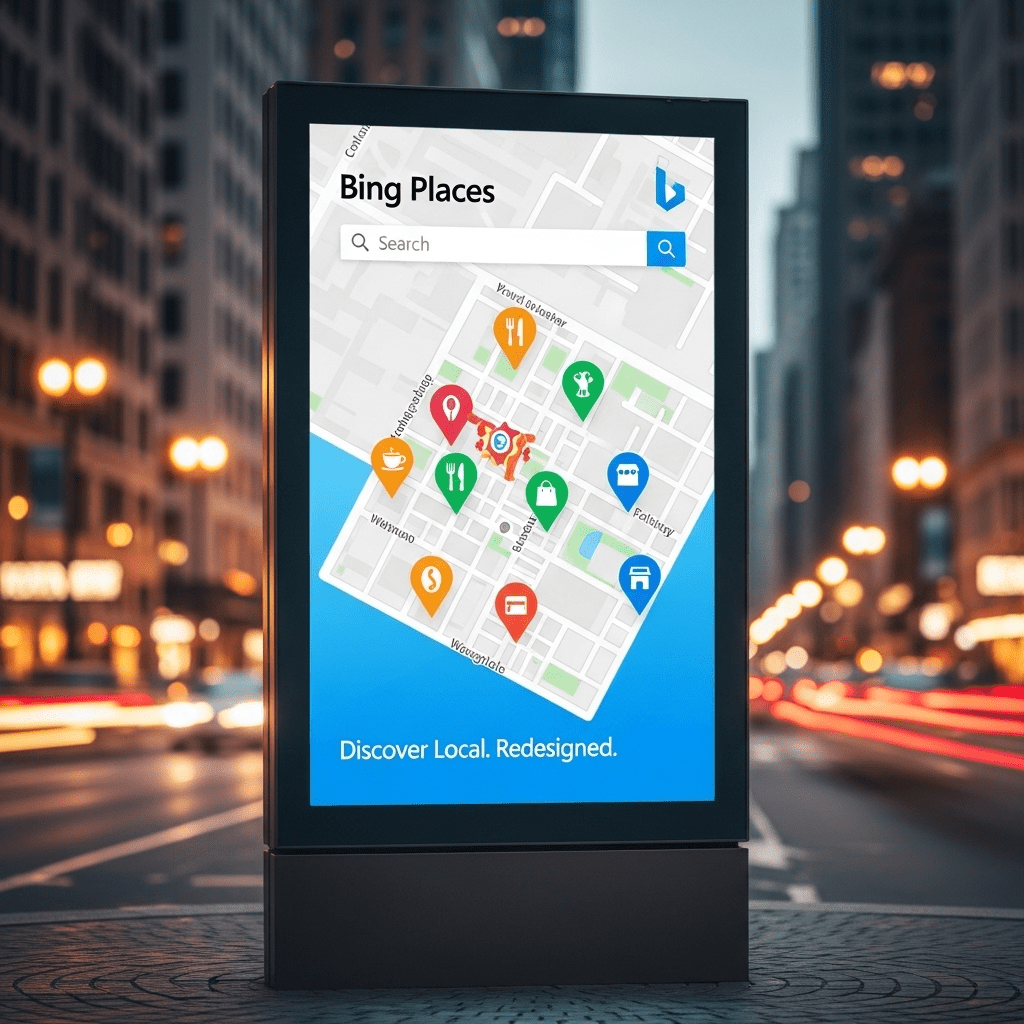
Tech giant rolls out overhauled business listing platform with AI-powered recommendations and streamlined Google imports—but faces uphill battle against market leader
October 3, 2025 — Microsoft has launched a completely redesigned Bing Places for Business platform, marking its most significant update to local business listings since the service debuted in 2013. The revamp comes as the company attempts to chip away at Google’s overwhelming dominance in local search, where Google Business Profile controls an estimated 90%+ of the market.
Table of Contents
ToggleThe Numbers Behind the Launch
The new platform, now hosted at bing.com/forbusiness (moved from bingplaces.com), introduces several features designed to close the gap with Google:
- 100% free business listing management across Bing Search and Bing Maps
- Automatic migration for all existing users and their business listings
- Bulk editing capabilities for multi-location businesses and agencies
- Real-time status updates for listing changes
- AI-powered recommendations for listing optimization
Bing vs. Google: The Local Search Battle
| Feature | Bing Places for Business | Google Business Profile |
|---|---|---|
| Market Share (US) | ~3-5% of searches | ~90%+ of searches |
| Cost | Free | Free |
| Import from Competitor | ✓ Google import | Limited |
| Bulk Management | ✓ New feature | ✓ Established |
| AI Recommendations | ✓ New tool | Partial |
| Mobile App | Available | Robust |
| Review Management | Basic | Advanced |
| API Access | Available | Available |
What’s Actually New
Microsoft’s update addresses three critical pain points identified through months of user research:
1. Smarter Google Business Profile Imports
The new import flow is faster, more reliable, and better at preserving key attributes like business name, hours, and contact details, with intuitive dashboards, bulk editing tools, and real-time status updates.
2. AI-Powered Recommendation Tool
The platform now analyzes listing completeness and suggests high-impact additions:
- Website and social media links
- Operating hours
- Photos and visual content
- Category-specific features (menu links for restaurants, booking systems for services)
“Before we wrote a single line of code, we spent months listening to business owners about their challenges and goals.”
— Microsoft Bing Team, Official Blog Post
3. Simplified Discovery
By consolidating under the Bing.com domain, Microsoft aims to make the service easier to find and align it with the broader Bing ecosystem, including potential future integration with Copilot AI.
The Reality Check: Can Bing Compete?
While Microsoft’s improvements are substantial, the company faces significant headwinds:
Search Engine Market Share (Desktop – US, 2025):
- Google: ~88%
- Bing: ~7%
- Others: ~5%
Mobile Search is Even More Lopsided:
- Google is the default search engine on both Android (majority of smartphones) and iOS
- Bing’s mobile presence is minimal outside Microsoft’s own devices
Expert Perspective on the Update
Barry Schwartz, Search Engine Roundtable founder and SEO industry veteran, has noted that while Bing Places improvements are “welcome for businesses looking for additional visibility,” the platform’s impact remains limited by Bing’s overall search market share. The local SEO community generally views Bing Places as a “nice to have” rather than essential, unlike Google Business Profile which is considered mandatory.
Who Should Use the New Bing Places?
Despite market share challenges, certain businesses can benefit significantly:
Strong Use Cases:
- B2B companies (Bing has higher usage among business/enterprise users)
- Older demographics (Bing skews toward users 45+)
- Desktop-heavy industries (where Bing’s market share is stronger)
- Multi-channel strategies (complementing Google for maximum visibility)
- International businesses (Bing has stronger presence in some markets)
Statistics Worth Noting:
- Microsoft claims 1 billion monthly active users across its search properties
- Bing powers search for Windows default browser and Microsoft ecosystem
- 30%+ of US desktop searches don’t go through Google
Technical Advantages Over Google
Bing Places does offer some unique benefits:
API Access: Microsoft’s Search Entity API brings rich contextual information about people, places, things, and local businesses to any application, blog, or website for a more engaging user experience.
Different Algorithm Priorities: Bing’s search algorithm favors the authority of older websites and content compared to newer sites, and prefers sites with more qualitative backlinks with less focus on quantity.
Visual Search Integration: Bing’s Visual Search capabilities allow users to search based on smartphone images
The Bottom Line for Businesses
Should you set up Bing Places?
Yes, because:
- It’s completely free
- Setup takes 10-15 minutes (especially with Google import)
- Adds another channel for customer discovery
- No ongoing maintenance required
- Potential AI/Copilot integration coming
But keep expectations realistic:
- You’ll get a fraction of the visibility compared to Google
- Most customers still find businesses through Google
- Investment in Google Business Profile remains priority #1
What’s Next for Microsoft
Microsoft is continuing to invest in features that make Bing Places for Business more powerful and accessible, including deeper integrations with Bing Maps and Copilot, and expanded support for agencies and other partners.
The integration with Copilot AI could be the game-changer Microsoft needs, as conversational AI search grows in popularity and usage patterns shift from traditional search engines.
Getting Started: Quick Setup Guide
- Visit bing.com/forbusiness
- Sign in with Microsoft, Google, or Facebook account
- Choose: “Import from Google Business Profile” or “Add Manually”
- Complete business details (name, address, hours, photos)
- Review AI recommendations and implement suggested improvements
- Enable notifications for listing issues
Total Setup Time: 10-15 minutes with Google import, 20-30 minutes manual entry
Conclusion: Incremental Progress, Not Revolutionary Change
Microsoft’s redesigned Bing Places for Business represents solid execution on user feedback and competitive feature parity. The improved Google import, AI recommendations, and cleaner interface remove friction for businesses wanting multi-platform presence.
However, this update won’t fundamentally shift the local search landscape. Google’s dominance—built on superior search market share, mobile integration, and years of refined local algorithms—remains virtually unassailable in the near term.
For businesses: Set it up, keep it updated via imports, but don’t expect meaningful traffic volumes. Consider it insurance and supplementary visibility rather than a primary discovery channel.
For Microsoft: This is a necessary but insufficient step. The real battle will be won or lost based on Bing’s overall search adoption and how effectively Copilot AI can create new search behavior patterns that bypass traditional engines altogether.
Have you set up your business on Bing Places? Share your experience and whether you’ve seen any meaningful traffic or customer inquiries from the platform.
Related posts:
- Local SEO Defies AI Disruption While Other Industries Struggle (Visual guide)
- Google Removes SEO Reference Local Ranking Documentation: What This Means for 2025
- Google AI images PageRank 2025, Google search updates, AI image SEO, Google algorithm news
- Cloudflare Accuses Perplexity of ‘Stealth Crawling’ to Bypass Website Restrictions