
Picture this: A patient wakes up at 2 AM with severe tooth pain. They grab their phone, Google “emergency dentist near me,” and guess what? Your practice doesn’t show up. Meanwhile, your competitor three blocks away gets the call—and a lifelong patient.
Ouch, right?
Here’s the reality: 77% of patients use search engines before booking a medical appointment, and 4 in 5 patients use search engines to find local healthcare providers. If you’re not dominating local search results, you’re literally turning away patients who are actively looking for your services.
Medical practice local SEO isn’t just another marketing buzzword—it’s the difference between a thriving practice with a steady patient flow and an empty waiting room where your staff scrolls through their phones.
The good news? You don’t need a massive marketing budget or a computer science degree. You just need the right strategies, implemented correctly. Let’s dive into exactly how to make your medical practice the go-to choice for patients in your area.
Table of Contents
ToggleWhat Is Local SEO for Medical Practices and Why Does It Matter?
Medical practice local SEO is the process of optimizing your online presence to appear prominently in local search results when potential patients search for healthcare services in your geographic area.
Unlike general SEO that targets broad national or international audiences, local SEO focuses on the “near me” searches and location-specific queries that drive actual foot traffic to your practice.
The Local Search Revolution in Healthcare
Think about how patients find doctors today versus 10 years ago. Gone are the days when people relied solely on phone book referrals or insurance directories.
According to BrightLocal’s 2024 Local Search Study, 98% of consumers used the internet to find local businesses in the past year. For healthcare specifically, that number is even higher because choosing a doctor is a high-stakes decision.
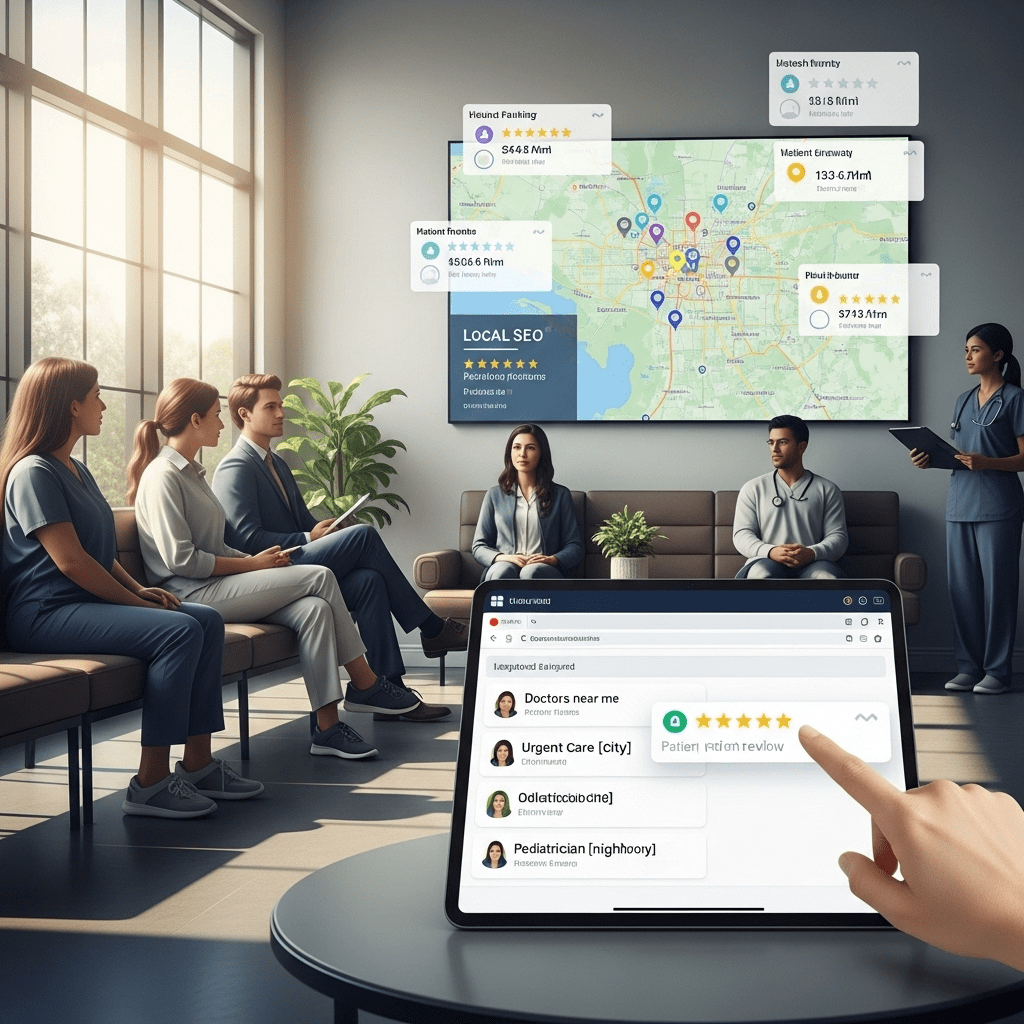
When someone searches for “pediatrician in Austin” or “orthopedic surgeon near me,” Google shows a Local Pack—those three highlighted businesses with map pins that appear above organic results. Landing in that coveted space can transform your practice.
Why Traditional Marketing Isn’t Enough Anymore
Yellow Pages ads? Dead. Newspaper classifieds? Extinct. Even billboards have limited ROI tracking.
Local SEO strategies for medical practices and clinics deliver measurable results:
- 28% of local searches result in a purchase within 24 hours
- 76% of people who search on their smartphones for something nearby visit a business within a day
- 46% of all Google searches are looking for local information
For medical practices, these aren’t just statistics—they’re patients walking through your door.
Pro Tip: Local SEO is particularly powerful for medical practices because healthcare is inherently local. Patients rarely travel more than 15 miles for routine care, making local visibility absolutely critical for practice growth.
How Does Google Determine Local Medical Practice Rankings?
Understanding Google’s local ranking algorithm is like understanding the rules before playing a game—you can’t win if you don’t know how scoring works.
Google uses three primary factors to rank local businesses, including medical practices. Let’s break them down in plain English.
1. Relevance: Does Your Practice Match What Patients Search For?
Relevance measures how well your healthcare Google Business Profile and website match what someone is searching for.
If a patient searches “sports medicine doctor Orlando,” Google evaluates whether your practice actually offers sports medicine services in Orlando. Sounds simple, but many practices fail here by being too vague.
How to maximize relevance:
- Use specific service descriptions (“pediatric allergist” not just “doctor”)
- Include all specialties and procedures you offer
- Match your business categories precisely to your services
- Use location-specific content throughout your digital presence
2. Distance: How Close Are You to the Searcher?
Google prioritizes practices closest to the searcher’s location (or the location mentioned in their search query).
You can’t change your physical location (well, you could, but that’s extreme), but you can optimize around it:
- Ensure your NAP (Name, Address, Phone) is consistent everywhere online
- Create location pages if you have multiple offices
- Use local landmarks and neighborhoods in your content
- Serve the entire radius around your practice, not just your immediate street
3. Prominence: How Well-Known and Trusted Is Your Practice?
Prominence combines your online reputation, review quantity/quality, citation consistency, and overall authority.
Think of it as Google’s way of asking: “Is this practice legit and trustworthy?”
Factors that build prominence:
- Quality and quantity of patient reviews management
- Mentions across the web (local citations, news, blogs)
- Backlinks from authoritative healthcare and local websites
- Social media presence and engagement
- Years in business and practice history
The practices that rank #1 in local search aren’t necessarily the “best” medically—they’re the ones that best signal relevance, proximity, and prominence to Google’s algorithm.
What Is a Healthcare Google Business Profile and How Do You Optimize It?
Your healthcare Google Business Profile (formerly Google My Business) is the single most important element of your local SEO strategy. Period.
It’s the information box that appears when someone searches for your practice or related services. It includes your address, hours, photos, reviews, and that crucial “Get Directions” button.
Setting Up Your Google Business Profile Correctly
Many practices rush through setup and miss critical optimization opportunities. Here’s the right way:
Step 1: Claim and verify your profile
- Go to google.com/business
- Search for your practice (it might already exist)
- Claim it and complete verification (usually via postcard)
- If you have multiple locations, create separate profiles for each
Step 2: Choose the right primary category This is HUGE. Your primary category tells Google exactly what type of practice you are.
Examples of medical practice categories:
- Family Practice Physician
- Pediatrician
- Dermatologist
- Orthopedic Surgeon
- Physical Therapist
- Urgent Care Center
Choose the single most accurate category as your primary, then add up to 9 additional relevant categories.
Step 3: Complete every single field Practices with complete profiles get 7x more visibility than incomplete ones.
Essential fields to complete:
- Exact practice name (no keyword stuffing)
- Full address with suite/unit numbers
- Local phone number (not an 800 number)
- Website URL
- Hours of operation (including holidays)
- Service area (if you serve patients beyond your location)
- Appointment booking link
- Attributes (wheelchair accessible, LGBTQ+ friendly, etc.)
Step 4: Write a compelling business description
You have 750 characters. Use them wisely.
Instead of: “We are a medical practice offering quality healthcare services to patients.
Write: “Serving Springfield families since 2010, Springfield Family Medicine provides comprehensive primary care for all ages. Dr. Sarah Chen and our board-certified team offer same-day appointments, preventive care, chronic disease management, and minor procedures. We accept most insurance plans and offer evening appointments for working families.”
Notice the difference? The second version includes:
- Location (Springfield – twice)
- Services offered
- Provider credentials
- Convenience factors (same-day, evening appointments)
- Target audience (families)
- Trust signals (since 2010, board-certified)
Adding Photos That Convert Browsers into Patients
Practices with photos receive 42% more requests for directions and 35% more click-throughs to their websites.
Photo types to upload:
Exterior photos – Help patients recognize your building Reception/waiting room – Reduces first-visit anxiety Exam rooms – Shows cleanliness and modern equipment Staff photos – Humanizes your practice Provider headshots – Builds trust before the first visit Facility amenities – Parking, accessibility features Before/after photos – For aesthetic practices (following regulations)
Upload at least 10-15 high-quality photos initially, then add 2-3 new photos monthly to keep your profile fresh.
Pro Tip: Photos with faces get 38% more engagement than those without. Include your team (with permission) to create a welcoming first impression.
Using Google Posts to Stay Visible
Google Posts appear directly in your Business Profile and help you share timely information:
- New services or providers joining
- Seasonal health tips
- COVID-19 updates and safety protocols
- Health awareness months
- Extended hours or schedule changes
- Patient success stories (de-identified)
Posts expire after 7 days, so plan to create 1-2 per week for maximum visibility.
How Do Local Citations Impact Medical Practice Visibility?
Local citations medical are online mentions of your practice’s NAP (Name, Address, Phone number) on other websites, directories, and platforms.
Think of citations as digital breadcrumbs that lead both patients and Google to your practice. The more consistent breadcrumbs you leave, the more confident Google becomes about your legitimacy and location.
The NAP Consistency Rule (It’s Non-Negotiable)
Your practice information must be EXACTLY the same across every platform. Not similar. Not close enough. Exactly identical.
Correct NAP example: Springfield Family Medicine 1234 Main Street, Suite 201 Springfield, IL 62701 (217) 555-0123
Inconsistent NAP examples that hurt rankings:
- Springfield Family Med (shortened name)
- 1234 Main St. Ste 201 (abbreviations)
- Springfield, Illinois 62701 (state spelled out)
- 217-555-0123 (different formatting)
These tiny differences confuse Google’s algorithm and dilute your local SEO power. Audit all your citations and fix inconsistencies immediately.
Top Healthcare-Specific Directories for Citations
Generic business directories matter, but local healthcare directories carry extra weight for medical practices.
Tier 1: Essential Healthcare Directories
| Directory | Why It Matters | Domain Authority |
|---|---|---|
| Healthgrades | 20M+ monthly healthcare searches | 87 |
| Vitals | Detailed physician profiles & reviews | 82 |
| WebMD Physician Directory | 60M+ monthly visitors seeking health info | 93 |
| Zocdoc | Online appointment booking platform | 84 |
| RateMDs | Physician ratings and reviews | 68 |
Tier 2: General Business Directories (Still Important)
- Yelp (yes, even for doctors)
- Facebook Business Page
- Apple Maps
- Bing Places
- Better Business Bureau
- Yellow Pages (online version)
Tier 3: Insurance & Specialty Directories
- Insurance provider directories (Aetna, Blue Cross, UnitedHealthcare)
- Specialty-specific directories (American Academy of Dermatology, etc.)
- Hospital affiliations
- Local chamber of commerce
Building Citations the Right Way
Manual submission approach (time-consuming but free):
- Create a master NAP document with your exact information
- Visit each directory individually
- Claim or create your listing
- Copy-paste your exact NAP (never retype)
- Fill out all available fields
- Upload photos and descriptions
- Verify listings when required
Citation management services (faster but paid):
- BrightLocal ($29-299/month)
- Moz Local ($129/year per location)
- Yext ($199-1,999/year)
- Whitespark ($35-350/month)
These services automate submission to 50+ directories and monitor consistency ongoing.
Pro Tip: Start with the top 20 most authoritative directories manually before investing in paid services. This ensures quality over quantity and gives you control over how your practice is represented.
Why Are Patient Reviews Critical for Doctor Local Search Rankings?
Here’s a stat that should wake you up: 94% of patients use online reviews to evaluate healthcare providers, and 84% trust online reviews as much as personal recommendations.
Patient reviews management isn’t just reputation management—it’s a direct ranking factor for doctor local search results.
How Reviews Impact Local Rankings
Google’s algorithm heavily weighs:
Review quantity – Practices with 50+ reviews rank higher than those with 10 Review recency – Fresh reviews (within last 30 days) signal an active practice Review velocity – Steady stream of new reviews looks natural Review ratings – Higher average ratings (4.0+) rank better Review responses – Responding shows engagement and care Review keywords – Patient mentions of services help relevance
A practice with 100+ reviews averaging 4.7 stars will almost always outrank a competitor with 15 reviews averaging 5.0 stars, even if the latter has better medical outcomes.
How to Ethically Request Patient Reviews (Without Violating Rules)
Medical practices face unique challenges with review requests due to HIPAA privacy rules. You CANNOT:
- Automatically post reviews to public platforms
- Share patient information when requesting reviews
- Incentivize reviews with discounts or gifts
- Post fake reviews or have staff write reviews
What you CAN do:
Strategy #1: Direct verbal requests Train front desk staff to say: “If you were happy with your care today, we’d appreciate if you’d share your experience on Google. It really helps other patients find us.”
Strategy #2: Post-appointment emails Send a follow-up email 24-48 hours after appointments:
“Thank you for choosing Springfield Family Medicine. If you’d like to share your experience, you can leave a review on [Google link]. Your feedback helps us improve and helps other patients in our community.”
Strategy #3: Text message reminders “Thanks for visiting us today! If you’re willing, please share your experience: [review link]”
Strategy #4: In-office signage Place small signs at checkout: “Satisfied with your care? Share your experience on Google” with a QR code linking directly to your review page.
Strategy #5: Review cards Hand patients a business card with review links after positive interactions.
The Art of Responding to Reviews (Good and Bad)
Responding to reviews is mandatory for local SEO success. It shows Google you’re engaged and shows patients you care.
Responding to positive reviews:
Instead of: “Thanks!”
Write: “Thank you for the kind words, Jennifer! We’re thrilled Dr. Chen could help with your back pain. Our entire team is committed to getting patients back to their active lifestyles. We appreciate you taking time to share your experience.”
Key elements:
- Personalize with patient’s first name (they already made it public)
- Reference specific details from their review
- Reinforce practice values
- Keep it under 100 words
Responding to negative reviews (while protecting HIPAA):
Never write: “I’m sorry your treatment didn’t work as expected” (implies patient-provider relationship)
Instead write: “Thank you for sharing your concerns. We take all feedback seriously and strive to provide the best care possible. I’d like to learn more about your experience. Please contact our office manager directly at (217) 555-0123 so we can address this properly.”
Key elements:
- Never confirm the person is a patient
- Don’t discuss treatment or medical details
- Show concern and willingness to resolve
- Move the conversation offline
- Respond within 24-48 hours
Negative reviews with thoughtful professional responses actually build trust. Potential patients see you take feedback seriously and handle complaints gracefully.
Getting More Reviews Than Your Competitors
The numbers game:
- Aim for 2-4 new reviews per week
- If you see 100 patients/week, just 2-3% leaving reviews hits this goal
- Consistency matters more than volume spikes
Make it ridiculously easy: Create a shortened link (bit.ly/SpringfieldFamilyMedReview) that goes directly to your Google review form. Include this link in:
- Email signatures
- Appointment reminder texts
- Post-visit emails
- Your website footer
- Staff email signatures
Track what works: Monitor which request methods generate the most reviews and double down on those channels.
How Do You Optimize Your Medical Practice Website for Local Search?
Your website is your digital practice. If your healthcare Google Business Profile is your storefront window, your website is the entire building.
Local SEO On-Page Optimization for Medical Websites
Location-specific content is king:
Every page should signal your geographic relevance to Google.
Homepage optimization:
- Include city/region in your H1 tag: “Family Medicine in Springfield, IL”
- Mention your location in the first 100 words
- Embed a Google Map of your practice
- Include neighborhood names you serve
- Display local phone number prominently
Service pages with local focus: Create individual pages for each service that include local elements:
Instead of: “Pediatric Care Services”
Write: “Pediatric Care for Springfield Families – Same-Day Appointments”
Then throughout the content, naturally mention:
- Local schools and daycare partnerships
- Springfield-specific health concerns (allergies, seasonal issues)
- Community involvement (Little League physicals, school health fairs)
- Insurance plans common in your area
Location pages for multi-location practices: If you have multiple offices, create unique pages for each:
Example structure:
- /springfield-location
- /chatham-location
- /rochester-location
Each location page should include:
- Unique content (not duplicated)
- Embedded Google Map
- Location-specific photos
- Individual staff bios
- Parking and accessibility information
- Neighborhood description
Schema Markup: Speaking Google’s Language
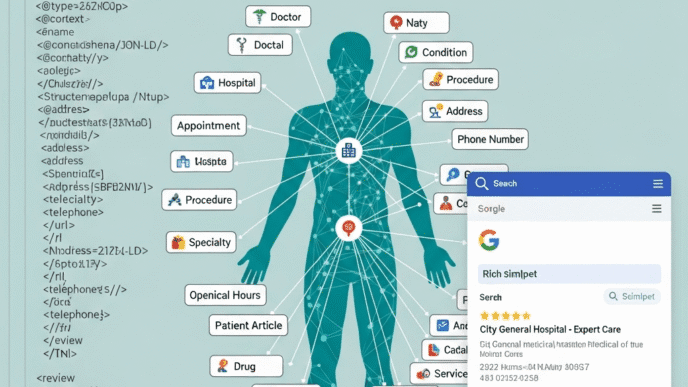
Schema markup is code that helps search engines understand your content better. For medical practices, it’s particularly powerful.
Medical Business Schema Example:
{
  "@context": "https://schema.org",
  "@type": "Physician",
  "name": "Dr. Sarah Chen",
  "image": "https://springfieldfamilymed.com/dr-chen.jpg",
  "medicalSpecialty": "Family Medicine",
  "address": {
    "@type": "PostalAddress",
    "streetAddress": "1234 Main Street, Suite 201",
    "addressLocality": "Springfield",
    "addressRegion": "IL",
    "postalCode": "62701"
  },
  "telephone": "(217) 555-0123",
  "priceRange": "$$"
}
This code helps Google display rich results, including your practice information directly in search results.
LocalBusiness Schema helps Google understand:
- Your practice name and specialty
- Physical location
- Hours of operation
- Accepted payment methods
- Service areas
Most website platforms (WordPress, Wix, Squarespace) have plugins that make schema implementation easy without coding knowledge.
Mobile Optimization: Where Most Patient Searches Happen
60% of local healthcare searches happen on mobile devices. If your site isn’t mobile-friendly, you’re losing patients.
Mobile optimization checklist:
✅ Click-to-call phone numbers (tap to dial)
✅ Easy-to-tap buttons (minimum 44×44 pixels)
✅ Fast loading speed (under 3 seconds)
✅ Readable text without zooming
✅ Easy navigation without pinching
✅ Online scheduling accessible from any page
✅ Maps and directions one-tap away
Test your site at Google’s Mobile-Friendly Test (search.google.com/test/mobile-friendly) and fix any issues immediately.
Local Content That Attracts Patients
Create blog content that serves your local community:
Seasonal health topics:
- “Dealing with Central Illinois Allergies: Spring Prevention Guide”
- “Winter Flu Shot Clinics in Springfield: Walk-In Welcome”
Community health issues:
- “Understanding Lyme Disease Risk in Sangamon County”
- “Heart Health Resources for Springfield Residents”
Local health news:
- “New Diabetes Management Program Launches at Springfield Family Medicine”
- “Free Blood Pressure Screenings at Springfield Farmers Market”
Local event participation:
- “Our Team at the Springfield Health & Wellness Fair”
- “Supporting Local High School Sports: Pre-Participation Physicals”
This content signals local relevance to Google while providing genuine value to potential patients in your community.
What Are the Best Local Link Building Strategies for Medical Practices?
Backlinks from local and authoritative websites tell Google your practice is legitimate, trustworthy, and embedded in the community.
Quality matters far more than quantity. One link from your city’s official hospital website carries more weight than 100 links from random blogs.
Healthcare-Specific Link Opportunities
Hospital affiliations: If you have admitting privileges, ensure the hospital’s website links to your practice. These are gold-standard medical backlinks.
Medical associations:
- State medical boards (licensing verification pages)
- Specialty societies (American Academy of Family Physicians member directory)
- County medical societies
- Professional organizations
Insurance networks: Appear in provider directories with your website linked:
- Blue Cross Blue Shield provider search
- Aetna Find a Doctor
- UnitedHealthcare provider directory
- Medicare Physician Compare
Medical schools and residency programs: If you precept students or residents, request a link from the teaching institution’s faculty/preceptor page.
Local Community Link Building
Chamber of Commerce: Join your local chamber and get listed in their member directory with a link to your practice website.
Local news and media:
- Offer expert quotes for health-related news stories
- Write guest columns for local newspapers
- Appear on local TV/radio health segments
- Sponsor community health screenings
Community organizations:
- Sponsor Little League teams
- Partner with schools for health education
- Support local health fairs and wellness events
- Collaborate with senior centers
Each sponsorship or partnership should result in a website link back to your practice.
Local business partnerships: Build relationships with complementary businesses:
- Gyms and fitness centers
- Nutritionists and dietitians
- Physical therapy clinics
- Pharmacies
- Chiropractors
Create mutually beneficial referral relationships and link to each other’s websites.
Creating Linkable Assets for Your Medical Practice
Give people a reason to link to your website by creating valuable resources:
Local health guides: “Complete Guide to Springfield Healthcare Resources” “New Resident’s Guide to Medical Services in Sangamon County”
Research and surveys: “Survey Results: Top Health Concerns of Springfield Families” “Analysis of Seasonal Illness Trends in Central Illinois”
Interactive tools:
- BMI calculator
- Symptom checker (with disclaimers)
- Insurance coverage checker
- Appointment cost estimator
Community health reports: Annual reports on local health statistics, programs, and initiatives that local news outlets and bloggers would reference and link to.
Pro Tip: Track your backlink profile using free tools like Google Search Console or Ahrefs’ free backlink checker. Monitor who’s linking to you and identify opportunities based on competitor backlinks.
How Do You Track and Measure Local SEO Success for Your Medical Practice?
You can’t improve what you don’t measure. Tracking the right metrics helps you understand what’s working and where to focus your efforts.
Key Performance Indicators (KPIs) for Medical Practice Local SEO
Google Business Profile metrics:
- Total views (how often your profile appears)
- Search views vs. Maps views
- Website clicks
- Direction requests
- Phone calls from profile
- Photo views
- Post engagement
Access these metrics in your Google Business Profile dashboard under “Performance.”
Website analytics (Google Analytics):
- Organic local traffic (users from your city/region)
- Top landing pages from local searches
- Conversion rate (appointment bookings, contact form submissions)
- Bounce rate on location pages
- Time on site
- Mobile vs. desktop traffic
Search ranking positions: Track where you rank for key local search terms:
- “[specialty] in [city]” (e.g., “dermatologist in Springfield”)
- “[specialty] near me”
- “[specific service] [city]” (e.g., “diabetes management Springfield IL”)
- Your practice name
Review metrics:
- Total number of reviews
- Average star rating
- Review velocity (new reviews per month)
- Response rate
- Response time
Citation metrics:
- Number of consistent citations
- Number of inconsistent citations needing cleanup
- Directory completeness score
- Citation sources (healthcare-specific vs. general)
Free and Paid Tools for Tracking Local SEO
Free tools:
Google Business Profile Insights – Built-in analytics for your profile Google Analytics – Website traffic and user behavior Google Search Console – Search queries, rankings, click-through rates Google My Business Dashboard – Review management and messaging BrightLocal’s Local Search Results Checker – Check rankings from different locations
Paid tools (worth the investment):
| Tool | Best For | Price Range |
|---|---|---|
| BrightLocal | Complete local SEO suite | $29-299/month |
| Moz Local | Citation management | $129/year per location |
| SEMrush | Comprehensive SEO analytics | $119-449/month |
| Whitespark | Local citation building & tracking | $35-350/month |
| GatherUp | Review management & reputation | $99-599/month |
Setting Realistic Local SEO Goals
Local SEO is a marathon, not a sprint. Here’s a realistic timeline:
Months 1-3: Foundation
- Google Business Profile optimized
- NAP consistency across top 20 directories
- 20+ new patient reviews
- Basic website local optimization
- Expected results: Modest ranking improvements, appearing in local pack occasionally
Months 4-6: Momentum Building
- 50+ total reviews across platforms
- 40+ consistent citations
- Regular content publication
- Initial backlink acquisition
- Expected results: Consistent local pack appearances, top 5 rankings for some keywords
Months 7-12: Domination
- 100+ total reviews
- 75+ high-quality citations
- Strong backlink profile
- Comprehensive local content
- Expected results: Local pack domination, #1 rankings for primary keywords, measurable patient increase
Year 2+: Maintenance and Growth
- Ongoing review generation
- Quarterly content updates
- Expanding service area coverage
- Expected results: Market dominance, predictable patient acquisition, brand recognition
What Are Common Local SEO Mistakes Medical Practices Make?
Even well-intentioned practices sabotage their local SEO efforts with preventable mistakes. Avoid these pitfalls:
Mistake #1: Incomplete or Inaccurate Google Business Profile
The problem: Rushing through setup, leaving fields blank, or providing inconsistent information.
The fix: Complete every single field in your profile. Schedule 2 hours to do this properly. Double-check your hours, phone number, and address. Update holiday hours proactively.
Mistake #2: Not Asking for Reviews Consistently
The problem: Only requesting reviews during “campaigns” or when you remember, creating sporadic review patterns that look suspicious.
The fix: Build review requests into your patient checkout process. Make it a standard practice, not an afterthought. Train every staff member on the process.
Mistake #3: Ignoring Negative Reviews or Responding Emotionally
The problem: Leaving negative reviews unanswered, or worse, responding defensively or providing medical details.
The fix: Respond to ALL reviews within 48 hours. Follow the HIPAA-compliant response template. Never get defensive. Always take the conversation offline.
Mistake #4: Having Multiple Listings for the Same Location
The problem: Different staff members create duplicate Google Business Profiles, confusing Google and splitting your reviews/metrics across multiple listings.
The fix: Search Google for your practice name. If multiple listings appear, claim all of them, then request duplicates be merged or removed through Google Business Profile support.
Mistake #5: Keyword Stuffing Your Business Name
The problem: Changing your business name to “Springfield Family Medicine – Best Doctor – Primary Care – Walk-In Clinic” to try to rank for more keywords.
The fix: Use your actual legal business name only. Google penalizes keyword-stuffed names. Optimize in descriptions and categories instead.
Mistake #6: Neglecting Mobile Experience
The problem: Website looks great on desktop but is unusable on phones where most searches happen.
The fix: Test your site on multiple devices. Implement responsive design. Ensure forms are easy to complete on small screens. Make phone numbers instantly clickable.
Mistake #7: Ignoring NAP Inconsistencies
The problem: Your address is listed 15 different ways across the internet (St. vs Street, Suite vs Ste, different phone formats).
The fix: Audit your citations using BrightLocal or Moz Local. Create a master NAP document. Systematically fix inconsistencies across all platforms.
Mistake #8: Not Localizing Website Content
The problem: Generic content that could apply to any practice anywhere, missing critical local signals.
The fix: Mention your city, neighborhoods, and region throughout your site. Create location-specific service pages. Reference local landmarks, schools, and community connections.
How Can Multi-Location Medical Practices Scale Local SEO?
Managing local SEO for multiple offices requires systematic approaches and careful attention to unique challenges.
Creating Location-Specific Strategies
Each location needs its own distinct local SEO identity:
Individual Google Business Profiles: Create separate profiles for each location, even if they share a brand name. Each should have:
- Location-specific phone numbers (not central call center)
- Unique photos of that specific office
- Location-specific posts and updates
- Individual review collection strategies
Unique website location pages: Avoid duplicating content across location pages. Each should feature:
- Unique provider bios for that location
- Office-specific amenities and features
- Neighborhood-specific information
- Location-specific patient testimonials
- Unique parking and access instructions
Location-specific content marketing: Blog about topics relevant to each community:
- “Allergy Season Tips for North Dallas Residents”
- “Pediatric Care Resources in the Richardson Area”
- “Senior Health Programs in Plano: What You Need to Know”
Maintaining Consistency Across Multiple Locations
Centralized citation management: Use tools like Yext or Moz Local that can manage citations for multiple locations from one dashboard. This prevents inconsistencies and saves time.
Standardized review request processes: Create a company-wide protocol for requesting reviews that each location implements consistently. Monitor review performance across all locations.
Unified brand messaging with local personalization: Your core brand message should be consistent, but localized appropriately:
Core message: “Compassionate family medicine for every stage of life”
Localized: “Serving Springfield families since 2010” / “Trusted by Chatham residents since 2015”
Shared resources, individual execution: Create template content that each location can customize:
- Social media post templates with location-specific details
- Email campaigns personalized by location
- Review response templates adapted to specific situations
Performance Tracking Across Locations
Location-level dashboards: Create separate tracking for each office to identify top and bottom performers:
- Which locations rank best locally?
- Which generate the most reviews?
- Which have the highest conversion rates?
- Which need additional support or resources?
Competitive benchmarking by location: Local competition varies by location. The orthopedic practice you’re competing against in Location A might be different from Location B’s main competitors.
Resource allocation based on performance: Invest more heavily in locations with:
- Higher patient volume potential
- Stronger local competition
- Better established online presence ready to scale
- Newer locations needing visibility boost
What Role Does Social Media Play in Medical Practice Local SEO?
While social media signals don’t directly impact search rankings, they significantly influence your local visibility and reputation in interconnected ways.
Facebook for Local Medical Practice Visibility
With 2.9 billion monthly users, Facebook remains crucial for local healthcare marketing.
Optimize your Facebook Business Page:
- Use the same NAP information as everywhere else
- Complete all business information sections
- Select “Medical & Health” as your category
- Enable reviews (yes, even with mixed feelings about them)
- Post regularly (2-3x per week minimum)
- Respond to comments and messages within 24 hours
Facebook features that boost local visibility:
Facebook Local Search – When people search “dentist near me” on Facebook, optimized business pages appear
Check-ins and Tags – Encourage patients to check in (with their permission) to increase visibility
Events – Promote health screenings, open houses, or community events
Facebook Groups – Participate in local community groups (without being salesy) to build awareness
Instagram for Building Local Practice Recognition
Instagram excels at humanizing your practice and building community connections.
Content types that work for medical practices:
Behind-the-scenes – Your team, office environment, day-in-the-life content Educational – Health tips, myth-busting, condition awareness Patient stories – Success stories and testimonials (with written consent) Community involvement – Health fairs, charity work, local sponsorships Staff spotlights – Introduce team members, celebrate milestones
Local hashtag strategy: Combine national and local hashtags:
- #SpringfieldIL
- #SpringfieldHealth
- #IllinoisHealthcare
- #CentralIllinoisDoctor
- #SpringfieldFamilies
Use 10-15 hashtags per post, mixing popular and niche tags.
Instagram Stories and Location Tags: Use Instagram’s location features to appear in local searches:
- Add location tags to every post
- Use location stickers in Stories
- Tag local businesses you partner with
- Share when you’re at community events
LinkedIn for Healthcare Professional Networking
LinkedIn builds professional authority that indirectly supports local SEO:
Optimize your practice’s LinkedIn Company Page:
- Complete all company information
- List all locations with addresses
- Showcase specialties and services
- Share industry insights and practice updates
Individual provider profiles: Every physician and provider should have an optimized LinkedIn profile:
- Link back to practice website
- List practice location in current position
- Include keywords naturally in descriptions
- Publish articles on healthcare topics
- Engage with local healthcare community
LinkedIn’s local visibility impact: When potential patients Google your providers’ names (which they do before appointments), strong LinkedIn profiles appear high in results, reinforcing credibility.
Real-World Local SEO Success Story: Small Practice Goes from Invisible to Dominating
Let’s examine how proper local SEO strategies for medical practices and clinics transformed a struggling practice’s patient acquisition.
The Practice: Riverside Family Medicine – Single-location primary care practice in a mid-sized city with 5 competing practices within 2 miles.
The Starting Point (January 2023):
- Google Business Profile: Claimed but incomplete
- Total reviews: 8 reviews (average 4.1 stars)
- Citations: 12 inconsistent listings
- Website: Outdated, not mobile-friendly, no local optimization
- Local pack appearance: 0%
- New patient acquisition: 3-4 per month from online sources
The Strategy Implemented:
Months 1-2: Foundation
- Fully optimized Google Business Profile with photos and complete information
- Launched systematic review request process
- Cleaned up NAP inconsistencies across all existing citations
- Added schema markup to website
Months 3-4: Expansion
- Submitted practice to 45 healthcare-specific and general directories
- Redesigned website with mobile-first approach
- Created location-specific service pages
- Published first 8 locally-focused blog articles
Months 5-8: Growth
- Continued review generation (target: 5-6 new reviews monthly)
- Built backlinks through community partnerships and local sponsorships
- Implemented monthly Google Posts strategy
- Launched Facebook and Instagram presence with local focus
Months 9-12: Optimization
- Refined content based on Search Console data
- Expanded to secondary keyword targets
- Strengthened healthcare directory presence
- Created patient success story content series
The Results (January 2024 – 12 Months Later):
| Metric | Before | After | Improvement |
|---|---|---|---|
| Google Reviews | 8 reviews | 87 reviews | +987% |
| Average Rating | 4.1 stars | 4.8 stars | +17% |
| Local Pack Appearance | 0% | 78% for primary keywords | +78% |
| Organic Local Traffic | 120/month | 1,240/month | +933% |
| Direction Requests | 18/month | 289/month | +1,506% |
| Phone Calls from GBP | 11/month | 156/month | +1,318% |
| New Patients (Online) | 3-4/month | 32-38/month | +900% |
ROI Analysis:
- Total 12-month investment: $18,000 ($8,000 agency fees + $10,000 internal time)
- Average new patient lifetime value: $3,200
- New patients acquired from local SEO: 420
- Total revenue impact: $1,344,000
- ROI: 7,367%
Key Takeaways from This Success:
✅ Consistency matters – Steady effort over 12 months, not quick fixes
✅ Reviews are transformative – Going from 8 to 87 reviews changed everything
✅ Complete optimization beats partial efforts – They addressed every element simultaneously
✅ Local content works – Blog posts about community health topics drove significant traffic
✅ Mobile-first is essential – 73% of their new patient traffic came from mobile devices
This practice didn’t have unlimited budget or fancy technology. They systematically implemented local SEO strategies for medical practices and tracked results monthly.
Advanced Local SEO Tactics for Competitive Medical Markets
In saturated markets with dozens of competing practices, these advanced strategies create separation.
Hyper-Local Content Targeting
Go beyond city-level targeting to neighborhood and even street-level specificity:
Create micro-location content:
- “Medical Care for Residents of the Lincoln Park Neighborhood”
- “Healthcare Services Near Springfield High School”
- “Primary Care Within Walking Distance of Downtown Springfield”
Target long-tail, ultra-specific queries:
- “pediatrician accepting new patients near Washington Park Springfield”
- “same day primary care appointment downtown Springfield”
- “family doctor with evening hours near 6th street”
Develop neighborhood guides: Create comprehensive guides for each neighborhood you serve:
- Demographics and health concerns
- Nearby amenities and parking information
- Local schools and senior centers
- Community resources and support services
Voice Search Optimization for Healthcare
55% of households will own a smart speaker by 2025, and voice searches are predominantly local.
Optimize for conversational queries:
Typed search: “pediatrician Springfield IL” Voice search: “Hey Google, find me a pediatrician near me that takes Blue Cross insurance”
How to optimize for voice:
- Create FAQ pages answering specific questions
- Use natural, conversational language in content
- Target question-based keywords (who, what, where, when, why, how)
- Ensure your Google Business Profile is complete (voice assistants pull from this)
- Optimize for featured snippets (voice assistants often read these aloud)
Common healthcare voice search patterns:
- “Find a [specialty] near me”
- “What are the symptoms of [condition]”
- “Is [practice name] open today”
- “How do I make an appointment with [doctor name]”
- “What insurance does [practice name] accept”
Video Content for Local Medical SEO
Video appears in 62% of Google searches, and healthcare searchers increasingly expect video content.
High-impact video types for medical practices:
Virtual office tours – Reduces first-visit anxiety, keeps visitors on your website longer
Provider introductions – Humanizes doctors before first appointment
Procedure explanations – Educates patients, builds trust
Patient testimonials – Social proof in the most compelling format
FAQ videos – Answers common questions, captures “how to” searches
Community event coverage – Shows local involvement
Video SEO optimization:
- Upload to YouTube with location in title and description
- Embed videos on relevant website pages
- Add transcripts (helps accessibility and SEO)
- Use local keywords in video titles and descriptions
- Create video schema markup
- Add location tags to YouTube videos
Example optimized YouTube title: “Meet Dr. Sarah Chen – Family Medicine Physician in Springfield, IL | Riverside Family Medicine”
Leveraging Google My Business Messaging
The messaging feature in your Google Business Profile allows potential patients to text you directly from search results.
Why this matters:
- 75% of people prefer text communication over phone calls
- Response time impacts local rankings
- Provides immediate engagement opportunity
- Can be integrated with appointment scheduling
Best practices for GBP messaging:
- Enable the feature in your profile settings
- Assign responsibility to specific staff members
- Respond within 15 minutes during business hours
- Use templates for common questions
- Always end with a clear call-to-action (schedule appointment, call for details)
- Monitor and track conversion rates from messaging
FAQs About Local SEO for Medical Practices
Q: How long does it take to see results from medical practice local SEO?
A: Expect 3-6 months for initial improvements and 8-12 months for significant results. Local SEO is a long-term strategy. Quick wins include Google Business Profile optimization (2-4 weeks), but building review quantity, citations, and authority takes sustained effort. Practices that commit to consistent optimization see compounding returns over time.
Q: Do negative reviews hurt my local search rankings?
A: Not significantly if you respond professionally and continue generating positive reviews. Google actually prefers profiles with some negative reviews (looks more authentic). What hurts rankings is ignoring reviews, having very few reviews, or having many recent negative reviews. A 4.5-star average with 100 reviews ranks better than 5 stars with only 10 reviews.
Q: Can I pay Google to rank higher in local search results?
A: No. Local pack rankings are organic and cannot be bought. Google Ads can place you above the local pack in paid positions, but the local pack itself is determined by relevance, distance, and prominence. Beware of anyone promising “#1 rankings” for a fee—these are usually scams.
Q: How do I optimize for multiple service areas without multiple physical locations?
A: Create comprehensive service area pages for each region you serve, but be honest about your primary location. Include location-specific content, local citations mentioning service areas, and clearly explain your coverage area in your Google Business Profile. Google will rank you for nearby communities if signals are strong enough.
Q: Should I focus on Google or other platforms like Bing and Apple Maps?
A: Google dominates healthcare search with 85%+ market share, so prioritize Google Business Profile. However, don’t ignore Bing Places (15% market share, particularly desktop users) and Apple Maps (crucial for iPhone users). The effort to optimize these platforms is minimal once your Google presence is solid—just ensure NAP consistency.
Q: Is it worth hiring a local SEO agency or should I do it myself?
A: Depends on your resources and expertise. DIY is possible but time-intensive. Expect to spend 10-15 hours monthly managing local SEO properly. Agencies cost $1,000-$5,000/month depending on market competitiveness and scope. Consider starting DIY with the basics (Google Business Profile, review requests) and hiring help for advanced tactics (citations, link building, technical optimization).
Q: How often should I update my Google Business Profile?
A: Add Google Posts 1-2x weekly, upload new photos monthly, respond to reviews within 48 hours, and update hours immediately for holidays. Review all information quarterly to ensure accuracy. Active, regularly updated profiles signal to Google that you’re engaged and earn preferential ranking treatment.
Q: Can social media activity improve my local search rankings?
A: Not directly, but indirectly through increased brand searches, backlinks from social shares, and improved online reputation. Social signals demonstrate community engagement and can drive traffic that generates reviews and citations. Maintain active social profiles but don’t expect immediate ranking boosts—think of social as supporting your broader local SEO strategy.
Final Thoughts: Your Local SEO Action Plan Starts Today
Here’s the truth about medical practice local SEO: It’s not complicated, but it is comprehensive. It’s not expensive, but it does require commitment. And it’s not instant, but it absolutely works.
The practices dominating local search in your area aren’t doing anything magical. They’re simply:
✅ Claiming and optimizing their Google Business Profile completely
✅ Systematically requesting patient reviews and responding to all feedback
✅ Building consistent citations across healthcare and local directories
✅ Creating locally-focused website content that serves their community
✅ Earning quality backlinks from local organizations and healthcare institutions
✅ Maintaining consistent NAP information across every online platform
✅ Tracking results and refining strategies based on data
Every patient searching “doctor near me” is a potential lifelong relationship worth thousands in lifetime value. Every local search you’re not visible in is a patient walking into a competitor’s office instead of yours.
The opportunity cost of ignoring local SEO is massive. The investment required to dominate local search is reasonable. The choice is yours.
Your 30-day local SEO kickstart plan:
Week 1: Claim and fully optimize your Google Business Profile, fix NAP inconsistencies Week 2: Implement review request process, respond to all existing reviews Week 3: Submit to top 20 healthcare directories, add schema markup to website Week 4: Create 2 locally-focused blog posts, audit mobile experience
Do these four weeks right, and you’ll see measurable improvements by month three. Maintain the momentum, and by month twelve, you’ll wonder why you didn’t prioritize local SEO years ago.
The patients in your community are searching for healthcare providers right now. Make sure they find you.
Disclaimer: This article provides guidance on local SEO strategies for medical practices for informational purposes. Always ensure your marketing practices comply with HIPAA privacy regulations, state medical board advertising rules, and FTC guidelines. Consult with legal counsel regarding healthcare-specific advertising compliance in your jurisdiction.
Related posts:
- Local SEO Mastery: The Complete Guide to Dominating Local Search in 2025 (Visual guide)
- Multi-Location SEO Strategy: Rank Multiple Business Locations in 2025
- Healthcare SEO: The YMYL-Compliant Guide to Medical Website Optimization in 2025
- Hospital and Healthcare System SEO: Multi-Location Optimization Strategy