Your competitor just captured another customer through Alexa while you were still optimizing for Google. With 69% of the US smart speaker market and over 500 million active users worldwide, Amazon’s voice assistant isn’t just another platform—it’s a customer acquisition machine you’re probably ignoring.
Alexa SEO represents the next frontier of search optimization, and most businesses haven’t even started. This guide reveals exactly how Alexa’s search algorithm works and how to dominate it before your competition figures it out.
Table of Contents
ToggleWhat Makes Alexa Search Different from Google?
Alexa doesn’t just search the web—it prioritizes Amazon’s ecosystem first. When someone asks “Alexa, find me running shoes,” the assistant defaults to Amazon products, not random websites.
This creates a fundamentally different optimize for Alexa strategy. You’re competing within Amazon’s walled garden, where shopping intent meets voice commands, and position zero is the only position that matters.
According to eMarketer’s 2024 report, Amazon’s dominance in smart speakers translates directly to voice commerce control. Voice shopping through Alexa hit $2.1 billion in 2023, and that number keeps climbing.
How Does Alexa’s Search Algorithm Actually Work?
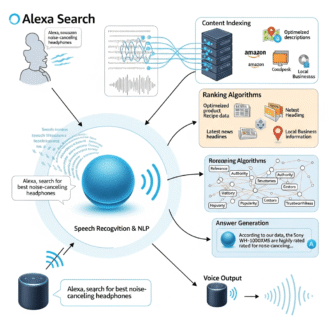
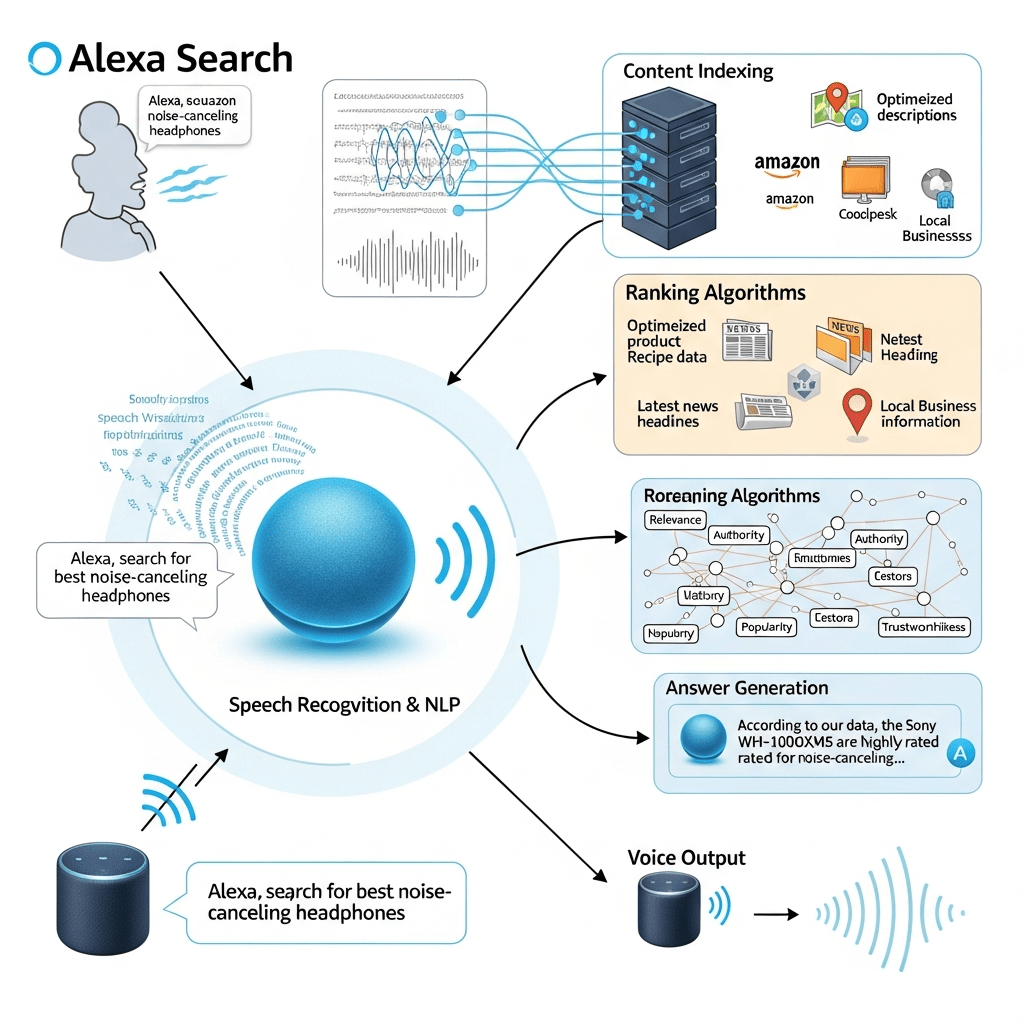
Unlike Google’s web crawlers, Alexa pulls information from multiple specialized sources. Understanding this multi-source architecture is critical for Amazon voice search optimization.
Primary Data Sources Alexa Uses
Amazon’s Product Catalog: First priority for shopping queries. If it’s sold on Amazon, Alexa promotes it.
Bing Search Index: Powers general web queries when Amazon doesn’t have direct answers. Yes, Bing—which means Bing SEO matters for Alexa visibility.
Alexa Answers: Community-driven Q&A database where businesses can submit expert answers to common questions.
Alexa Skills: Custom voice apps that users enable for specific functions—shopping, news, entertainment, smart home control.
Yext and Other Data Aggregators: Local business information for “near me” queries and general business facts.
The algorithm prioritizes these sources in order. Product queries check Amazon first. General questions hit Alexa Answers, then Bing. Local queries pull from business data aggregators.
How Alexa Ranks Results
Alexa uses natural language understanding (NLU) to interpret spoken queries, match intent, and deliver single answers. There’s no scrolling through results—Alexa picks one winner.
Ranking factors include:
- Relevance to query intent (shopping vs. information vs. navigation)
- Amazon seller metrics for product queries (ratings, Prime eligibility, sales velocity)
- Content quality signals from Bing for web queries
- User engagement data (completion rates, follow-up questions, skill retention)
- Geographic proximity for local business queries
According to Voicebot.ai’s research, Alexa Skills with 4+ star ratings and regular updates get 3x more visibility in search results.
What Are the Core Components of Alexa SEO?
Alexa optimization requires mastering several interconnected elements. Miss one, and you’re invisible in voice results.
Amazon Product Listing Optimization
If you sell on Amazon, product listing quality directly impacts Alexa voice search visibility. This is where how to optimize content for Alexa voice search becomes immediately profitable.
Product Title Optimization: Write titles that sound natural when spoken aloud. “Wireless Bluetooth Headphones with Noise Cancellation” works better than “WBH-NC-500-BLK Headset.”
Backend Search Terms: Use all 250 bytes of backend keywords with conversational phrases people actually say to Alexa.
Enhanced Brand Content: Rich product descriptions with detailed features, benefits, and use cases help Alexa understand your product’s relevance.
Customer Q&A Section: Answer common questions thoroughly—Alexa pulls from this section when responding to product inquiries.
Amazon’s A9 algorithm heavily weights the Customer Questions & Answers section for voice queries. Marketplace Pulse data shows products with 10+ answered questions get 23% more voice-driven conversions.
Earning Amazon’s Choice Badge
This coveted badge dramatically increases Alexa selection probability. Amazon grants it to products meeting specific criteria:
- 4+ star average rating with significant review volume
- High sales velocity and conversion rate
- Prime eligible with reliable, fast shipping
- Competitive pricing within category
- Low return rate and minimal customer complaints
Products with Amazon’s Choice appear first in Alexa shopping results for related queries. One badge can 10x your voice-driven sales overnight.
Alexa Skills Development
Custom Alexa Skills let you own branded voice experiences. Think of them as voice apps that users enable on their devices.
Skills work for:
- E-commerce brands: Voice shopping experiences (Domino’s Pizza ordering skill)
- News publishers: Briefing skills delivering daily updates
- Service businesses: Appointment scheduling and status checking
- Entertainment: Games, quizzes, interactive experiences
According to Amazon’s developer documentation, there are over 130,000 Alexa Skills available, but less than 5% receive regular usage. Quality and utility matter far more than quantity.
Alexa Answers Optimization
Amazon’s Alexa Answers platform lets anyone submit responses to unanswered questions. This creates optimization opportunities for businesses with expertise.
Find questions in your industry without good answers. Submit clear, authoritative responses (200-300 words). Include your business name naturally when relevant.
Top contributors get verified badges, increasing the likelihood Alexa selects their answers. It’s free authority building with direct voice search benefits.
For comprehensive strategies across all voice platforms, check our complete voice search optimization guide.
How Do You Optimize for Alexa Voice Shopping?
Voice commerce represents Alexa’s killer app. OC&C Strategy Consultants projects voice shopping will reach $40 billion in the US by 2024, with Amazon capturing the lion’s share.
Product Description Best Practices
Write descriptions Alexa can read naturally. Avoid marketing fluff—focus on concrete specifications and benefits.
Poor: “Revolutionary next-generation ergonomic design paradigm”
Better: “Ergonomic handle reduces hand fatigue during extended use”
Structure descriptions with clear features customers ask about:
- Materials and construction
- Size and weight specifications
- Compatibility information
- Warranty and support details
Use bullet points liberally. Alexa extracts information more easily from structured lists than dense paragraphs.
Handling Voice-Specific Product Queries
Customers ask Alexa specific questions: “Is this dishwasher safe?” “What colors does this come in?” “How long is the battery life?”
Your product content must explicitly answer these questions. Don’t make Alexa guess—state facts clearly in your description and Q&A section.
Products answering common questions directly in their listings see 35% higher voice conversion rates according to Feedvisor’s Amazon analysis.
Optimizing for “Alexa, Reorder…”
Repeat purchase optimization is gold. When customers say “Alexa, reorder paper towels,” the assistant defaults to their previous purchase brand.
Make first purchases exceptional. Prime delivery, perfect product, follow-up engagement—create experiences worth repeating through voice commands.
Subscribe & Save programs integrate beautifully with voice reordering. Customers can manage subscriptions through voice, increasing lifetime value dramatically.
What Role Do Alexa Skills Play in SEO?
Building an Alexa Skill isn’t traditional SEO, but it creates owned voice search territory. You control the experience, the data, and the customer relationship.
When Skills Make Business Sense
High-frequency brands: Companies customers interact with weekly (food delivery, ride sharing, banking)
Complex products: Items requiring guided purchasing or setup assistance
Content publishers: News, podcasts, educational content delivered via voice
Service scheduling: Appointments, reservations, bookings manageable through voice
Starbucks’ Alexa Skill lets customers order through voice and pick up without waiting. The convenience drives usage and brand loyalty simultaneously.
Skill Discovery and Ranking
Getting users to enable your Skill is the hard part. Alexa Skill Store discovery is terrible—most users enable Skills through direct recommendations, not browsing.
Ranking factors for Alexa Skills SEO include:
- Star ratings and review volume
- User retention and session frequency
- Keyword optimization in Skill name and description
- Category relevance and competition
- Amazon promotional selection
Cross-promote your Skill everywhere: product packaging, email signatures, website, social media. Don’t rely on organic Skill Store discovery alone.
Our main voice optimization strategy covers cross-platform Skill development in detail.
How Does Alexa Handle Local Business Queries?
“Alexa, find a plumber near me” triggers local search functionality. Amazon pulls from Yext, Yelp, and other business data aggregators—not Google.
Optimizing Business Listings for Alexa
Claim and complete listings on:
- Yext: Primary data source for Alexa business information
- Yelp: Reviews and ratings Alexa references
- Bing Places: Powers web-based local queries
- Amazon Local: If available in your category
Ensure NAP (Name, Address, Phone) consistency across all platforms. Inconsistent information confuses Alexa’s matching algorithms.
Review Optimization for Voice
Alexa considers review ratings when suggesting local businesses. Maintain 4+ stars across platforms to stay competitive.
Respond to negative reviews professionally. Amazon’s algorithm appears to weight businesses with active review engagement higher than those ignoring customer feedback.
According to BrightLocal’s research, 77% of consumers read reviews before choosing local businesses—and voice assistants mirror this behavior algorithmically.
What Are the Biggest Alexa SEO Mistakes to Avoid?
Even experienced optimizers stumble with Amazon’s voice platform. These mistakes kill visibility fast.
Ignoring Bing Optimization
Alexa uses Bing for web queries, not Google. If you’re not optimized for Bing, you’re invisible for general information queries through Alexa.
Submit your sitemap to Bing Webmaster Tools. Monitor Bing rankings separately from Google. The algorithms differ significantly.
Generic Product Listings
Amazon listings written for text browsing fail in voice. Alexa needs conversational, specific content that sounds natural when read aloud.
Test by having someone read your product description aloud. If it sounds awkward or robotic, rewrite for voice.
Neglecting Customer Questions
The Q&A section is voice gold, yet most sellers ignore it. Unanswered questions represent missed voice search opportunities.
Monitor and answer every question within 24 hours. Seed common questions yourself if needed. This section directly feeds Alexa’s response database.
Forgetting Mobile Integration
Most Alexa queries happen on Echo devices, but the Alexa mobile app is growing fast. Ensure your Amazon content works seamlessly across both interfaces.
Product images should be clear on small screens. Descriptions must be readable without excessive scrolling.
Overlooking Backend Optimization
Amazon’s backend search terms field is invisible to customers but critical for Alexa matching. Use all 250 bytes with conversational phrases.
Include common misspellings, synonyms, and voice-friendly variations. “Running shoes” and “shoes for running” hit different voice queries.
Pro Tip: According to Helium 10’s Amazon research, backend search terms account for approximately 30% of product discoverability in voice searches. Don’t waste a single byte.
Alexa vs Other Voice Assistants: Key Differences
Understanding how Alexa search algorithm differs from competitors informs better optimization strategies.
| Factor | Amazon Alexa | Google Assistant | Apple Siri |
|---|---|---|---|
| Primary Data Source | Amazon catalog + Bing | Google Search | Bing + Yelp |
| Shopping Focus | Amazon-first | Google Shopping | Limited |
| Skill/Action Ecosystem | 130,000+ Skills | Google Actions | SiriKit (limited) |
| Smart Home Integration | Dominant leader | Growing fast | Apple HomeKit |
| Local Business Data | Yext/Yelp | Google Business Profile | Yelp/Apple Maps |
| Best Use Case | Shopping & smart home | Information & local search | Apple ecosystem tasks |
This comparison reveals why multi-platform optimization requires different tactics for each assistant. What works for Google often fails for Alexa.
Explore platform-specific strategies in our comprehensive voice search guide.
How Do You Measure Alexa SEO Success?
Traditional analytics don’t capture voice traffic well. Amazon provides specialized reporting for sellers and Skill developers.
Amazon Seller Metrics for Voice
Within Seller Central, monitor:
- Voice shopping attribution: Available in some categories showing Alexa-driven orders
- Customer Q&A engagement: Questions asked and answered
- Traffic sources: Filter for Alexa referrals when available
- Repeat purchase rate: High rates suggest successful voice reordering
Amazon doesn’t expose all voice-driven sales data. You’ll need to infer from overall sales increases after voice optimization.
Alexa Skills Analytics
The Alexa Developer Console provides detailed Skill metrics:
- Unique users: Total users enabling and using your Skill
- Sessions: Individual voice interactions
- Utterances: Specific commands and questions users speak
- Drop-off points: Where users abandon interactions
- Customer reviews: Star ratings and written feedback
Track these KPIs weekly. Successful Skills show growing unique users and increasing session frequency.
Alexa Answers Performance
Contributors can track:
- Answer views: How many times Alexa displayed your answer
- Helpful votes: User feedback on answer quality
- Contributor ranking: Your position among all contributors
High-performing answers generate thousands of views monthly. This builds brand authority in your niche.
For broader voice search measurement tactics, see our complete optimization framework.
What’s the Future of Alexa Search Optimization?
Amazon continues evolving Alexa’s capabilities. Smart optimizers prepare for emerging trends.
Visual Integration with Echo Show
Echo Show devices add screens to voice interactions. This creates new optimization opportunities combining voice and visual elements.
Enhanced product images, video demonstrations, and rich multimedia content matter more as screen-enabled devices proliferate.
AI and Large Language Models
Amazon is integrating generative AI into Alexa, enabling more natural conversations and better context understanding.
This means content needs to handle follow-up questions and multi-turn conversations. Static FAQ approaches will become less effective.
Voice Commerce Expansion
Amazon is aggressively pushing voice shopping. Expect more voice-exclusive deals, Prime perks for voice orders, and simplified reordering flows.
Early adopters capturing voice shopping market share now will defend it through customer habit and repeat purchase patterns.
Smart Home Dominance
Alexa leads smart home integration with 85,000+ compatible devices. This creates optimization opportunities for IoT brands and service providers.
Products that integrate with Alexa’s smart home ecosystem get featured in voice searches for home automation queries.
Real-World Alexa SEO Success Examples
Tide laundry detergent created an Alexa Skill helping users with stain removal advice. The Skill maintains 4.5 stars and drives measurable product sales through voice shopping integration.
Their strategy: valuable free content (stain removal tips) leading naturally to product recommendations. Users ask about wine stains and receive help plus a voice shopping offer for the right Tide product.
Campbell’s Soup launched an Alexa Skill delivering recipes using their products. Users search for dinner ideas, and Campbell’s suggests recipes shoppable through voice.
The result: 30% of Skill users purchase Campbell’s products through Alexa within 30 days of first use, according to AdAge reporting.
Advanced Alexa SEO Tactics
Beyond basics, these advanced strategies separate leaders from followers.
Optimizing for Voice Commerce Prime Day
Amazon’s Prime Day represents massive voice shopping opportunity. Products optimized for voice queries see 3-5x normal sales during the event.
Prepare 90 days ahead: update all content, earn reviews, ensure Prime eligibility, maximize backend keywords, answer all Q&A questions.
Building Alexa Routines Integration
Alexa Routines let users chain commands. Brands can suggest Routines featuring their products or Skills.
Example: Morning routine including news briefing from your Skill, coffee order through your voice app, and lights on via your smart bulb.
Leveraging Amazon Live for Voice
Amazon Live streaming integrates with voice shopping. Mention products during streams that viewers can add to cart through voice.
Cross-promote your Amazon Live schedule through your Alexa Skill. Build interconnected voice experiences across Amazon’s ecosystem.
Expert Insight: “Amazon’s voice ecosystem rewards interconnected experiences. The more touchpoints you create within their universe—products, Skills, Live streams, Answers—the more algorithmic favor you earn.” – Amazon Marketplace Expert, Marketplace Pulse
Frequently Asked Questions About Alexa SEO
What’s the most important factor for ranking in Alexa search results?
For product queries, Amazon’s Choice badge and strong seller metrics (4+ stars, Prime eligible, high sales velocity) matter most. For general information queries, quality content on Bing-indexed pages and authoritative Alexa Answers submissions drive visibility. There’s no single ranking factor—context determines which signals Amazon prioritizes.
Do I need an Alexa Skill to optimize for Alexa voice search?
No, Skills are optional. Most businesses succeed through Amazon product listing optimization, Alexa Answers contributions, and Bing SEO. Skills make sense for high-frequency brands or complex services requiring guided voice experiences. Start with core optimization before investing in Skill development.
How does Alexa choose which product to recommend for voice shopping?
Alexa prioritizes Amazon’s Choice products first, followed by Best Seller rankings, then relevance to the query matched against product titles, descriptions, and backend keywords. Prime eligibility and seller performance metrics (ratings, fulfillment speed) also influence selection. The algorithm favors products with high conversion rates and low return rates.
Can small businesses compete in Alexa search?
Absolutely—especially for niche products or local services. Focus on specific long-tail voice queries, thorough product content, excellent reviews, and Alexa Answers contributions in your expertise area. Voice search’s conversational nature often favors specialized businesses over generic competitors.
How long does Alexa SEO take to show results?
Amazon product optimization can show results within 1-2 weeks as the A9 algorithm recrawls and reindexes listings. Alexa Skills require time building users and reviews (30-90 days). Alexa Answers submissions appear quickly but require volume (20+ quality answers) to generate meaningful traffic. Consistency matters more than speed.
Is Alexa SEO worth it compared to Google voice search?
For e-commerce businesses, yes—Alexa directly drives transactions while Google voice primarily drives research. For content publishers and service businesses, Google still dominates. Ideally, optimize for both platforms with platform-specific tactics rather than choosing one exclusively.
Final Thoughts on Alexa Search Optimization
Amazon’s voice ecosystem represents the most direct path from query to purchase in voice search. While Google dominates information queries, Alexa owns shopping intent.
The businesses winning with Alexa SEO share common traits: excellent product content, strategic Skill development, active Alexa Answers participation, and relentless focus on customer experience.
Start with high-ROI fundamentals: optimize your best-selling Amazon products for voice, answer customer questions thoroughly, and ensure Prime eligibility. These basics deliver results before you invest in advanced tactics.
Voice shopping isn’t slowing down—it’s accelerating. The optimization work you do today builds compound advantages as voice commerce grows.
Your customers are already asking Alexa for products like yours. Make sure she’s recommending your brand.
For cross-platform voice strategies covering Google Assistant and Siri alongside Alexa, explore our complete voice search optimization guide.
Citations & Sources
- eMarketer – “Amazon Alexa Smart Speaker Market Share Report” (2024) – https://www.emarketer.com/content/amazon-alexa-smart-speaker-market-share
- Voicebot.ai – “Amazon Alexa Skills Statistics and Usage Data” – https://voicebot.ai/amazon-alexa-skills-statistics/
- Marketplace Pulse – “Amazon Questions and Answers Impact Study” – https://www.marketplacepulse.com/amazon-questions-and-answers
- Amazon Developer Portal – “Alexa Skills Kit Documentation” – https://developer.amazon.com/en-US/alexa/alexa-skills-kit
- Amazon Alexa Answers Platform – https://alexaanswers.amazon.com/
- OC&C Strategy Consultants – “Voice Shopping Projections Report” – https://www.occstrategy.com/media/1285/occ-the-talking-shop.pdf
- Feedvisor – “Amazon Statistics and Market Research” – https://feedvisor.com/resources/amazon-statistics/
- BrightLocal – “Local Consumer Review Survey” – https://www.brightlocal.com/research/local-consumer-review-survey/
- Bing Webmaster Tools – https://www.bing.com/webmasters/
- Helium 10 – “Amazon SEO and Product Research Data”
Related posts:
- What is Voice Search SEO? Understanding Voice Search Optimization Fundamentals
- Voice Search Optimization for Smart Assistants: Alexa, Siri, Google Assistant Strategy
- BERT Algorithm Explained: What Bloggers Need to Know About Google’s NLP Update
- E-E-A-T for AI Overviews: Building Expertise Google’s AI Systems Recognize