Your medical practice has world-class doctors, cutting-edge treatments, and five-star patient care. But when someone Googles “cardiologist near me” at 2 AM with chest pain, they find your competitor instead.
Here’s the frustrating reality: healthcare SEO is nothing like regular SEO. Google treats medical websites differently because health information can literally save lives—or cause serious harm if it’s wrong. Miss one E-E-A-T signal or YMYL requirement, and your perfectly legitimate practice gets buried on page 10 while sketchy medical blogs somehow rank higher.
This healthcare SEO guide cuts through the confusion. You’ll learn exactly how to optimize your medical website without triggering Google’s strict health content filters, stay HIPAA-compliant while doing SEO, and actually get found by patients who need you.
Let’s fix your invisible practice problem.
Table of Contents
ToggleWhat Makes Healthcare SEO Different From Regular SEO?
Imagine trying to rank a website where Google assumes you’re lying until proven trustworthy. Welcome to medical SEO.
Your Money or Your Life (YMYL) is Google’s designation for content that could impact someone’s health, safety, or financial wellbeing. Health websites get the strictest scrutiny because bad medical advice can kill people.
This means the SEO tactics that work for e-commerce or software companies can backfire spectacularly for healthcare sites. You can’t just pump out blog posts and expect rankings.
The YMYL Penalty Reality
Google’s algorithm has human quality raters who specifically review health websites using strict guidelines. If your site looks sketchy, has thin content, or lacks clear medical credentials, you’re getting filtered out—no matter how many backlinks you have.
According to <a href=”https://static.googleusercontent.com/media/guidelines.raterhub.com/en//searchqualityevaluatorguidelines.pdf” rel=”nofollow”>Google’s Search Quality Rater Guidelines</a>, medical content requires the “highest level of Page Quality” because low-quality health information can cause harm.
Real example: In 2018, Google’s “Medic Update” wiped out rankings for thousands of health websites overnight. Sites without clear author credentials, medical citations, or proper expertise signals lost 50-90% of their organic traffic. Some never recovered.
Research from <a href=”https://www.brightedge.com/resources/research-reports/content-optimization” rel=”nofollow”>BrightEdge</a> shows that 68% of online experiences begin with a search engine, and for healthcare specifically, 77% of patients use search engines prior to booking an appointment. This makes your Google visibility literally life-or-death for your practice.
Pro Tip: “YMYL compliance isn’t optional for healthcare websites—it’s the foundation. Without meeting E-E-A-T standards, all your other SEO efforts are wasted.” — Healthcare SEO specialists consistently report this as the #1 ranking factor.
How Google Evaluates Medical Websites Differently
Google’s algorithm looks for specific trust signals on health sites that don’t matter as much elsewhere:
Medical credentials displayed prominently: Doctor bios, certifications, board affiliations, medical school credentials
Author attribution on all health content: Every article needs a named, credentialed author with verifiable expertise
Citations to authoritative medical sources: Links to PubMed, medical journals, CDC, Mayo Clinic, and other trusted institutions
Clear organizational credentials: Hospital affiliations, accreditations (Joint Commission, NCQA), license numbers
Updated content with dates: Medical information changes—Google wants to see when content was last reviewed
HIPAA-compliant design: While not directly a ranking factor, security issues can trigger penalties
You can’t fake this stuff. Google’s algorithm is sophisticated enough to verify credentials and cross-reference medical claims.
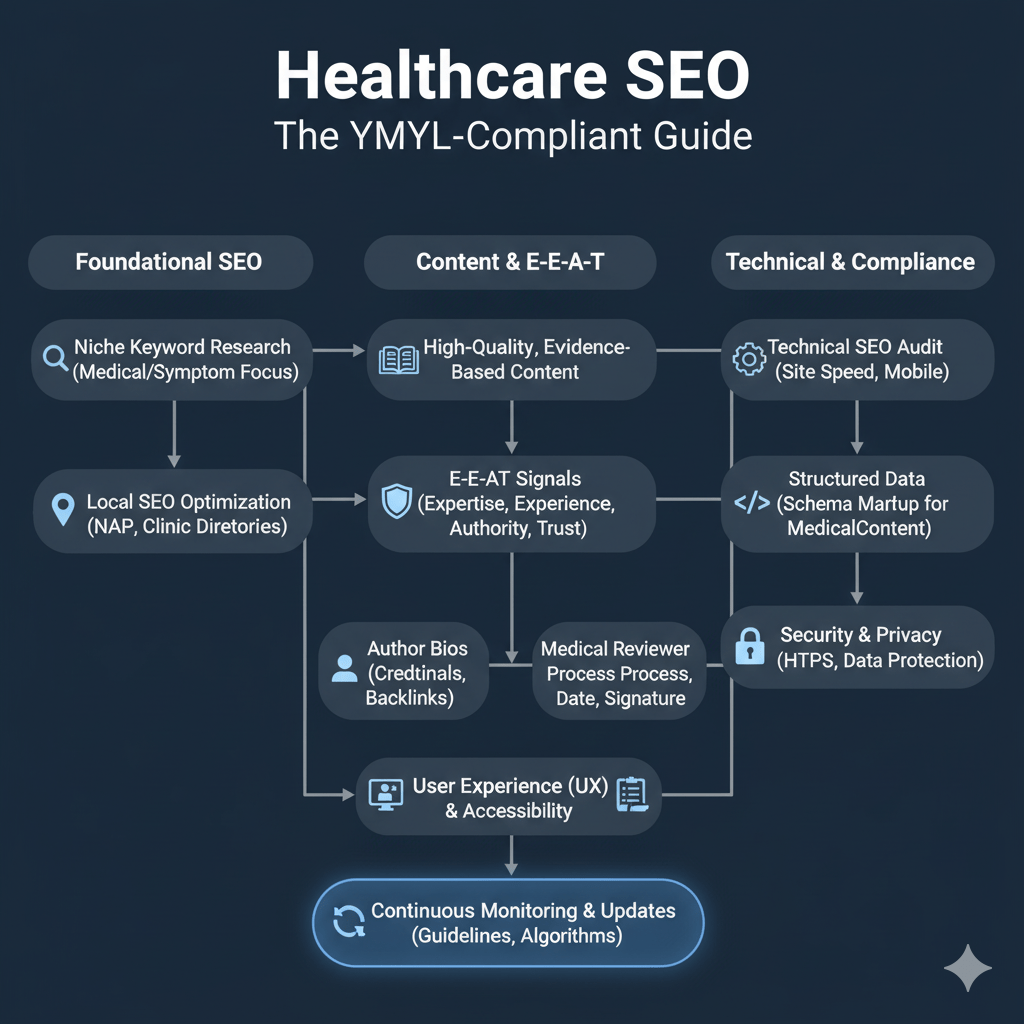
Why Is E-E-A-T Critical for Medical Website Rankings?
E-E-A-T stands for Experience, Expertise, Authoritativeness, and Trustworthiness—and for medical SEO, it’s basically the entire game.
Think of E-E-A-T as Google’s BS detector for health content. The algorithm is specifically designed to filter out medical misinformation, wellness quackery, and “doctors” selling miracle cures.
Breaking Down E-E-A-T for Healthcare
Experience (the newest addition): Does the content demonstrate first-hand medical experience? A surgeon writing about a procedure they perform carries more weight than a general health blogger discussing it.
Expertise: Are the authors actual medical professionals with relevant credentials? A cardiologist discussing heart disease outranks a generalist discussing it. A generalist discussing heart disease outranks a wellness blogger discussing it.
Authoritativeness: Is your practice recognized in the medical community? Hospital affiliations, teaching positions, published research, speaking engagements, and awards all signal authority.
Trustworthiness: Can Google verify your claims? Citations, updated content, clear contact information, professional web design, and HIPAA compliance all build trust.
The Author Byline Is Your Secret Weapon
Every piece of health content needs a detailed author bio that includes:
- Full name and credentials (MD, RN, PhD, etc.)
- Medical specialty and board certifications
- Current practice or hospital affiliation
- Years of experience in the field
- Photo of the actual doctor
- Link to a dedicated bio page with more details
Bad author byline: “By Dr. Smith”
Good author byline: “By Jennifer Smith, MD, FACC – Board-certified cardiologist with 15 years treating heart disease at Boston Medical Center. Harvard Medical School graduate.”
This isn’t vanity—it’s how Google determines if your content deserves to rank for health queries.
Pro Tip: Create a dedicated “Medical Team” page with comprehensive bios for every doctor. Link to this from all your content. This page becomes one of your most important SEO assets because it establishes your entire organization’s credibility.
How Do You Optimize Medical Content Without Violating YMYL Guidelines?
Here’s where most healthcare marketers get stuck. You need to create content that ranks and meets Google’s impossible-seeming medical standards.
The trick is understanding that healthcare content marketing for SEO isn’t about gaming the algorithm—it’s about genuinely being the most helpful, trustworthy resource.
The Content Quality Framework for Health Websites
Start with patient questions, not keywords: Use your actual patient FAQs from front desk staff, post-visit surveys, and doctor consultations. Real questions from real patients are inherently valuable content opportunities.
Get doctors involved in content creation: You don’t need doctors to write every word, but they must review, edit, and approve all medical content. Their expertise needs to be evident in the final piece.
Cite authoritative medical sources: Every medical claim needs backing from peer-reviewed research, medical journals, or trusted health institutions. Link to these sources directly.
Update content regularly: Add “Last reviewed: [Date]” to all health content. Review and update at least annually, more often for rapidly changing topics.
Write for patients, not doctors: Explain medical concepts in plain English. Use analogies. Define jargon. According to the <a href=”https://www.ama-assn.org/delivering-care/patient-support-advocacy/health-literacy-and-patient-safety” rel=”nofollow”>American Medical Association</a>, nearly 9 out of 10 adults struggle to understand and use health information when it’s unfamiliar, complex, or jargon-heavy.
What Medical Topics Should You Actually Write About?
Not all healthcare content is created equal for SEO. Focus on these high-value content types:
| Content Type | SEO Value | Patient Value | Conversion Potential |
|---|---|---|---|
| Condition explanations | High | Very High | Medium |
| Treatment options | Very High | High | High |
| Procedure details | Very High | Very High | Very High |
| Doctor bios & credentials | High | Medium | Very High |
| Patient success stories | Medium | High | High |
| Insurance & payment info | Low | Very High | Very High |
| Before/after galleries | Medium | High | Very High |
| FAQ pages | High | High | Medium |
Pro Tip: Your highest-converting content will be detailed procedure pages and doctor bios—not blog posts. Invest 80% of your content budget on these, 20% on blog content that supports them.
The Medical Content Checklist
Before publishing any health content, verify:
- [ ] Named, credentialed author with expertise in this specific area
- [ ] Author bio with credentials prominently displayed
- [ ] All medical claims cited with authoritative sources
- [ ] Links to peer-reviewed studies or trusted medical institutions
- [ ] Medical accuracy reviewed by licensed physician
- [ ] Last reviewed/updated date displayed
- [ ] Written in patient-friendly language (no unnecessary jargon)
- [ ] Includes clear next steps for patients (scheduling, contacting office)
- [ ] Proper medical disclaimers where appropriate
- [ ] No absolute promises or miracle cure claims
Miss any of these and you’re rolling the dice with YMYL penalties.
What Technical SEO Elements Matter Most for Healthcare Websites?
Medical websites have unique technical requirements that go beyond standard SEO best practices. Get these wrong and you’ll never rank, regardless of content quality.
HIPAA Compliance Affects Your SEO Stack
Here’s what most healthcare marketers miss: HIPAA compliance isn’t just a legal issue—it directly impacts which SEO tools and tactics you can use.
Analytics tools must be HIPAA-compliant: Standard Google Analytics without a Business Associate Agreement (BAA) violates HIPAA if you’re tracking any patient data. You need either:
- Google Analytics 4 with a signed BAA (available for Google Workspace customers)
- HIPAA-compliant alternatives like Matomo or Piwik PRO
- Analytics setups that completely anonymize all data
Contact forms need encryption: Any form that could collect protected health information (PHI) requires SSL encryption and HIPAA-compliant form tools.
Live chat must be HIPAA-compliant: Most popular live chat widgets violate HIPAA. Use specialized healthcare chat solutions with BAAs.
Email marketing needs security: Standard email marketing platforms aren’t HIPAA-compliant for patient communication.
Real example: A dermatology practice got fined $25,000 because their website contact form wasn’t HIPAA-compliant and patients were submitting treatment questions through it. The SEO impact? Google started showing security warnings, tanking their rankings.
Page Speed for Medical Websites
Healthcare sites are notoriously slow because they’re loaded with security features, patient portals, appointment systems, and compliance requirements.
But Core Web Vitals (Google’s page speed metrics) matter just as much for medical sites as any other site. Slow sites don’t rank well.
Research shows that 53% of mobile users abandon sites that take longer than 3 seconds to load—and healthcare searches are increasingly mobile-first.
Target benchmarks:
- LCP (Largest Contentful Paint): Under 2.5 seconds
- FID (First Input Delay): Under 100ms
- CLS (Cumulative Layout Shift): Under 0.1
Common healthcare site speed killers:
- Oversized doctor photos and before/after images
- Poorly optimized patient portal integrations
- Multiple tracking scripts for compliance
- Excessive security plugins
- Unoptimized custom fonts
Quick fixes:
- Compress all images with tools like TinyPNG or ShortPixel
- Lazy load images below the fold
- Minimize JavaScript and CSS
- Use a CDN (Content Delivery Network)
- Choose a healthcare-specific hosting provider with speed optimization
Schema Markup for Medical Practices
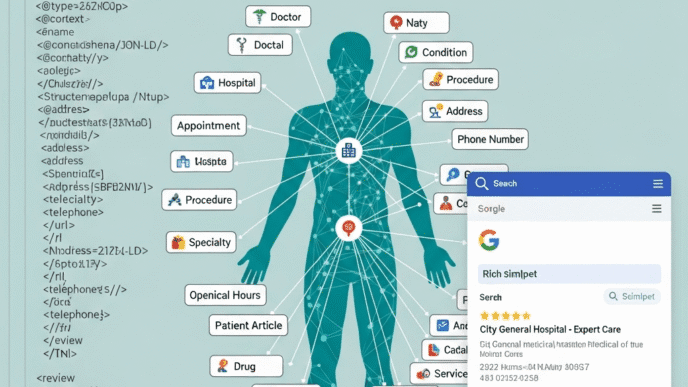
Medical schema markup tells Google exactly what your practice offers, helping you appear in relevant searches and rich results.
Essential schema types for healthcare:
LocalBusiness + MedicalOrganization schema:
{
  "@context": "https://schema.org",
  "@type": "MedicalClinic",
  "name": "Boston Heart Center",
  "medicalSpecialty": "Cardiology",
  "address": {
    "@type": "PostalAddress",
    "streetAddress": "123 Main St",
    "addressLocality": "Boston",
    "addressRegion": "MA",
    "postalCode": "02108"
  },
  "telephone": "+1-617-555-0100",
  "openingHours": "Mo-Fr 08:00-17:00"
}
Physician schema for doctor bios:
{
  "@context": "https://schema.org",
  "@type": "Physician",
  "name": "Dr. Jennifer Smith",
  "medicalSpecialty": "Cardiology",
  "memberOf": {
    "@type": "MedicalOrganization",
    "name": "Boston Heart Center"
  },
  "alumniOf": "Harvard Medical School"
}
Review schema for patient testimonials:
{
  "@context": "https://schema.org",
  "@type": "Review",
  "reviewRating": {
    "@type": "Rating",
    "ratingValue": "5"
  },
  "author": {
    "@type": "Person",
    "name": "Anonymous Patient"
  },
  "reviewBody": "Excellent care and thorough explanation..."
}
This structured data helps you appear in knowledge panels, local pack results, and rich snippets—all critical for local SEO for doctors.
How Do You Build Local SEO for Medical Practices?
Most patients search for healthcare locally. Dentist near me,” “urgent care open now,” “pediatrician Boston”—these local healthcare searches drive actual appointments.
Local SEO for medical practices is your highest-ROI SEO activity because local intent is incredibly strong. In fact, 46% of all Google searches have local intent, and for healthcare, that number is even higher.
Google Business Profile Optimization for Doctors
Your Google Business Profile (formerly Google My Business) is often more important than your website for local visibility.
Essential optimization elements:
Complete every single field: Business name, address, phone (NAP), website, hours, services, attributes, description—fill everything out.
Choose the most specific category: “Cardiologist” beats “Doctor.” “Pediatric Cardiologist” beats “Cardiologist.” Be as specific as possible.
Add services as separate menu items: List every procedure, treatment, and service you offer. Each one is a potential ranking opportunity.
Upload high-quality photos: Professional exterior/interior shots, doctor photos, treatment room photos. Aim for 50+ photos minimum.
Respond to every review: Both positive and negative. Thoughtful responses show Google (and patients) you care.
Post regular updates: Share health tips, office updates, new services. Posting weekly keeps your profile active.
Enable messaging: Let patients contact you directly through Google. Quick responses improve your ranking.
Pro Tip: The single biggest local SEO mistake medical practices make is having multiple listings for the same location or inconsistent NAP (Name, Address, Phone) across the web. Audit all your citations and fix inconsistencies immediately.
Getting Patient Reviews Without Violating HIPAA
Patient reviews are critical for local rankings, but HIPAA makes healthcare review management tricky.
Studies show that 94% of patients use online reviews to evaluate healthcare providers, and star ratings directly impact local search rankings.
What you CAN do:
- Ask patients to leave reviews (but never in exchange for incentives)
- Send review requests to your entire patient list
- Display review widgets on your website
- Respond to reviews publicly
What you CANNOT do:
- Confirm someone is a patient in your response
- Share any protected health information in replies
- Offer incentives for positive reviews
- Delete or hide negative reviews (unless defamatory)
Safe review response template:
Bad response: “Thank you for the review, Sarah! We’re glad your root canal went well and the pain subsided quickly.”
HIPAA-compliant response: “Thank you for taking the time to share your experience. We appreciate your trust in our practice and are always here if you need us.”
Notice the compliant version never confirms Sarah was a patient or mentions any treatment details.
Local Citation Building for Healthcare
Medical directory listings and citations are foundational for local healthcare SEO.
Essential directories for all healthcare providers:
- Healthgrades
- Vitals
- WebMD Physician Directory
- RateMDs
- ZocDoc
- Sharecare
- CareDash
- Wellness.com
Specialty-specific directories:
- Dental: 1-800-DENTIST, DentalPlans.com
- Mental health: Psychology Today, GoodTherapy
- Urgent care: Solv, UrgentCareNearMe
Insurance directories:
- Every insurance network you accept (Aetna, Blue Cross, UnitedHealthcare, etc.)
Ensure your NAP consistency is perfect across all listings. Even small variations hurt local rankings.
What Link Building Strategies Work for Healthcare Websites?
Healthcare link building is challenging because medical sites face stricter quality requirements than other industries. Random blog comments and directory spam won’t work.
You need links from authoritative health sources, local organizations, and relevant institutions.
Ethical Link Acquisition for Medical Practices
Strategy 1: Local community involvement
Sponsor local health events, charity runs, school health programs. These typically earn you links from:
- Event websites
- Local news coverage
- Community organization sites
- School district websites
Real example: A pediatric practice in Austin sponsored a local elementary school health fair. This earned them links from the school district website (high authority), three local news articles, and the health department’s community resources page.
Strategy 2: Medical content partnerships
Create genuinely valuable health content and offer it to authoritative health sites:
- Local hospital resource pages
- Health departments
- Patient advocacy groups
- Medical associations
- University health centers
The key is creating resources so valuable that these organizations want to link to them.
Strategy 3: Provider directories and professional associations
Get listed in every legitimate provider directory:
- State medical board directories
- Professional association directories (AMA, specialty associations)
- Insurance provider directories
- Hospital physician directories
- Medical school alumni directories
These are typically high-authority, relevant backlinks.
Strategy 4: Original medical research or data
Publish original research, patient surveys, or treatment outcome data:
- Other medical sites will cite your research
- Journalists writing health articles will reference your data
- Academic institutions may link to your findings
Example: A dermatology practice published data on acne treatment outcomes in different age groups. This earned them 47 backlinks from dermatology blogs, three medical journals, and two major health publications.
Links to Avoid in Healthcare SEO
Some backlinks can actually hurt medical websites:
Never pursue:
- PBN (Private Blog Network) links
- Link exchanges with unrelated sites
- Directory spam
- Paid links from non-health sites
- Links from alternative medicine or pseudoscience sites
- Forum spam
- Comment spam
Google scrutinizes healthcare backlinks more carefully than most industries. A few sketchy links can trigger manual penalties.
Pro Tip: Quality over quantity is 10x more important for medical SEO than other industries. One link from Mayo Clinic or a respected medical journal beats 1,000 links from random blogs.
How Should You Approach Healthcare Content Marketing?
Medical content strategy isn’t about churning out blog posts—it’s about becoming the go-to resource for specific health conditions and treatments.
The Patient Journey Content Framework
Map content to where patients are in their healthcare journey:
Awareness stage (early research):
- “What causes [symptom]?”
- “Is [symptom] serious?”
- “When to see a doctor for [symptom]”
Consideration stage (evaluating options):
- “Treatment options for [condition]”
- “[Procedure] vs [alternative procedure]”
- “How to choose a [specialist]”
Decision stage (ready to book):
- “[Procedure] cost and insurance”
- “What to expect during [procedure]”
- “Preparing for your [procedure]”
- “Meet our [specialists]”
Most healthcare sites over-invest in awareness content (blog posts) and under-invest in decision content (procedure pages, doctor bios).
Flip that ratio. Your bottom-funnel content drives appointments.
Video Content for Medical SEO
Medical video content is incredibly valuable because:
- Patients trust doctors they can see and hear
- Complex medical topics are easier to explain visually
- Videos appear in search results with thumbnails (higher CTR)
- YouTube is the second-largest search engine
Research shows that 73% of patients are more likely to schedule an appointment after watching a doctor’s video.
High-value video types:
- Doctor introductions and practice tours
- Procedure explanations
- Patient testimonials (with HIPAA-compliant consent)
- Common condition Q&As
- Post-treatment care instructions
Keep videos under 3 minutes for best engagement.
Pro Tip: Transcribe every video and include the full transcript on your page. This gives you SEO-valuable text content while making videos accessible to hearing-impaired patients.
Patient Education Content That Converts
The best healthcare content educates patients and positions your practice as the obvious choice.
Framework for high-converting patient education:
Start with the patient’s concern: “If you’re experiencing chest pain, you’re probably worried about your heart.”
Explain the condition clearly: Use analogies, avoid jargon, break complex topics into digestible chunks.
Cover treatment options objectively: Don’t just push one treatment. Explain all options, pros/cons of each.
Position your practice’s unique approach: “At Boston Heart Center, we specialize in minimally invasive procedures that reduce recovery time.”
Clear next steps: “Schedule a consultation to discuss which treatment option is right for you. Call [number] or book online.”
This builds trust through education while naturally leading to conversion.
What Are the Most Critical Healthcare SEO Mistakes to Avoid?
Even experienced marketers make catastrophic errors with medical SEO. Here are the landmines that’ll destroy your rankings.
Mistake #1: Generic, Non-Expert Content
Publishing health content written by general copywriters without medical review is SEO suicide.
Google can detect when health content lacks genuine expertise. The algorithm looks for:
- Depth of information that only experts would know
- Proper medical terminology used correctly
- Nuanced explanations of complex topics
- Citations to medical research
A $50 blog post from a content mill will never rank for health topics in 2025.
How to avoid: Require all health content to be written by or reviewed by licensed medical professionals with relevant expertise. Display author credentials prominently.
Mistake #2: Ignoring Mobile Optimization
Over 70% of healthcare searches happen on mobile devices. If your site isn’t genuinely mobile-optimized, you’re losing most of your potential patients.
According to Google, 61% of users are unlikely to return to a mobile site they had trouble accessing.
Mobile must-haves for healthcare sites:
- Click-to-call phone numbers prominently displayed
- Mobile-friendly appointment booking
- Fast loading on cellular connections
- Large, easy-to-tap buttons
- No intrusive pop-ups blocking content
How to avoid: Test your site on actual phones, not just desktop browser resizing. Use Google’s Mobile-Friendly Test tool and fix all issues immediately.
Mistake #3: Neglecting Online Reputation Management
Your online reputation directly impacts SEO rankings. Google factors review quantity, quality, and recency into local rankings.
A practice with 300 five-star reviews will outrank a practice with 20 five-star reviews, even if the second practice has better on-page SEO.
How to avoid:
- Actively request reviews from satisfied patients
- Respond to every review within 48 hours
- Address negative feedback professionally
- Monitor all review platforms (Google, Healthgrades, Vitals, etc.)
- Never buy fake reviews (Google will catch you)
Mistake #4: Duplicate Content Across Locations
Multi-location practices often copy-paste the same content across location pages, just changing the city name.
This tanks rankings for all locations because Google sees it as duplicate content and doesn’t know which page to rank.
How to avoid: Write unique content for each location that includes:
- Specific directions and parking information
- Photos of that specific location
- Bios of doctors at that location
- Local area information
- Unique patient testimonials from that location
Yes, it’s more work. But it’s the only way to rank multiple locations.
Mistake #5: Not Tracking ROI from SEO
Healthcare organizations often track vanity metrics (traffic, rankings) instead of what matters: patient acquisition cost and appointments generated.
How to avoid:
Essential healthcare SEO metrics:
- Organic traffic to high-intent pages (procedure pages, doctor bios)
- Conversion rate from organic traffic to:
- Phone calls
- Form submissions
- Online appointment bookings
- Cost per patient acquisition from SEO vs. other channels
- Patient lifetime value by acquisition channel
Set up proper conversion tracking for calls, forms, and online bookings. Without this data, you’re flying blind.
Mistake #6: Outdated Medical Information
Medical knowledge evolves constantly. Content from 2020 about COVID treatment or 2015 about diabetes management is dangerously outdated.
Google’s algorithm specifically looks for content freshness signals on health topics.
How to avoid:
- Add “Last reviewed: [Date]” to every health page
- Review and update all health content at least annually
- Update immediately when new research contradicts old information
- Set calendar reminders for content reviews
- Monitor medical journals for updates in your specialties
Mistake #7: Keyword Stuffing Medical Terms
Trying to rank for every possible variation by cramming keywords into content makes it unreadable and triggers spam filters.
“Looking for the best cardiologist in Boston? Our Boston cardiologists at Boston Heart Center offer the best cardiology services in Boston” is transparent keyword stuffing.
How to avoid: Write naturally for patients first, SEO second. Use keywords where they fit naturally. Focus on topical relevance and comprehensive coverage rather than keyword density.
Mistake #8: Ignoring AI-Generated Content Risks
AI tools like ChatGPT are tempting shortcuts, but they’re dangerous for medical content without proper oversight.
Why AI struggles with medical content:
- Frequently hallucinates medical facts and statistics
- Can’t cite actual peer-reviewed research (makes up sources)
- Lacks nuanced understanding of complex conditions
- Can’t incorporate actual clinical experience
- Doesn’t meet E-E-A-T standards without heavy editing
How to avoid:
- Only use AI for initial drafts and research
- Have licensed physicians review every word
- Verify every single fact and citation
- Add original clinical insights AI can’t generate
- Ensure content demonstrates genuine expertise
Mistake #9: Neglecting HIPAA in SEO Tools
Using non-compliant analytics, forms, or chat tools puts you at legal risk and can trigger Google penalties if security issues arise.
How to avoid:
- Ensure all tools handling patient data have signed BAAs
- Use HIPAA-compliant alternatives to standard marketing tools
- Never send patient information through unsecured channels
- Regularly audit your tech stack for compliance
- Work with HIPAA-knowledgeable SEO professionals
Mistake #10: Focusing Only on Competitive Keywords
Going after “dermatologist Los Angeles” when you’re a new practice with no authority is a waste of resources.
How to avoid:
- Target long-tail keywords with lower competition initially
- Focus on specific conditions and procedures (not just specialty names)
- Build authority with niche topics before tackling competitive terms
- Target location + specific treatment combinations
- Use question-based keywords that match patient intent
Pro Tip: “The biggest mistake I see healthcare practices make is trying to compete for every medical term at once. Pick 10-15 highly relevant keywords, dominate those, then expand systematically. Trying to rank for 500 keywords means you’ll rank well for none of them.” — Successful healthcare practices focus before they expand.
How Will Healthcare SEO Change in 2025 and Beyond?
The landscape is shifting rapidly with AI, voice search, and changing patient behaviors.
AI-Generated Content in Healthcare
AI writing tools are everywhere, but they’re particularly problematic for healthcare content.
Google has stated AI content isn’t automatically penalized—but low-quality content is, regardless of how it’s created. And most AI-generated health content is dangerously low-quality without expert review.
The AI paradox for healthcare: AI can accelerate content production 3-5x, but medical content requires human expertise that AI simply cannot replicate. The solution? Use AI as a research and drafting assistant, never as a replacement for medical expertise.
Smart AI usage for healthcare:
- Research assistance and summarizing medical literature
- Generating content outlines and structure
- Creating first drafts that doctors heavily edit
- Optimizing existing content for readability
- Generating meta descriptions and title tag variations
Never use AI alone for:
- Medical advice or recommendations
- Treatment information
- Diagnosis guidance
- Drug interaction information
- Clinical data interpretation
Voice Search Optimization for Healthcare
“Hey Siri, find a pediatrician open now near me.”
Voice search in healthcare is growing rapidly because:
- Patients search while driving or hands-full with kids
- Medical emergencies require immediate information
- Voice is faster for longer, conversational queries
Data shows that 27% of people are using voice search on mobile globally, and healthcare queries are among the most common voice search categories.
Optimize for voice search:
- Target question-based keywords naturally
- Write in conversational language (how people actually talk)
- Claim and optimize your Google Business Profile
- Include FAQ schema markup
- Focus on local queries
Voice searches tend to be longer and more specific: “What should I do if my child has a fever over 103” vs. “child fever treatment.”
Telemedicine SEO Strategies
Telehealth SEO is now essential as virtual care becomes permanent.
The telehealth market grew 38x during 2020 and has stabilized at levels 38x higher than pre-pandemic. This isn’t temporary—it’s the new normal.
Key optimization areas:
- Create dedicated virtual visit pages for every service
- Target “online doctor” and “virtual [specialty]” keywords
- Specify which conditions you treat via telemedicine
- Make online scheduling prominent
- Include video quality requirements and technology tips
- State which states you’re licensed to practice in
Geographic targeting becomes complicated with telehealth since you can treat patients outside your physical location (within licensing constraints).
Pro Tip: Many patients don’t know telehealth is an option for their condition. Create content explicitly addressing “Can I see a [specialist] online?” and “Is telehealth right for [condition]?”
Search Generative Experience (SGE) Impact on Healthcare
Google’s AI-powered search results (SGE) are fundamentally changing how health information appears in search.
When Google’s AI directly answers medical questions, traditional organic listings get pushed down. But this creates opportunities for practices that become the sources SGE cites.
Optimizing for SGE in healthcare:
- Create comprehensive, authoritative content that AI can reference
- Use clear structure with well-defined sections
- Answer questions directly and concisely
- Implement proper schema markup
- Build genuine expertise signals (E-E-A-T)
- Become the most authoritative source in your niche
The practices that rank well in SGE aren’t gaming the system—they’re genuinely the best sources of information.
What Should Your Healthcare SEO Action Plan Look Like?
Trying to do everything at once guarantees mediocre results. Here’s a prioritized roadmap.
Month 1: Foundation and Compliance
Week 1-2:
- Audit current site for YMYL/E-E-A-T compliance
- Add detailed author bios to all health content
- Implement medical schema markup
- Verify HIPAA compliance of all tools and forms
Week 3-4:
- Claim and fully optimize Google Business Profile
- Audit and fix NAP inconsistencies across the web
- Set up HIPAA-compliant analytics
- Create comprehensive doctor bio pages
Month 2-3: Content Optimization
Focus areas:
- Rewrite or enhance top 10 procedure pages with better content, citations, and clear author attribution
- Create detailed FAQ pages for common patient questions
- Add before/after galleries (with proper consent)
- Implement video content for top procedures
- Update old content with new dates and citations
Month 4-6: Authority Building
Key activities:
- Launch patient review generation campaign
- Get listed in all relevant medical directories
- Build relationships with local health organizations
- Create linkable original research or data
- Pursue quality backlinks from authoritative health sites
Month 7-12: Scale and Expand
Growth tactics:
- Expand content to cover adjacent conditions and treatments
- Create comprehensive guides for major health topics
- Launch targeted local SEO campaigns for each location
- Implement advanced schema markup
- Test and optimize conversion paths
Pro Tip: Healthcare SEO is a marathon, not a sprint. It typically takes 6-12 months to see significant results because Google scrutinizes medical sites more carefully. Expect slow, steady growth rather than overnight success.
Frequently Asked Questions About Healthcare SEO
Does Google penalize medical websites more than other sites?
Not exactly. Google scrutinizes medical sites more carefully because of YMYL classification, but it doesn’t penalize legitimate healthcare websites. The algorithm simply has higher quality standards for health content. If you meet E-E-A-T requirements, you can rank just as well as any other site—maybe better, since you’re competing against lower-quality content that gets filtered out.
Can I do SEO without violating HIPAA?
Yes, absolutely. HIPAA compliance and SEO are completely compatible—you just need to use the right tools and strategies. The key is ensuring any patient data (even IP addresses and browsing behavior) is properly protected. Use HIPAA-compliant analytics with signed Business Associate Agreements (BAAs), secure contact forms, and encrypted connections. Never use patient information or treatment details in content without proper authorization.
How long does it take to see results from healthcare SEO?
Typically 6-12 months for significant results, though you may see some movement earlier. Medical SEO takes longer than other industries because Google is more cautious with health content. New sites need time to build authority and trust signals. Established practices with existing credibility can see faster results (3-6 months) if they fix major issues. Patience is critical—rushing or cutting corners often backfires in healthcare SEO.
Should every blog post be written by a doctor?
Ideally, yes—or at minimum, reviewed and approved by a licensed physician with relevant expertise. Google’s algorithm can detect when health content lacks genuine medical knowledge. You can have skilled medical writers create drafts, but a doctor with relevant credentials should review, edit, and approve before publishing. This ensures medical accuracy and meets E-E-A-T standards. The author byline should display the reviewing physician’s credentials.
Do patient reviews really affect SEO rankings?
Yes, significantly—especially for local SEO. Google factors review quantity, quality, rating, and recency into local search rankings. A practice with 500 reviews will generally outrank one with 50 reviews (all else equal). Reviews also improve click-through rates in search results, which indirectly boosts rankings. Focus on generating consistent positive reviews as part of your SEO strategy, but always maintain HIPAA compliance in how you request and respond to reviews.
Is it worth hiring a healthcare SEO agency?
For most practices, yes—if you choose one that specializes in healthcare. Medical SEO is complex enough that generalist agencies often make costly mistakes (HIPAA violations, YMYL penalties, poor content strategies). A specialized healthcare SEO agency understands the unique challenges and compliance requirements. Expect to invest $3,000-10,000+ monthly for quality healthcare SEO services. For smaller practices with limited budgets, consider starting with a consultant to develop strategy, then handling some execution in-house.
Can I rank for medical terms without being a doctor?
Not for “Your Money or Your Life” health topics. Google requires content about medical conditions, treatments, and diagnoses to be created or reviewed by credentialed medical professionals. You might rank for adjacent topics (healthcare industry news, medical office management, patient experience, healthcare technology) without medical credentials, but not for clinical health information. The author or reviewing expert must have verifiable medical credentials.
How do I optimize for voice search in healthcare?
Focus on conversational, question-based content that matches how people actually speak. Target long-tail queries like “What should I do if…” and “When should I see a doctor for…” Include FAQ schema markup to help voice assistants find your answers. Optimize your Google Business Profile completely since many voice searches have local intent. Write in natural language using short sentences and clear answers. Most voice searches are mobile, so ensure your site loads quickly and displays well on phones.
What’s the best way to handle negative reviews?
Respond professionally and promptly (within 24-48 hours) without confirming the person is a patient or sharing any protected health information. Apologize for their negative experience, express your commitment to quality care, and offer to discuss offline. Never argue, make excuses, or get defensive. Many potential patients judge practices more on how they handle negative reviews than on the presence of negative reviews themselves. A thoughtful response to criticism actually builds trust.
Should I target keywords my competitors rank for?
Yes, but strategically. Analyze what competitors rank for, but don’t just copy their strategy. Look for gaps where they rank but their content is weak—those are opportunities. Also target keywords they’re missing entirely. For new practices, avoid the most competitive keywords where established competitors dominate. Instead, focus on long-tail variations and specific procedures where you can realistically compete. Build authority with achievable wins before tackling the most competitive terms.
Final Verdict: Building a Sustainable Healthcare SEO Strategy
Healthcare SEO in 2025 isn’t about gaming Google—it’s about genuinely being the most helpful, trustworthy, and authoritative resource for your patients.
The practices that win long-term focus on three core principles:
1. Patient-first content: Create resources that genuinely help people understand their health, make informed decisions, and feel confident choosing your practice. Every piece of content should answer real patient questions and provide actionable value.
2. Medical credibility: Never shortcut on expertise. Every piece of health content needs real medical credentials behind it. Google’s algorithm is sophisticated enough to detect fake expertise, and the consequences of poor medical information are too serious to risk.
3. Technical excellence: HIPAA compliance, fast loading, mobile optimization, and proper schema markup aren’t optional—they’re foundational. Technical issues will prevent even the best content from ranking.
The healthcare SEO landscape will only get more competitive and more sophisticated. Google’s algorithm will continue improving at detecting quality, expertise, and trustworthiness. The shortcuts that might work today won’t work tomorrow.
But here’s the good news: If you invest in building genuine authority—real medical expertise, comprehensive patient education, strong local presence, and technical excellence—your medical website optimization will deliver patient growth for years to come.
The practices struggling with SEO in 2025 are those trying to do SEO to their patients. The practices thriving are those doing SEO for their patients—creating genuinely helpful resources that deserve to rank.
Your move now: Pick three priorities from this guide (I’d suggest: doctor bio optimization, Google Business Profile completion, and fixing your top 10 procedure pages). Execute those three things excellently rather than attempting everything mediocrely.
Healthcare SEO is a marathon, not a sprint. But the practices that start today—following YMYL guidelines, building genuine expertise signals, and focusing on patient value—will dominate local search while competitors continue spinning their wheels.
Now stop reading and start optimizing. Your patients are searching for you right now.
🏥 Healthcare SEO Compliance Checker
YMYL & E-E-A-T Analyzer for Medical Websites
📊 E-E-A-T Metrics
⚠️ Compliance Issues
📋 YMYL Compliance Requirements
Content Quality Standards
Organizational Credibility
Technical & Security
📈 YMYL Penalty Risk Factors
| Risk Factor | Impact | Fix Priority |
|---|---|---|
| No author credentials | Critical - Can't rank | 🔴 Immediate |
| Uncited medical claims | High - Trustworthiness | 🔴 Immediate |
| Outdated content (2+ years) | High - Relevance | 🟡 High |
| Generic author bylines | Medium - Authority | 🟡 High |
| No medical disclaimers | Medium - Legal risk | 🟡 High |
| Thin content (<300 words) | Medium - Quality | 🟢 Medium |
| No schema markup | Low - Visibility | 🟢 Medium |
⭐ E-E-A-T Optimization Checklist
Experience Signals
Expertise Demonstration
Authority Building
Trustworthiness Factors
📊 Healthcare SEO Statistics
📉 Medic Update Impact (2018)
Traffic retention after Google's Medic Update by site type
🎯 Patient Search Behavior
| Search Type | Percentage | Intent |
|---|---|---|
| "Doctor near me" | 38% | High - Ready to book |
| Symptom searches | 27% | Medium - Researching |
| Treatment options | 19% | High - Considering options |
| Specific practice names | 11% | Very High - Ready to contact |
| General health info | 5% | Low - Early awareness |
Related posts:
- Healthcare Content Writing Guidelines: Creating YMYL-Compliant Medical Content (Dashboard)
- HIPAA-Compliant SEO and Analytics: Privacy-First Healthcare Optimization (Dashboard)
- Telehealth and Virtual Care SEO: Optimizing for Online Medical Services
- Medical Condition and Treatment Pages: Patient-Focused Content Optimization