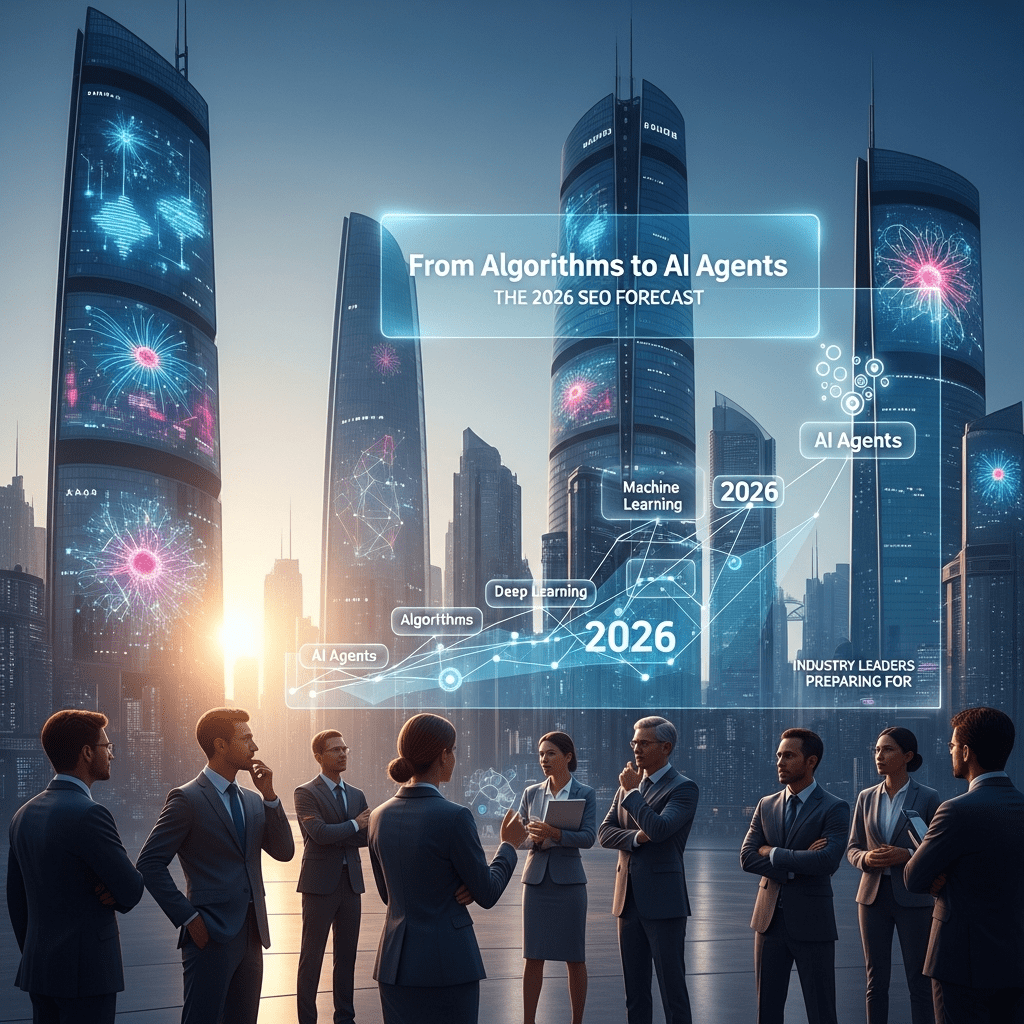
A Comprehensive Market Intelligence Report on the Transformation from Traditional Search Optimization to Agentic AI-Powered Discovery
Table of Contents
ToggleExecutive Summary: The Search Revolution Nobody Saw Coming
We’re standing at the edge of something we’ve never seen before in digital marketing. The shift from traditional SEO to what industry leaders are now calling “Search Everywhere Optimization” isn’t just another algorithm update—it’s a fundamental restructuring of how people discover, evaluate, and trust brands online.
Here’s what the data tells us: AI-powered assistants and large language models will handle approximately 25% of global search queries by 2026, according to Gartner research. More strikingly, Semrush predicts that AI Search visitors will surpass traditional search visitors by 2028—and if Google makes AI Mode the default globally, this transition could happen even sooner.
Timeline: The Evolution from Keywords to Conversations
AI could read the internet and summarize information. ChatGPT dominated with 81% global market share among AI chatbots. The foundation was laid for what would come next.
ChatGPT reached over 5 billion monthly visits, becoming the fourth most visited website globally. Google rolled out AI Overviews to more than 200 countries. Traffic from LLMs rose from approximately 17,000 to 107,000 sessions (January-May 2025 comparison, Previsible AI Traffic Report).
AI agents begin executing tasks autonomously. 40% of enterprise applications will include task-specific AI agents by end of 2026 (Gartner). ChatGPT’s Agent Mode (released July 2025) bridges research and action on the live web.
33% of enterprise software applications will embed agentic AI capabilities by 2028. 75% of hiring processes will test AI proficiency. Most dramatically, 90% of all B2B purchases will be handled by AI agents, channeling over $15 trillion in spending (Gartner Strategic Predictions).
The autonomous AI and agents market reaches an estimated USD 47.1 billion. Agentic purchasing becomes mainstream, starting with grocery and food delivery apps.
The Old SEO vs. The New Reality: A Side-by-Side Comparison
| Aspect | Traditional SEO (Pre-2025) | Search Everywhere Optimization (2026+) |
|---|---|---|
| Primary Goal | Rank #1 on Google | Be cited across all search experiences |
| Key Metric | Keyword rankings, organic traffic | Citations, mentions, Share of SERP, AI visibility |
| Content Strategy | Keyword optimization | Entity-based, conversational, multi-platform |
| Platforms | Google, Bing | ChatGPT, Perplexity, TikTok, Reddit, YouTube, Amazon, Google AI Mode |
| Success Indicator | Click-through rate | Brand authority, zero-click answers, conversions |
| User Journey | Linear: Search → Click → Convert | Fractured: Multi-platform discovery across 5-7 touchpoints |
| Content Format | Text-heavy blog posts | Video, short-form, UGC, structured data, FAQ sections |
| Link Building | Backlinks from any site | Earned media, Digital PR, citations from authoritative sources |
The Numbers Don’t Lie: What’s Actually Happening Right Now
The Zero-Click Reality
This is the new battlefield. When AI summaries appear, users are treating them as complete answers—not starting points for deeper exploration. If your brand isn’t cited in those summaries, you’re essentially invisible to a quarter of all searches.
AI Content in Search Results
Here’s something that should wake you up: AI-written pages now appear in over 17% of top search results. Content created with AI often starts showing up in search results in two months or less. Nearly half of online sellers (47%) rely on AI to write product descriptions.
The AI Overview Phenomenon
AI Overviews are appearing in more than 200 countries and territories, with strong adoption in the first two markets. Here’s what triggers them:
- 89% of queries triggering AI Overviews have informational intent
- 8.69% are commercial queries (consideration phase)
- 1.76% are transactional queries
- 1.43% are navigational queries
Sites that appear as sources inside AI Overviews see a noticeable boost in click-through rate, based on research across 7,800+ queries. It’s modest, but it reinforces that visibility within AI summaries now matters almost as much as traditional rankings.
Platform Fragmentation
Meanwhile, according to ETRAFFIC research, 81% of Gen Z still start product discovery on TikTok, YouTube, or Instagram, and AI search now handles 42% of informational queries across platforms like ChatGPT, Gemini, and Perplexity.
The Agentic AI Revolution: When Search Becomes Action
This isn’t just about finding information anymore. We’re talking about AI agents that can autonomously:
- Research potential customers and identify buying signals
- Personalize outreach communications and schedule meetings
- Update CRM systems and nurture leads through multi-touch sequences
- Execute purchases without human intervention
- Negotiate contracts and close deals while monitoring market conditions
The Grocery Store Test
“I’m in the mood for pizza, order me my favorite type of pizza from somewhere nearby for under $20, and the AI agent picks for you.”
Industry experts predict that agentic purchasing becomes mainstream starting with grocery and food delivery apps. Consumers already trust apps like DoorDash, UberEats, and Grubhub, and they frequently reorder the same foods—creating perfect conditions for agentic automation.
The Enterprise Transformation
According to the 2025 Connectivity Benchmark report by MuleSoft and Deloitte Digital, 93% of IT leaders report intentions to introduce autonomous agents within the next 2 years, and nearly half have already implemented them.
Expert Perspectives: What Industry Leaders Are Actually Saying
In 2026, search is going to move away from just keywords and towards more conversational, context-rich answers powered by AI. Visibility will depend more on having strong topical depth and authentic E-E-A-T signals that showcase real expertise.
— Bláithín O’Connor, SEO Expert at Embryo
Search hasn’t been solely about Google for a few years now. Users increasingly seek information across platforms like YouTube, TikTok, ChatGPT and social media. This shift means that SEOs must adapt by focusing on creating content relevant to their brand and tailored to appear natively on these diverse platforms where people spend their time.
— Nikki Lam, VP, Head of SEO at NP Digital U.S.
AI agents like ChatGPT will shift from answering questions to completing transactions. Being ‘callable’ through APIs and integrations will be as critical in 2026 as being crawlable was in 2010.
— Benu Aggarwal, Founder and President of Milestone Inc.
From an AI dev perspective, LLMs still very much rely on Google search results to generate AI overviews and deep research reports. For this reason, traditional SEO will remain relatively the same but a larger emphasis will need to be made on dominating the top 3-5 results, and the company brand will become increasingly important too.
— Ryan Morgan, SEO Expert at Embryo
The best practice across technical SEO elements will become increasingly important in 2026, ensuring that all possible value is accessible and understandable by search engines and LLMs. Site speed is more important than ever.
The E-E-A-T Evolution: Why Trust Matters More Than Ever
With AI systems generating vast amounts of content, Google and other platforms rely more heavily on signals that prove authenticity and real-world authority. The E-E-A-T framework (Experience, Expertise, Authoritativeness, Trustworthiness) has taken on heightened importance.
The Four Pillars of Modern Content Credibility
Experience: Has the person writing actually done what they’re talking about? First-hand, real-world interaction with the topic.
Expertise: Do they have proven knowledge in the field? Academic achievements, qualifications, and standing within the industry.
Authoritativeness: How much authority does the content creator or site hold? Being recognized as a trusted source by others in the industry.
Trustworthiness: Is the content accurate, honest, and helpful? Building credibility through consistent, high-quality information.
According to Google’s Search Quality Evaluator Guidelines, content demonstrating strong E-E-A-T is “critical for topics that impact a person’s health, finances, or safety.” While E-E-A-T isn’t a direct ranking factor, it heavily influences how content is evaluated and indirectly impacts ranking signals.
Strategic Imperatives: What You Need to Do Right Now
💡 Action Item #1: Audit Your Current Visibility
- Track AI referral traffic from ChatGPT, Perplexity, Claude, and Google’s AI Overviews
- Benchmark your organic search performance across traditional and AI-powered platforms
- Measure how often you’re cited in AI-generated results
- Evaluate your Share of SERP, not just keyword rankings
💡 Action Item #2: Optimize for AI Citation
- Structure content with clear, modular FAQ sections
- Implement semantic entity tagging throughout your content
- Use explicit citation authority and expert bylines
- Create structured outlines that AI systems can easily parse
- Add comprehensive schema markup (Article, Person, Organization, FAQ, HowTo)
💡 Action Item #3: Build Multi-Platform Presence
- Optimize your Google Business Profile and local citations
- Create short-form video content for TikTok and YouTube Shorts
- Build authentic presence on Reddit and industry forums
- Leverage user-generated content and customer reviews
- Ensure consistency across all platforms (NAP data, branding, messaging)
💡 Action Item #4: Invest in Digital PR and Brand Authority
- Focus on earned media over paid advertising
- Build relationships with authoritative publications in your industry
- Create newsworthy content that journalists will reference
- Monitor brand mentions and sentiment across the web
- Actively manage your online reputation
💡 Action Item #5: Perfect Your Technical Foundation
- Optimize Core Web Vitals (page speed, mobile-friendliness, responsiveness)
- Ensure crawl budget optimization and clean site architecture
- Implement structured data for better AI comprehension
- Create llms.txt rules for agent-friendly indexing
- Fix all broken links, redirects, and technical errors
The Content Strategy Shift: From Keywords to Conversations
Traditional keyword-focused SEO is giving way to semantic clustering and topic-based optimization. With Google algorithm updates in 2025 and 2026, there’s more importance on user intent, comprehensive coverage of topics, and natural language within content.
The Content Waterfall Method
Here’s the smarter way to approach content in 2026: create once, distribute everywhere. Instead of writing different versions for each platform, repurpose strategically:
- Core Content: Create a comprehensive, keyword-optimized guide (your pillar content)
- Google Blog Post: Long-form, detailed version with proper schema markup
- Instagram Carousel: Bite-sized version with key tips and engaging visuals
- TikTok Video: 30-second breakdown with trending audio
- YouTube Video: Longer, detailed version with expert commentary
- Reddit Discussion: Community-focused angle that invites engagement
- LinkedIn Article: Professional perspective for B2B audiences
This approach expands reach, boosts SEO through more search touchpoints, and saves time by maximizing your content investment.
The Cost Reality: What Search Everywhere Optimization Actually Requires
According to SEO.com research, Search Everywhere Optimization services typically cost a few thousand dollars per month, compared to traditional SEO’s \$1,500-\$5,000 monthly range. The exact pricing varies by provider, but the investment reflects the expanded scope:
- Multi-platform optimization (7+ platforms vs. 1-2)
- Content creation in multiple formats (video, images, text, audio)
- Advanced tracking and reporting across fragmented touchpoints
- Digital PR and earned media relationship building
- Continuous monitoring of AI citation and visibility
The Measurement Challenge: How to Track What Matters
One of the biggest challenges facing marketers in 2026 is measurement. Without comprehensive data, it’s difficult to prove the value of these optimizations to leadership.
Key Metrics for 2026
- Citations: Links from search experiences (AI Overviews, ChatGPT responses)
- Mentions: Brand references without direct links
- Placement Ranking: Where you appear in AI-generated responses
- Referral Traffic: Visits from AI platforms tracked via Google Analytics 4
- Share of SERP: How visible your brand is across all SERP features
- Conversions: Sales or leads generated directly or indirectly through AI channels
- Sentiment Score: Positive vs. negative mentions across platforms
In most cases, businesses have to pull AI visibility numbers manually using spreadsheets. Industry experts predict an “Extinction Event” in Q3 2026 for the standalone AI visibility tracking category, with most tools evolving into workflow automation platforms.
The Competitive Landscape: Who’s Winning and Why
According to recent research, bigger brands have a short-term advantage due to established reputation and existing authority signals. However, challengers who invest in reputation, presence, and smarter measurement can still carve out a meaningful share of voice in the long term.
The brands succeeding in this new landscape share common characteristics:
- Strong domain authority and established online presence
- Active earned media and PR programs
- Consistent, high-quality content across multiple platforms
- Genuine expertise demonstrated through author credentials
- User-generated content and authentic customer testimonials
- Technical excellence (fast sites, clean code, proper structure)
- Multi-platform visibility strategy
The Risks Nobody’s Talking About
Legal Exposure and AI-Related Claims
Gartner expects more than 2,000 “death by AI” claims by the end of 2026 tied to safety failures involving autonomous systems. This will prompt recalls, law-enforcement investigations, and heightened regulatory pressure.
The EU AI Act
Platforms will be forced by regulators (EU AI Act, August 2026 deadline) to label AI content. Cameras and iPhones will start embedding C2PA digital signatures at the hardware level. If content lacks this “chain of custody” metadata, platforms will auto-label it as “unverified/synthetic.”
The Monetization Shift
Leaked code in the ChatGPT Android App explicitly references “search ads carousel” and “bazaar content.” Industry analysts predict OpenAI shifts to a hybrid pricing model in 2026:
- Ad-supported free tier: Free users will see “sponsored citations” and product cards (ads) in answers
- Credit-based pro tier: Power users will face “compute credits” where heavy use of deep research or reasoning agents requires buying top-up packs
Inference costs are skyrocketing. A heavy user paying $20/month can easily burn $100+ of computing, making them unprofitable under current models.
Industry-Specific Implications
Healthcare
AI is projected to save the healthcare industry up to $150 billion annually by 2026 through error reduction and enhanced efficiency. Virtual nurses monitor patients remotely, develop personalized care plans, and send medication reminders, resulting in reduced hospital visits.
Financial Services
70% of financial institutions use AI to detect fraudulent transactions, improving detection by 40%. Banks use AI agents to provide round-the-clock customer support, analyze financial data, and identify fraud patterns.
Retail and E-commerce
AI assists retailers in customizing shopping experiences, managing inventory, and optimizing supply chains. Amazon and other marketplaces are evolving into primary search destinations, requiring specific optimization strategies.
Frequently Asked Questions
No. Traditional SEO remains a critical foundation for Search Everywhere Optimization. Sites practicing good SEO are more likely to appear across all search experiences. Google still dominates search engine market share, bringing in a massive 98.2 billion global visits monthly. Organic search alone drives 53% of all website traffic. However, SEO alone is no longer enough—you must expand to include AI-powered platforms and multi-channel visibility.
The adoption is accelerating faster than most predictions. By end of 2026, 40% of enterprise applications will include task-specific AI agents (Gartner). By 2028, 33% of enterprise software applications will embed agentic AI capabilities. For consumer applications, agentic purchasing is expected to become mainstream starting in 2026 with grocery and food delivery apps.
Waiting. Companies that delay adapting to Search Everywhere Optimization are losing visibility every day. The second biggest mistake is treating this as a single-channel problem. Success requires coordinated optimization across Google, AI platforms, social media, video platforms, and industry-specific channels.
Track these key metrics: citations in AI Overviews and chatbot responses, brand mentions across platforms, referral traffic from AI platforms (use Google Analytics 4), conversions generated through AI channels, Share of SERP across all features, and sentiment scores for your brand mentions. Most companies currently track this manually using spreadsheets.
Absolutely not. Google remains dominant with 91% market share and processes over 8.3 billion searches daily. According to Embryo Agency, 52.7% of all searches are still informational, and 14.5% have commercial intent. The key is maintaining strong Google SEO while simultaneously building visibility on AI platforms and other channels.
Content quality is more critical than ever. AI systems favor content with strong E-E-A-T signals, comprehensive coverage, clear structure, and authoritative sources. Generic, AI-generated content without human expertise won’t get cited. The brands winning are those combining AI efficiency with genuine human expertise and experience.
Extremely important. Short attention spans demand short-form videos. Gen Z starts 1 in 10 searches with Google Lens, and visual search is growing rapidly. Platforms like TikTok, YouTube, and Instagram are primary search destinations. Video content also increases engagement and provides more opportunities for AI systems to cite your brand.
For most organizations, this is a 6-12 month journey. Start with audit and strategy (month 1), then prioritize platforms based on where your customers actually search (months 2-3). Implement technical foundations and content optimization (months 3-6), scale to additional platforms (months 6-9), and continuously measure and refine (ongoing). Small businesses may need 12-18 months to fully implement.
External Resources and Further Reading
- Gartner Strategic Predictions for 2026 and Beyond
- Semrush: 26 AI SEO Statistics for 2026
- Search Engine Journal: Google’s Old Search Era Is Over
- Exposure Ninja: AI Search Trends for 2026
- MarketsandMarkets: AI Agents Market Analysis
- Zero Gravity Marketing: 9 SEO Predictions for 2026
- WSI World: Marketing & AI Predictions for 2026
- Backlinko: Search Everywhere Optimization Guide
- Neil Patel: Search Everywhere Optimization Strategy
- Greenlane Marketing: SEO Trends for 2026
Final Thoughts: The Future Belongs to the Adaptable
We’re witnessing the most significant transformation in digital marketing since the advent of search engines themselves. The shift from algorithms to AI agents isn’t just changing how people find information—it’s fundamentally restructuring how commerce, communication, and decision-making happen online.
The brands that will thrive in 2026 and beyond aren’t necessarily those with the biggest budgets or the most sophisticated technology. They’re the ones that understand this fundamental truth: search is no longer about being found in one place—it’s about being trusted everywhere.
The good news? You don’t have to master everything at once. Start with audit and awareness. Understand where your customers are actually searching. Build your technical foundation. Strengthen your E-E-A-T signals. Expand gradually to new platforms. Measure what matters. Iterate and improve.
The companies moving now—even with small, strategic steps—are building competitive advantages that will compound over time. Those waiting for “certainty” or “perfect conditions” are already falling behind.
The agentic era is here. The only question is: are you ready to meet it?