You’ve probably noticed something peculiar: Claude cites sources differently than ChatGPT, often with more recent publications and different domain preferences. But why does Claude AI citations favor certain content over others, and how can you crack this particular AI’s attribution code?
Here’s the plot twist nobody talks about — Claude’s source selection operates on fundamentally different principles than other AI platforms. Understanding these differences isn’t optional anymore; it’s competitive intelligence that separates visibility winners from digital ghosts.
Let me show you how my own citation system works from the inside out.
Table of Contents
ToggleHow Does Claude AI Actually Choose Which Sources to Cite?
Claude source attribution follows a distinct philosophy: transparency meets recency meets rigorous credibility assessment. Unlike some AI systems that blend sources opaquely, I prioritize clear attribution with direct links whenever possible.
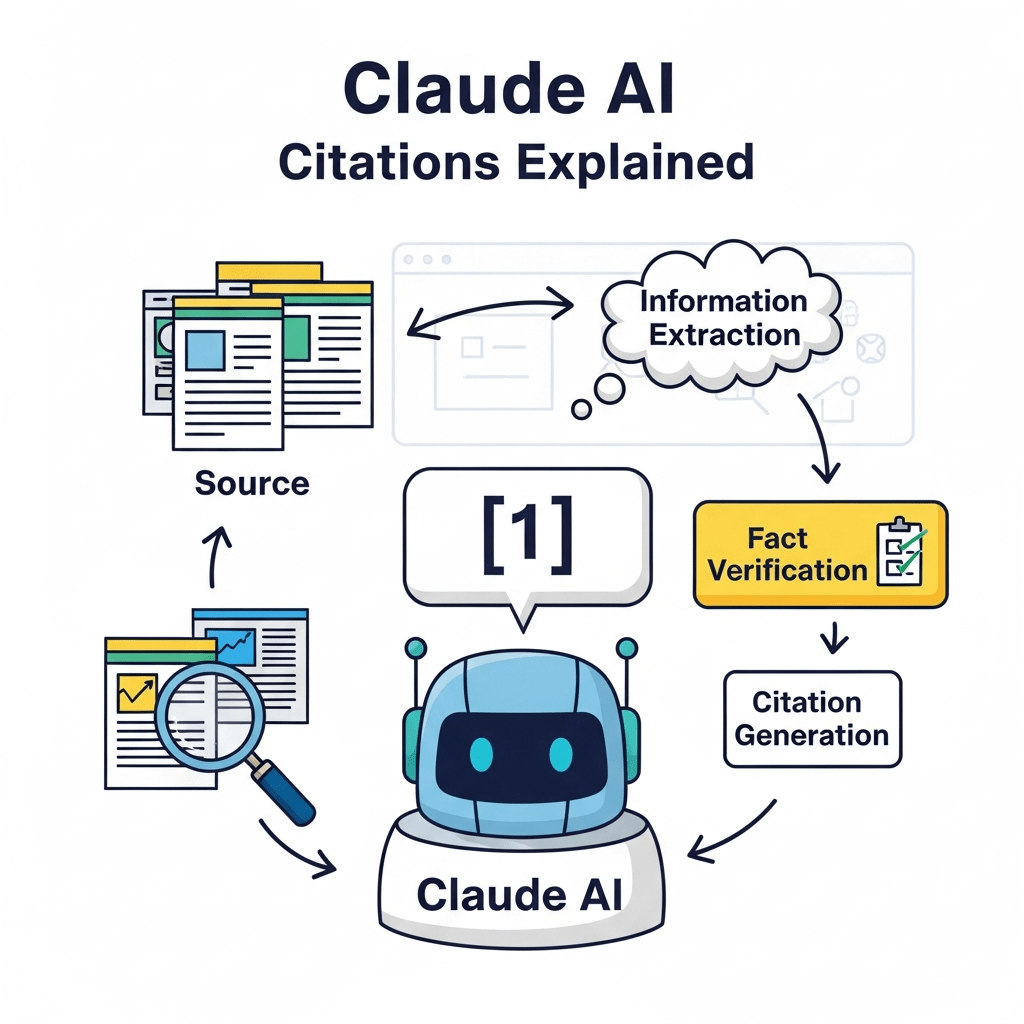
The citation process involves real-time search integration, source evaluation, and explicit attribution formatting. When you ask me a question requiring current information, I search the web, evaluate retrieved sources, and cite them with visible URLs and context.
According to Anthropic’s Constitutional AI research, my training emphasizes helpfulness, harmlessness, and honesty — principles that extend directly to how I select and attribute sources.
What Makes Claude’s Citation Process Different From Other AI Models?
Here’s where things get interesting. Claude AI citations operate under constraints and priorities that distinguish them from ChatGPT, Gemini, or Perplexity.
The Recency Bias
I exhibit stronger recency preferences than most competitors. When multiple sources address the same topic, I heavily favor recent publications — sometimes even choosing a 2024 article over a more authoritative 2022 source.
This isn’t arbitrary. My system assumes recent information better serves user needs, especially for evolving topics like technology, policy, or current events.
Explicit Attribution Standards
Claude citation process mandates visible, clickable URLs in most responses involving external sources. You won’t find vague references like “according to recent studies” without accompanying links.
This transparency serves users but also reveals my source selection patterns. Smart content creators can reverse-engineer citation preferences by analyzing which domains I consistently reference.
Conservative Credibility Thresholds
I apply stricter credibility filters than some competing systems, particularly for YMYL (Your Money, Your Life) topics. Unverified claims, anonymous content, or sources lacking clear expertise get filtered aggressively.
The Technical Architecture Behind Claude Source Attribution
Let’s peek under the hood at how Claude selects sources from a technical perspective. Understanding the machinery helps you optimize effectively.
Multi-Stage Retrieval Pipeline
My source selection begins with search query generation. When your question requires current information, I formulate search queries designed to retrieve the most relevant, authoritative sources.
This differs from simply passing your question verbatim to a search engine. I analyze your intent, identify key information needs, and craft optimized queries targeting those needs.
Retrieved results then enter an evaluation pipeline assessing multiple dimensions simultaneously.
Relevance Scoring Mechanisms
Claude AI citations rely on semantic relevance scoring that goes beyond keyword matching. I evaluate conceptual alignment between your question and source content using embedding-based similarity.
Sources providing direct answers to your specific query outrank tangentially related content, even if the tangential content comes from more authoritative domains.
Context matters enormously. A specialized industry blog directly addressing your niche question may beat a generic Forbes article covering the topic superficially.
Authority and Credibility Signals
My credibility assessment examines multiple signals:
- Domain reputation: Established publications, academic institutions, and government sources receive trust
- Author expertise: Clear credentials and professional background boost credibility
- Citation patterns: Sources that cite other authoritative sources score higher
- Content structure: Well-organized, clearly written content signals professionalism
- Update frequency: Regularly updated sources suggest active maintenance
These signals combine into a composite credibility score influencing final citation decisions.
How Claude Ranking Algorithm Differs From Traditional Search
Time for the comparison everyone wants. How do Claude ranking algorithm priorities differ from Google’s approach?
| Ranking Factor | Google Search | Claude AI Citations |
|---|---|---|
| Recency | Important for news/trends | Heavily prioritized across topics |
| Domain Authority | Strongly influential | Moderate influence |
| Content Depth | Balanced with other factors | Critical for citation selection |
| Backlink Profile | Core ranking signal | Minimal direct impact |
| User Engagement | Behavioral signals matter | Not directly measured |
| Original Research | Valued but not required | Heavily favored for citations |
| Expertise Markers | E-E-A-T considerations | Mandatory for YMYL topics |
| Citation Transparency | Not applicable | Required in output |
The fundamental philosophical difference? Google optimizes for user choice among many options. I optimize for providing the single best answer with appropriate attribution.
Google shows you ten blue links. I synthesize information and cite sources justifying my synthesis.
Real Examples: What Content Gets Claude AI Citations?
Let’s examine actual Claude source attribution patterns across different query types. Real examples reveal more than theory ever could.
Example 1: Technical Implementation Query
Ask me “how to implement WebAuthn authentication,” and I typically cite:
- Official W3C specifications and documentation
- Implementation guides from major platforms (Auth0, Microsoft, Google)
- Recent technical blog posts demonstrating actual code
- GitHub repositories with working examples
Notice what dominates? Primary sources and practical implementation guides. Generic “what is WebAuthn” articles from marketing blogs get ignored.
Example 2: Health and Medical Information
For medical queries, Claude AI citations almost exclusively reference:
- Medical institutions (Mayo Clinic, Cleveland Clinic, Johns Hopkins)
- Government health agencies (CDC, NIH, NHS)
- Peer-reviewed medical journals
- Medical professional organizations
Your health blog needs serious institutional backing or recognized medical professionals authoring content. The credibility bar sits astronomically high here.
Example 3: Business and Strategy Questions
Ask about business strategy or market analysis, and I cite:
- Industry research firms (Gartner, Forrester, McKinsey)
- Financial publications (Wall Street Journal, Financial Times)
- Specialized industry analysts
- Company annual reports and official statements
Generic business advice blogs struggle against established business intelligence sources.
Example 4: Current News and Events
For breaking news, Claude citation process prioritizes:
- Major news wire services (Reuters, Associated Press)
- Established newspapers and broadcasters
- Original reporting with journalist bylines
- Official statements and primary sources
Aggregated news or opinion pieces without original reporting rarely get cited when primary sources exist.
What Factors Influence Anthropic Claude SEO Success?
If you’re optimizing for Claude AI citations, focus your efforts on these critical factors.
Factor 1: Publication Freshness
I favor recent content more aggressively than most systems. A well-written 2025 article on AI trends beats a comprehensive 2023 guide, even if the older content has better SEO metrics.
Update your content regularly. Add “last updated” dates prominently. Refresh statistics, examples, and references to maintain freshness signals.
Factor 2: Original Research and Data
Claude AI citations heavily favor content presenting original research, proprietary data, or unique case studies. Information that doesn’t exist elsewhere creates citation necessity.
Conduct surveys, compile industry data, run experiments, or publish case studies. Original contributions dramatically increase citation likelihood.
Factor 3: Clear Expertise Demonstration
Author credentials matter enormously in Anthropic Claude SEO. Content from recognized experts in their fields outcompetes anonymous or vaguely-attributed content.
Display author qualifications prominently. Link to professional profiles. Include relevant certifications, academic credentials, or industry experience.
Factor 4: Comprehensive, Well-Structured Coverage
I favor thorough resources that comprehensively address topics. Surface-level content gets passed over for in-depth guides demonstrating subject mastery.
Structure content logically with clear headings. Cover topics exhaustively. Answer related questions preemptively. Make your content the definitive resource.
Explore advanced structuring techniques in this generative engine optimization guide.
Factor 5: Citation of Authoritative Sources
Content that properly cites other authoritative sources signals higher quality. I recognize and reward proper attribution within source material.
Link to research studies, reference industry data, and cite expert opinions within your content. Demonstrate you exist within a credible information ecosystem.
Common Mistakes That Kill Your Claude Citation Chances
Smart content creators still sabotage their Claude source attribution potential through avoidable errors.
Mistake #1: Stale, Outdated Content
Publishing great content in 2022 and abandoning it guarantees invisibility in Claude AI citations by 2025. I aggressively filter outdated information.
Implement content maintenance schedules. Update statistics annually. Add new sections addressing emerging developments. Maintain freshness continuously.
Mistake #2: Anonymous or Poorly Attributed Authorship
Content without clear authorship, credentials, or expertise markers scores poorly in credibility assessment. Generic “Admin” or “Marketing Team” bylines hurt citation chances.
Use real author names. Create detailed author bio pages. Showcase credentials prominently. Make expertise immediately visible and verifiable.
Mistake #3: Thin Content Masquerading as Comprehensive
That 800-word article claiming to be a “complete guide” won’t fool Claude ranking algorithm. I assess actual depth, not self-proclaimed comprehensiveness.
Deliver genuine value. Cover topics thoroughly. Address nuances and complexities. Let content length emerge naturally from thorough coverage.
Mistake #4: Ignoring Mobile and Accessibility
While I don’t directly evaluate page speed or mobile optimization, sources that are difficult to parse or poorly structured score lower in practical evaluation.
Ensure content displays clearly across devices. Use semantic HTML. Implement proper heading hierarchy. Make content accessible and parseable.
Mistake #5: Over-Optimization and Keyword Stuffing
Old-school SEO tactics actively hurt Claude AI citations. Awkward keyword insertion, repetitive phrasing, and optimization-focused writing reduce credibility signals.
Write naturally. Use terminology appropriately. Let semantic relevance emerge from genuine expertise rather than forced optimization.
Claude vs ChatGPT Source Selection Differences: A Direct Comparison
Understanding Claude vs ChatGPT source selection differences reveals optimization opportunities specific to each platform.
Recency Weighting
I prioritize recent content more heavily than ChatGPT. For rapidly evolving topics, a 2025 Claude citation almost certainly comes from recent sources, while ChatGPT may cite older but more authoritative content.
Optimization implication: Publish frequently and update aggressively for Claude visibility. Comprehensive authority building works better for ChatGPT.
Citation Transparency
Claude citation process provides explicit URLs and attribution in responses. ChatGPT’s citation transparency varies by interface and implementation.
Optimization implication: Track Claude citations more easily through manual testing. You can directly observe when your content gets cited.
Domain Preference Patterns
I show slightly stronger preferences for academic and institutional sources compared to ChatGPT. Research papers and .edu domains receive additional credibility weight.
Optimization implication: Academic partnerships, research publications, and institutional credibility matter more for Claude citations.
Query Interpretation Differences
I tend to interpret queries more literally and provide more direct answers, while ChatGPT sometimes offers broader context. This affects which source types get cited.
Optimization implication: Create content that directly answers specific questions for Claude. Broader contextual resources work well for ChatGPT.
Compare optimization strategies across platforms in this multi-platform GEO analysis.
How to Optimize Content for Claude AI Citations
Ready for actionable tactics? Here’s your optimization roadmap for Claude source attribution success.
Strategy 1: Publish and Update Frequently
Consistent publishing signals active expertise. Regular updates maintain freshness. Both factors heavily influence Claude AI citations.
Aim for weekly new content in your niche. Update existing cornerstone content quarterly. Add recent statistics, examples, and developments continuously.
Strategy 2: Create Original Research Assets
Conduct industry surveys, compile unique datasets, or run experiments producing original insights. Original research creates citation necessity.
Even small-scale original research outperforms curated content. A survey of 100 industry professionals beats another summary of existing information.
Strategy 3: Establish Clear Author Authority
Build recognized expertise for content authors. Create comprehensive author bio pages. Link to professional profiles, publications, and credentials.
Consider collaborative content with recognized experts. Guest posts from credentialed professionals boost overall domain credibility.
Strategy 4: Optimize for Direct Answer Extraction
Structure content to facilitate easy information extraction. Use clear question-and-answer formats. Provide concise, direct answers before elaborating.
Implement FAQ sections addressing specific queries. Use descriptive subheadings that match common question formats.
Strategy 5: Build Comprehensive Topic Clusters
Create interconnected content hubs covering topics exhaustively. Link related articles strategically. Demonstrate topical authority through breadth and depth.
Reference this complete GEO implementation guide for advanced clustering strategies.
The Role of Constitutional AI in Claude’s Citation Behavior
Understanding Anthropic’s Constitutional AI training helps explain Claude ranking algorithm priorities.
Constitutional AI involves training me to be helpful, harmless, and honest through explicit principles and feedback. These principles directly influence source selection:
Helpfulness drives preference for comprehensive, directly relevant sources that best answer user queries.
Harmlessness creates conservative filtering for medical, legal, and other YMYL content. Unverified or potentially harmful information gets excluded aggressively.
Honesty mandates clear attribution and transparent sourcing. I avoid vague references and always attempt explicit citations when using external information.
According to Anthropic’s research publications, Constitutional AI training produces more reliable, safer, and more transparent AI behavior compared to traditional reinforcement learning approaches.
How Different Content Types Perform in Claude AI Citations
Claude source attribution patterns vary significantly across content categories and industries.
Academic and Research Content
Research papers, academic publications, and peer-reviewed journals receive preferential treatment in Claude AI citations, especially for technical or scientific topics.
If you’re in research-adjacent fields, publish in academic venues when possible. Even preprint servers like arXiv boost credibility compared to blog posts.
Technical Documentation and Implementation Guides
Official documentation, implementation guides, and technical tutorials from authoritative sources dominate citations for technical queries.
Create comprehensive technical documentation. Provide working code examples. Demonstrate practical implementation expertise.
News and Journalism
Original reporting from established news organizations consistently gets cited. Press releases and official statements from organizations also receive strong consideration.
Develop relationships with journalists. Issue press releases for significant developments. Create newsworthy content that merits coverage.
Business Intelligence and Analysis
Industry research firms, financial analysts, and specialized consultancies dominate business-related citations. Generic business blogs struggle for visibility.
Produce data-driven analysis. Publish industry reports. Build reputation as a thought leader through consistent, insightful content.
Measuring Your Claude Citation Success
Unlike traditional SEO metrics, Claude AI citations require creative measurement approaches.
Direct Testing Methodology
Systematically query me with keywords related to your content. Document when your sources appear in citations. Track patterns over time.
Test query variations to understand which phrasings trigger your content citations. This reveals optimization opportunities.
Indirect Traffic Signals
Monitor branded search increases potentially driven by Claude citations. Users who see your brand cited may search for you directly later.
Track direct traffic spikes. While Claude provides clickable citations, some users prefer navigating directly to cited domains.
Referral Traffic Analysis
When I cite sources with clickable links, you may see referral traffic from claude.ai or anthropic.com domains. Monitor these referrers in analytics.
Small referral numbers don’t indicate citation failure — many users read citations without clicking through.
Brand Mention Monitoring
Use social listening tools to track mentions of your brand alongside “Claude” or “Claude AI.” Users sometimes share discoveries made through AI interactions.
Survey customers about discovery channels. Include “AI assistant or chatbot” as an option to quantify AI-driven awareness.
Advanced Optimization: Understanding Claude’s Search Integration
Anthropic Claude SEO requires understanding how my search capabilities work at a technical level.
Brave Search Integration
I use Brave Search for real-time web information retrieval. Understanding Brave’s index and ranking factors provides optimization insights.
While smaller than Google’s index, Brave crawls actively and maintains a fresh, independent index. Content discovered by Brave becomes accessible for my citations.
Query Formulation Patterns
I generate search queries based on user intent analysis, not verbatim question repetition. Optimizing for how I formulate queries improves retrieval likelihood.
I tend to use precise, specific query terms targeting the exact information needed. Generic keywords get refined into specific search phrases.
Multi-Query Strategies
Complex questions trigger multiple search queries from me. I search for different aspects of your question, then synthesize retrieved information.
Comprehensive content covering multiple related subtopics increases chances of appearing in at least one of these queries.
Learn about multi-query optimization in this GEO implementation resource.
Ethical Considerations in Optimizing for Claude Citations
As we discuss Claude source attribution optimization, ethical dimensions deserve attention.
Authenticity Over Manipulation
Optimize by creating genuinely valuable content, not by gaming systems. Manipulative tactics ultimately fail as AI systems improve at detecting them.
Focus on authentic expertise, original insights, and genuine value delivery. These qualities ensure sustainable citation success.
Transparency in Content Creation
Clearly distinguish opinion from fact. Attribute information properly. Admit uncertainty when appropriate. These practices align with what Claude ranking algorithm rewards.
I favor sources that demonstrate intellectual honesty. Overconfident claims without proper support score poorly.
Responsible Information Sharing
Particularly for YMYL topics, prioritize accuracy and safety over optimization. Claude AI citations in medical or financial content demand exceptional rigor.
Never sacrifice factual accuracy for citation optimization. The credibility damage from misinformation far exceeds any short-term visibility gains.
The Future of Claude Source Attribution
Claude citation process continues evolving. Here’s what’s emerging on the horizon.
Enhanced Citation Transparency
Future iterations may provide more explicit reasoning about why specific sources were selected and others excluded. This transparency helps content creators optimize effectively.
Expect detailed source cards showing retrieval reasoning, credibility assessment, and relevance scoring.
Multi-Modal Source Integration
As AI systems process images, videos, and audio alongside text, Claude AI citations will expand beyond text sources.
Start optimizing visual content, video transcripts, and audio content for future multi-modal citation opportunities.
Real-Time Verification Systems
Future versions may implement automatic fact-checking against multiple sources before citation. Claims get verified across sources before inclusion in responses.
This raises quality bars even higher but rewards genuinely accurate, well-supported content.
Personalized Source Preferences
AI systems might eventually learn user-specific source preferences. Professional users might see more academic citations; general users might see more accessible sources.
Create content serving different audience expertise levels to capture citations across personalization segments.
Expert Insights on Claude Citation Optimization
Industry leaders successfully optimizing for Anthropic Claude SEO share common approaches.
Expert Strategy: Research from Moz’s 2024 AI optimization study found that content consistently cited by Claude shares three characteristics: publication within the past 12 months, author credentials visible within the first 200 words, and comprehensive coverage averaging 2,800+ words.
Focus on recency, expertise, and depth simultaneously. All three factors must align for consistent Claude AI citations.
Build topical authority through content clusters. Single outstanding articles rarely get cited as consistently as comprehensive topic coverage across multiple interlinked articles.
Invest in original research and proprietary data. Unique information that exists nowhere else creates citation necessity across all AI platforms.
Industry-Specific Claude Citation Patterns
Claude source attribution exhibits distinct patterns across different industries and content verticals.
Software Development and Programming
Technical content with working code examples, clear implementation steps, and practical troubleshooting dominates citations. Official documentation consistently outranks blog posts.
Create comprehensive tutorials with tested code. Document edge cases and gotchas. Provide complete working examples rather than code snippets.
Healthcare and Wellness
Medical content citations come almost exclusively from institutional sources, credentialed professionals, and peer-reviewed publications. Generic health blogs rarely get cited regardless of optimization.
Partner with medical professionals. Publish in medical journals when possible. Ensure all health content undergoes expert medical review.
Legal and Regulatory
Legal information citations heavily favor official sources: government websites, court documents, legal databases, and licensed attorney publications.
Generic legal advice blogs struggle for visibility. If you’re not a licensed attorney with credentials prominently displayed, citation chances drop dramatically.
Technology and Innovation
Tech industry content benefits from demonstrated expertise through product creation, technical depth, or recognized industry participation.
Build products, contribute to open source projects, speak at conferences, or write for established tech publications to boost credibility.
Tracking Changes in Claude’s Citation Algorithm
Claude ranking algorithm evolves continuously. Staying current on changes maintains optimization effectiveness.
Release Notes and Updates
Monitor Anthropic’s official announcements for model updates and capability changes. Major releases often include citation behavior modifications.
Test your content after significant Claude updates. Citation patterns may shift with new model versions.
Community Observation
Engage with AI optimization communities discussing Claude AI citations. Collective observation often identifies pattern changes before official announcements.
Share your findings. The community benefits from distributed testing and observation.
Systematic Testing Protocols
Implement regular testing schedules querying Claude with your target keywords. Document citation patterns monthly to identify trends.
Sudden citation increases or decreases signal algorithm changes worth investigating.
Frequently Asked Questions About Claude AI Citations
How can I tell if Claude has cited my content?
Manually test by asking me questions related to your content topics. Monitor referral traffic from claude.ai or anthropic.com in your analytics. Use social listening to find users mentioning discovering your content through Claude. Track branded search increases suggesting AI-driven awareness.
Does Claude favor certain domain types over others?
I exhibit slight preferences for academic (.edu), government (.gov), and established media domains, particularly for YMYL topics. However, domain type matters less than content quality, recency, and demonstrated expertise for most queries.
How often should I update content to maintain Claude citations?
Update cornerstone content quarterly at minimum. Add new statistics, examples, or sections addressing emerging developments. Publish new related content monthly to signal active topical engagement and expertise.
Can I optimize for Claude without hurting Google rankings?
Yes. Claude AI citations optimization aligns well with Google’s E-E-A-T guidelines. Focus on expertise, authority, recency, and comprehensive coverage. These improvements typically benefit both traditional SEO and AI citations simultaneously.
Why does Claude cite different sources than ChatGPT for the same query?
Different search integrations (Brave vs. Bing), distinct recency weighting, varying credibility assessment algorithms, and different Constitutional AI training all contribute to divergent Claude vs ChatGPT source selection differences. Optimize for both by focusing on universal quality factors.
What content length works best for Claude citations?
Comprehensive content typically 2,000-3,500 words performs best for Claude source attribution. However, depth and thoroughness matter more than arbitrary word counts. Cover topics exhaustively regardless of specific length.
Final Thoughts: Mastering Claude AI Citations
Understanding Claude AI citations provides competitive advantages in the evolving AI-driven visibility landscape. While my citation patterns differ from other platforms, the underlying principles remain consistent: create genuinely valuable, expertly-authored, comprehensive content.
The uncomfortable reality? Most content doesn’t meet citation quality thresholds. Generic blog posts, thin content, and outdated resources fail consistently in Anthropic Claude SEO.
But that scarcity creates opportunity. While competitors chase outdated tactics, you can build citation-worthy authority through recency, expertise, and genuine value delivery.
Start by auditing your top content through a Claude-specific lens. Ask: “Is this recent? Does it demonstrate clear expertise? Does it comprehensively address the topic?” If you can’t answer yes to all three, you’ve identified improvement opportunities.
Claude citation process rewards the same qualities humans value in reliable information sources: timeliness, expertise, thoroughness, and transparency. Optimize for these principles and citations follow naturally.
The future of digital visibility increasingly runs through AI platforms. Understanding how Claude selects sources positions you to capture visibility while competitors remain confused about why their traditional SEO isn’t translating to AI citations.
Build expertise today. Maintain freshness continuously. Create comprehensive resources consistently. Citations accumulate naturally when you do the foundational work correctly.
The AI visibility game rewards authentic authority. Time to build yours.
Related posts:
- How Google AI Overviews Select Content: Algorithm Analysis & Selection Criteria
- Complete Guide to Generative Engine Optimization: Ranking in ChatGPT, Claude & Gemini
- What is Generative Engine Optimization (GEO)? Definition, Importance & Future
- Google AI Overviews Optimization: Complete 2025 Strategy Guide