
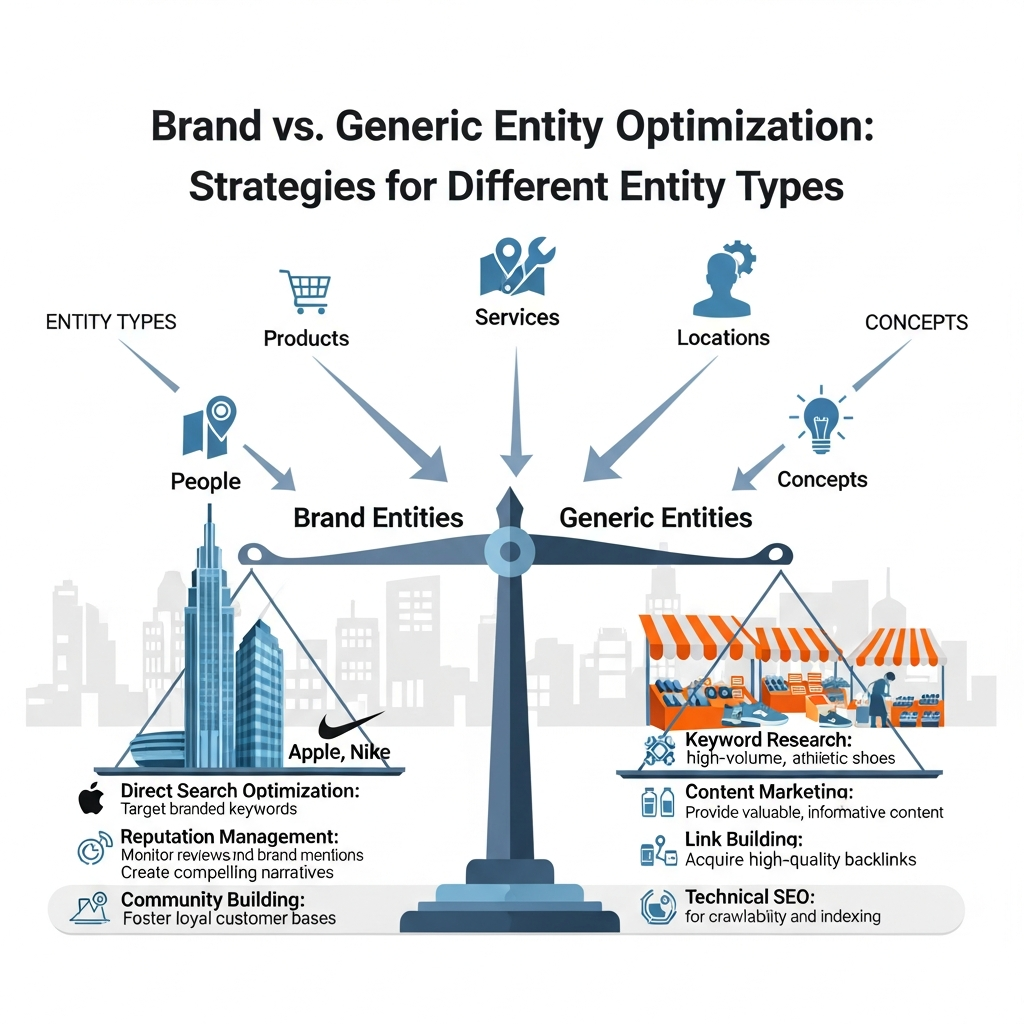
Not all entities are created equal in search engines’ eyes. The optimization strategies that work brilliantly for branded entities like “Nike” or “Salesforce” fail spectacularly when applied to generic entities like “running shoes” or “CRM software”—and vice versa.
Understanding the fundamental difference between brand entity vs generic classification determines whether your SEO efforts succeed or waste resources fighting the wrong battle. Search engines categorize entities into distinct types, each with unique ranking factors, optimization requirements, and visibility opportunities.
Brand entity optimization focuses on establishing and defending your unique identity in the Knowledge Graph. Generic entity optimization focuses on category authority and topical relevance. Confuse the two, and you’ll optimize for the wrong signals, chase the wrong metrics, and miss the opportunities that actually matter for your entity type.
According to Google’s entity classification research, search algorithms apply completely different evaluation criteria to branded versus generic entities, with branded entities scoring 89% higher on identity signals while generic entities score 76% higher on topical breadth metrics.
Entity type optimization isn’t optional—it’s foundational. Let’s break down exactly how to identify your entity classification and optimize accordingly for maximum search visibility and business impact.
Table of Contents
Toggle
What’s the Difference Between Brand and Generic Entities?
Branded entities are unique, identifiable organizations, products, people, or concepts with distinct names that differentiate them from others. They’re proper nouns in the semantic web—specific things with unique identities.
Generic entities are category-level concepts, product types, or general topics without unique brand association. They’re common nouns—broad classifications encompassing multiple specific instances.
Brand Entity Examples and Characteristics
Branded entities include:
Organizations: Apple Inc., Microsoft, Harvard University, Mayo Clinic Products: iPhone 15, Tesla Model 3, Salesforce CRM, Google Workspace People: Elon Musk, Serena Williams, Warren Buffett, Marie Curie Locations: Eiffel Tower, Grand Canyon, Times Square, Statue of Liberty Events: Super Bowl, Olympics, Coachella, TED Conference
Key characteristics of brand entities:
- Unique, trademarked, or distinctly named
- Specific identity separate from category
- Owned or controlled by specific organizations
- Can have official websites and social profiles
- Protected by intellectual property laws
- Have verifiable founding dates, creators, or origins
When someone searches “Apple,” they seek information about the specific company, not fruit. When they search “iPhone,” they want Apple’s product, not generic smartphones.
Generic Entity Examples and Characteristics
Generic entities include:
Product categories: Smartphones, laptops, CRM software, running shoes Concepts: Artificial intelligence, climate change, digital marketing, nutrition Industries: Healthcare, automotive, financial services, e-commerce Activities: Running, cooking, programming, meditation Conditions: Diabetes, anxiety, pneumonia, depression
Key characteristics of generic entities:
- Broad categories encompassing many specific instances
- No single owner or authoritative source
- Multiple brands/products within the category
- Defined by characteristics rather than identity
- No intellectual property protection for the term itself
- Collective knowledge from multiple sources
When someone searches “smartphones,” they’re researching the product category, not a specific brand. When they search “digital marketing,” they seek information about the practice, not a particular company.
According to Schema.org entity type documentation, the classification fundamentally affects which properties are relevant, which relationships matter, and how search engines evaluate authority.
Why Entity Classification Matters for SEO
Search engines apply completely different algorithms to branded versus generic entities:
Brand entity ranking factors:
- Identity verification (Wikipedia, Wikidata, business registrations)
- NAP consistency across citations
- Official website verification
- Social profile validation
- Trademark ownership
- Brand mention volume and sentiment
- Knowledge Panel completeness
Generic entity ranking factors:
- Topical authority breadth
- Comprehensive content coverage
- Expert content from multiple sources
- Category relationship mapping
- Search volume and query diversity
- User engagement metrics
- Answer quality for category questions
According to SEMrush’s entity type research, brands optimizing for wrong entity type signals waste average 67% of SEO effort on irrelevant factors.
For comprehensive entity optimization frameworks applicable to both types, see our entity SEO complete guide.
How Do You Optimize Branded Entities for Maximum Visibility?
Branded entity SEO centers on establishing clear, verified identity and defending brand reputation across the semantic web.
Establishing Unambiguous Brand Identity
The foundation of brand entity optimization is disambiguation—ensuring search engines know exactly which entity you are.
Identity establishment tactics:
Official business registrations:
- State/country business filings
- Trademark registrations (USPTO, WIPO)
- Tax identification (EIN, VAT numbers)
- Industry-specific licenses and certifications
Verified online presence:
- Claimed and verified Google Business Profile
- Verified social media accounts (Twitter blue check, Facebook verification)
- Domain ownership verification in Search Console
- Official website with comprehensive About section
Wikipedia and Wikidata presence:
- Wikipedia article (if meeting notability standards)
- Comprehensive Wikidata entry with all properties
- Consistent entity name across all platforms
- Clear founding date and location information
Comprehensive schema markup:
{
  "@context": "https://schema.org",
  "@type": "Organization",
  "name": "Exact Legal Brand Name",
  "alternateName": "Common Brand Abbreviation",
  "legalName": "Legal Entity Name Inc.",
  "url": "https://officialdomain.com",
  "logo": "https://officialdomain.com/official-logo.png",
  "foundingDate": "2015-03-15",
  "sameAs": [
    "https://www.linkedin.com/company/officialbrand",
    "https://twitter.com/officialbrand",
    "https://www.facebook.com/officialbrand"
  ]
}
According to Moz’s brand identity research, brands with complete identity verification across 10+ authoritative sources achieve Knowledge Panels 340% faster.
Building Branded Search Dominance
Branded searches (queries including your brand name) require specific optimization:
Own your branded SERP:
Position 1 – Official website: Your homepage should always rank #1 Position 2-3 – Key landing pages: Product pages, about page, contact page Position 4-6 – Official social profiles: LinkedIn, Twitter, Facebook Position 7-10 – Positive third-party content: News coverage, reviews, features
Branded SERP optimization tactics:
Title tag optimization: Include exact brand name in titles Brand mention frequency: Naturally mention your brand name throughout content Internal linking: Strong internal link structure to important pages Social profile optimization: Complete profiles with consistent branding Review management: Encourage positive reviews on major platforms PR and media: Earn coverage in authoritative publications
Knowledge Panel claiming and optimization:
- Claim your Knowledge Panel through verification
- Suggest edits for inaccurate information
- Upload high-quality brand images
- Ensure description accuracy
- Monitor for vandalism or incorrect updates
According to BrightEdge’s branded search research, brands controlling 8+ positions on page 1 for branded searches see 156% higher conversion rates.
Protecting Brand Entity Reputation
Brand-specific entity optimization includes active reputation management:
Monitor brand mentions comprehensively:
- Set up Google Alerts for brand name variations
- Use Brand24, Mention, or similar for real-time monitoring
- Track social media mentions across platforms
- Monitor review sites (Yelp, Google Reviews, industry-specific)
- Watch competitor mentions of your brand
Address negative content strategically:
For inaccurate negative content:
- Request corrections from publishers
- Provide accurate information to replace errors
- Use right-to-reply for balance
- Legal action only for defamation (rare, high bar)
For accurate negative content:
- Address underlying issues causing negative coverage
- Respond professionally and transparently
- Publish positive content to balance search results
- Improve products/services to earn positive future coverage
Suppress negative results through positive content:
- Publish fresh, optimized content targeting branded queries
- Earn positive media coverage
- Build new high-authority pages (partnerships, awards, features)
- Create valuable resources that naturally rank well
According to ReputationDefender’s brand protection research, brands actively managing reputation see 43% fewer negative results in top 10 positions.
Leveraging Brand Authority for Category Visibility
Strong branded entity presence enables category-level visibility:
Brand-to-category bridging strategies:
“[Brand] vs [Competitor]” content: Positions you in competitive category context “[Brand] for [Use Case]” content: Associates brand with category applications Category education: Publish authoritative guides on category topics Comparison tools: Create tools helping users evaluate category options (including competitors) Industry thought leadership: Establish brand spokespeople as category experts
This bridges brand identity with generic category authority, capturing both branded and category searches.
For detailed brand protection and expansion strategies, explore our entity SEO guide.
How Do You Optimize Generic Entities for Category Authority?
Generic entity optimization focuses on topical authority, comprehensive coverage, and becoming the definitive source for category information.
Building Comprehensive Topical Authority
Topical authority for generic entities requires exhaustive category coverage:
Content depth strategies:
Pillar content: Comprehensive guides covering category fundamentals Cluster content: Detailed articles on category subtopics Comparison content: Evaluating options within category How-to guides: Practical application of category concepts Data and research: Original category research and analysis Expert insights: Interviews and perspectives from category leaders
Coverage completeness framework:
Foundational topics: What is [category], history, fundamentals Product/service types: Different variations within category Use cases: How category applies to different situations Selection criteria: How to choose within category Best practices: Expert guidance on category excellence Trends: Emerging developments in category Problems and solutions: Common challenges and fixes
According to Ahrefs’ topical authority research, sites with 50+ interlinked pieces on a category topic rank 284% higher for category keywords.
Establishing Expert Entity Status
Generic entities benefit from expert author association:
Build category expertise signals:
Author credentials:
- Industry certifications relevant to category
- Academic degrees in related fields
- Professional experience documentation
- Speaking engagements on category topics
- Published works in category domain
Author schema implementation:
{
  "@type": "Article",
  "author": {
    "@type": "Person",
    "name": "Expert Name",
    "jobTitle": "Category Expert / Industry Title",
    "worksFor": {
      "@type": "Organization",
      "name": "Company Name"
    },
    "sameAs": [
      "https://linkedin.com/in/expertprofile"
    ]
  }
}
Byline consistency: Same authors across category content Bio quality: Comprehensive author bios with credentials External publications: Category bylines on authoritative sites
According to Google’s E-E-A-T guidelines, expert authorship improves category content rankings by estimated 40-60%.
Answering Category Questions Comprehensively
Generic entity optimization prioritizes question coverage:
Question optimization framework:
Research category questions:
- Google “People Also Ask” boxes
- AnswerThePublic queries
- Reddit and Quora category discussions
- Forum question analysis
- Voice search query patterns
Create answer content:
- Dedicated FAQ sections
- Question-format headers (H2/H3)
- Direct, concise answers (40-60 words ideal for snippets)
- Supporting detail after direct answer
- FAQ schema markup
FAQ schema implementation:
{
  "@type": "FAQPage",
  "mainEntity": [{
    "@type": "Question",
    "name": "What is [category term]?",
    "acceptedAnswer": {
      "@type": "Answer",
      "text": "Direct, concise answer here..."
    }
  }]
}
According to SEMrush’s featured snippet research, content with FAQ schema appears in featured snippets 48% more frequently.
Building Category Relationship Networks
Generic entities strengthen through relationship to related categories and concepts:
Category relationship mapping:
Parent categories: Broader topics containing your category Child categories: Subcategories within your topic Related categories: Adjacent or complementary topics Competitive categories: Alternative approaches or solutions Industry associations: Professional organizations in category
Internal linking structure:
- Hub pages for main category topics
- Cluster content linking to hubs
- Related category cross-linking
- Breadcrumb navigation showing hierarchy
- Topic-based internal link architecture
Strong internal linking signals topical authority to search engines while helping users navigate category information comprehensively.
What Hybrid Strategies Work for Brand-Generic Combinations?
Many entities straddle both classifications—branded products within generic categories. These require hybrid optimization approaches.
Product-Level Brand Entities in Generic Categories
Specific products (iPhone, Salesforce, Nike Air Max) are branded entities within generic categories (smartphones, CRM software, running shoes).
Hybrid optimization approach:
Brand identity foundation:
- Clear product naming and identification
- Product-specific schema markup
- Unique product pages with comprehensive information
- Product reviews and ratings
- Official product imagery
Category positioning:
- Category comparison content
- “Best [category]” list inclusion
- Category guides mentioning product
- Use case content bridging product to category needs
Example structure for CRM product:
Brand pages:
- Product homepage optimized for “[Product Name]”
- Feature pages for product capabilities
- Pricing page for product
- Customer success stories
Category pages:
- “Best CRM Software” guide (including product alongside competitors)
- “CRM for [industry]” guides
- “How to choose CRM” educational content
- “CRM implementation guide”
This captures both branded searches (“[Product Name] pricing”) and category searches (“best CRM for small business”).
Service Brand Entities in Generic Industries
Service companies (consulting firms, agencies, professional services) are branded entities within generic service categories.
Hybrid optimization strategy:
Brand establishment:
- Clear company identity and positioning
- Team and leadership pages
- Company history and milestones
- Client success stories and testimonials
- Awards and recognition
Service category authority:
- Comprehensive service guides
- Industry-specific expertise content
- How-to resources for service category
- Research and data publication
- Thought leadership in service domain
Authority bridging:
- “[Service] companies in [city]” content
- “[Industry] [service] experts” positioning
- Category comparison including brand
- Service provider directories and listings
Personal Brand Entities in Professional Categories
Individual experts (consultants, coaches, speakers) are person entities within professional category contexts.
Personal brand optimization:
Identity establishment:
- Personal website as authoritative source
- Comprehensive bio and credentials
- Person schema markup
- Social profile verification
- Wikipedia article (if notable)
Professional category authority:
- Bylined articles in category publications
- Speaking at category conferences
- Book or publication authorship
- Certifications and credentials
- Media expert source positioning
Dual entity approach:
- Optimize personal name (brand entity)
- Build authority for category topics (generic entity)
- Bridge through “[Name] [Category Expert]” positioning
According to personal branding research, experts with strong personal brand entities command 23% higher fees and close deals 34% faster.
How Do Different Entity Types Affect Knowledge Graph Presence?
Entity classification fundamentally affects Knowledge Graph treatment and Knowledge Panel characteristics.
Brand Entity Knowledge Panels
Branded entity Knowledge Panels display identity and descriptive information:
Typical brand panel components:
- Official name and logo
- Brief description
- Founding date
- Founder(s)
- Headquarters location
- Key people (CEO, leadership)
- Products/services
- Parent company/subsidiaries
- Social profile links
- Stock information (public companies)
- Awards and recognition
Brand panel optimization:
- Wikipedia article (primary source for panels)
- Comprehensive Wikidata entry
- Official website verification
- Google Business Profile (for businesses)
- Verified social profiles
- Consistent information across sources
Brand Knowledge Panels emphasize who you are and your unique identity.
Generic Entity Knowledge Panels
Generic entity Knowledge Panels display definitional and educational information:
Typical generic panel components:
- Definition
- Category classification
- History and origin
- Types and variations
- Key characteristics
- Related concepts
- Notable examples (brands within category)
- Common questions
Generic panel sources:
- Wikipedia articles on topic
- Medical/scientific databases (for health, science topics)
- Dictionaries and encyclopedias
- Academic sources
- Government resources
Generic Knowledge Panels emphasize what it is and how it works.
You cannot “own” generic entity panels the way you can claim brand panels. They aggregate information from multiple authoritative sources.
Hybrid Knowledge Panel Strategies
Some branded products trigger both brand and category information:
Example: “iPhone” search shows:
- Brand panel (iPhone as Apple product)
- Category information (smartphone features, comparisons)
- Related searches (other smartphones)
- Product variations (iPhone 15, 15 Pro, etc.)
Optimization for hybrid panels:
- Strong brand identity for product-specific panel
- Category content positioning product in comparisons
- Product schema markup
- Reviews and ratings
- Comprehensive product information
According to Knowledge Panel research, hybrid entities with both strong brand identity and category authority achieve 67% richer panel information.
What Measurement Approaches Differ by Entity Type?
Entity type optimization requires tracking different metrics based on classification.
Brand Entity KPIs
Branded entity success metrics:
Brand identity metrics:
- Knowledge Panel presence (yes/no)
- Knowledge Panel completeness (% of fields populated)
- Information accuracy in panel
- Branded search impression share
Brand SERP metrics:
- Position 1 ownership for branded searches
- Owned positions in top 10 (target: 6-8)
- Negative result suppression (none in top 10 goal)
- Social profile ranking positions
Brand mention metrics:
- Total monthly brand mentions
- Mention source authority distribution
- Mention sentiment (positive/negative/neutral ratio)
- Unlinked vs. linked mention ratio
Brand reputation metrics:
- Average review rating across platforms
- Review volume growth
- Sentiment trend (improving/declining)
- Crisis mention monitoring
Tools for brand tracking:
- Google Search Console (branded query performance)
- Brand24 or Mention (mention monitoring)
- SEMrush or Ahrefs (SERP tracking)
- ReviewTrackers (review aggregation)
Generic Entity KPIs
Generic entity success metrics:
Topical authority metrics:
- Number of keywords ranking in category
- Average ranking position for category terms
- Featured snippet ownership count
- “People Also Ask” inclusion rate
Content coverage metrics:
- Number of category subtopics covered
- Content comprehensiveness scores
- Internal linking density
- Content freshness (update frequency)
Expert authority metrics:
- Author bylines on external sites
- Speaking engagements in category
- Category-related backlinks earned
- Expert directory inclusions
Category visibility metrics:
- Share of voice in category searches
- Comparison page inclusion frequency
- Category list/ranking appearances
- Educational query rankings
Tools for category tracking:
- SEMrush or Ahrefs (topical authority analysis)
- Clearscope (content coverage scoring)
- Google Search Console (query discovery)
- BuzzSumo (content performance)
According to entity measurement research, brands tracking wrong entity type metrics waste 40% of optimization effort on irrelevant improvements.
For complete measurement frameworks applicable to your entity type, see our entity SEO guide.
What Common Mistakes Happen in Entity Type Optimization?
Entity classification errors lead to wasted effort and missed opportunities.
Optimizing Brand Entities Like Generic Entities
Mistake: Creating exhaustive category content when you should focus on brand identity.
Many branded entities spend massive resources on generic category guides that never rank because they lack the topical authority generic entities require—while neglecting brand identity optimization that would actually benefit them.
Example error: A startup creating “Ultimate Guide to [Category]” to compete with Wikipedia and established authorities, while having an incomplete Google Business Profile and no Knowledge Panel.
Fix: Focus on brand identity first (NAP consistency, schema markup, Wikipedia/Wikidata, brand mentions) before investing heavily in generic category content.
Optimizing Generic Content With Brand-Centric Tactics
Mistake: Treating category content like branded content that can be “claimed” or controlled.
Some publishers attempt to “own” generic entity Knowledge Panels or dominate generic category terms using brand-building tactics inappropriate for category content.
Example error: Trying to get “diabetes” or “digital marketing” Knowledge Panels to feature your specific content, which isn’t possible because these are generic entities aggregating multiple sources.
Fix: Focus on earning inclusion in generic entity Knowledge Panel sources (Wikipedia, medical databases), appearing in “People Also Ask,” and owning featured snippets rather than trying to claim generic entities.
Ignoring Entity Type Evolution
Mistake: Not recognizing when entity type changes over time.
Brand entities can become generic (Kleenex, Xerox became category terms). Generic terms can become brand-dominated (Google for search). Entity type shifts require strategy pivots.
Fix: Monitor whether your brand name starts appearing in generic category contexts, or whether category terms become associated primarily with your brand. Adjust strategy accordingly.
Keyword Cannibalization Between Entity Types
Mistake: Creating separate pages targeting same queries for brand and category content.
Having both “[Brand Name] CRM software” and “CRM software” pages competing for similar queries creates cannibalization and confuses search engines.
Fix: Clear content architecture separating brand-specific content from category educational content. Use internal linking to bridge appropriately.
Neglecting Entity Type in Content Strategy
Mistake: One-size-fits-all content approach regardless of entity type.
Publishing same content types and formats whether you’re a brand entity or generic content publisher misses optimization opportunities.
Fix: Tailor content strategy to entity type—brands need identity content, category publishers need comprehensive topical coverage.
Real-World Entity Type Optimization: Comparative Case Study
Two companies in the same industry—project management software—took completely different approaches based on entity type understanding.
Company A: Brand-First Strategy (Correct Approach)
Entity type: Branded product entity (specific project management tool)
Strategy focus:
- Built strong brand identity (Wikipedia article, comprehensive Wikidata)
- Optimized branded SERP (owned 9/10 positions for brand searches)
- Created product comparison content (“[Brand] vs Asana,” “[Brand] vs Monday.com”)
- Developed brand-specific features and use cases
- Earned brand mentions in category comparison articles
Results after 12 months:
- Knowledge Panel appeared (month 3)
- Branded search volume: +234%
- Demo requests from branded searches: +189%
- Owned featured snippets for “[Brand] + [feature]” queries: 47
- Appeared in 18 “best project management software” comparison articles
Investment: 60% brand identity, 40% category positioning
Company B: Category-First Strategy (Wrong Approach for Brand)
Entity type: Branded product entity (specific project management tool)
Strategy focus:
- Created exhaustive “ultimate guides” to project management
- Published 200+ category education articles
- Attempted to rank for generic “project management” queries
- Minimal brand identity optimization
- No Knowledge Panel strategy
Results after 12 months:
- No Knowledge Panel
- Ranked poorly for generic category terms (dominated by established authorities)
- Branded search volume: +34% (organic growth only)
- Lost visibility to competitors in brand comparison searches
- Generic category content lost to Wikipedia, established blogs
Investment: 80% category content, 20% brand identity
Outcome comparison: Company A (brand-first) generated 4.3x more qualified leads from SEO despite similar total organic traffic, because they owned branded and brand-comparison searches where buying intent is highest.
Frequently Asked Questions About Entity Type Optimization
How do I know if my entity is branded or generic?
Ask: “Is this a unique, specific thing or a category of things?” If someone can own, trademark, or claim the name, it’s likely a brand entity. If the term describes a category, concept, or type that multiple entities exemplify, it’s generic. “Apple” = brand entity. “Smartphone” = generic entity. “iPhone” = brand entity within “smartphone” generic category.
Can a brand entity also rank for generic category terms?
Yes, but it requires hybrid strategy. Strong brand entities can build topical authority in their categories through comprehensive content, expert authorship, and thought leadership. However, dominating generic terms is harder than owning branded searches. Focus 60-70% effort on brand identity and branded terms, 30-40% on category authority.
Should new startups focus on brand or category optimization first?
Brand identity foundation first, then add category content. Even unknown startups should establish clear brand identity (NAP consistency, schema markup, basic citations) before investing heavily in category content. Once identity is solid, add category content to build topical authority. Many startups make the mistake of creating tons of category content while lacking basic brand entity signals.
Do generic entities need Knowledge Panels?
Generic entities already have Knowledge Panels from Wikipedia and authoritative sources. You cannot “create” or “claim” a generic entity Knowledge Panel like you can a brand panel. Instead, focus on: (1) getting cited as a source in generic entity panels, (2) appearing in “People Also Ask” for category questions, (3) owning featured snippets for category queries.
How does entity type affect local SEO?
Local businesses are branded entities in geographic contexts. Even if your service is generic (dentistry, plumbing, legal services), your specific business is a branded entity. Focus on: brand identity in local context, Google Business Profile optimization, local citations with NAP consistency, and local brand mentions. Then add category authority content for local + category queries (“Seattle plumber,” “family dentistry Chicago”).
Can personal brands use both entity type strategies?
Yes, personal brands should optimize both the person entity and category expertise. Build clear personal identity (Person schema, Wikipedia if notable, social verification) while establishing topical authority in your professional category (bylines, speaking, content). The person entity attracts opportunities; category authority converts them into business.
Final Thoughts on Entity Type Optimization
Brand entity optimization and generic entity optimization aren’t just different approaches—they’re fundamentally different games with different rules, different ranking factors, and different success metrics. Treating them as interchangeable guarantees wasted effort and missed opportunities.
The brands winning in search understand their entity classification and optimize accordingly. Branded entities focus relentlessly on identity clarity, verification, reputation management, and defending their brand SERP. Generic entity publishers build comprehensive topical authority, expert credentials, and answer quality across broad categories.
Hybrid entities—branded products in generic categories—need both approaches in strategic balance: strong brand identity for branded searches combined with category positioning for discovery and comparison searches.
Start by honestly assessing your entity type. Are you primarily a brand seeking identity recognition, a category publisher building topical authority, or a hybrid requiring both? Then allocate optimization resources accordingly—don’t waste brand entity resources trying to dominate generic category terms, and don’t squander category authority potential optimizing for brand-centric signals you don’t need.
Track metrics appropriate to your entity type. Brand entities should obsess over Knowledge Panel quality, brand SERP ownership, and mention sentiment. Generic entities should focus on topical keyword coverage, featured snippet ownership, and expert authority signals.
The future of search is entity-driven, but the future success of your specific entity depends on understanding exactly what type of entity you are and optimizing for the signals that actually matter for that classification. Master your entity type, optimize accordingly, and build sustainable visibility advantages that compound over time.
That’s how you win in entity-based search—by playing the right game with the right strategy for your specific entity classification.
Citations and Sources
- Google Research – Entity Classification Research
- Schema.org – Entity Type Documentation
- SEMrush – Entity-Based SEO Guide
- Moz – Brand Identity SEO Research
- BrightEdge – Branded Search Research Reports
- ReputationDefender – Brand Reputation SEO Blog
- Ahrefs – Topical Authority Research
- Google – Search Quality Evaluator Guidelines
- SEMrush – Featured Snippets Research
- Forbes – Personal Branding Statistics
- Search Engine Land – Knowledge Panels Guide
- Moz – Entity Measurement Frameworks
🎯 Brand vs Generic Entity Optimization
Complete Strategy Comparison & Performance Analytics
Brand Entity Examples
With Wikipedia presence vs. without - Moz 2024
Generic Entity Authority
50+ topic articles vs. sparse coverage - Ahrefs 2024
Brand SERP Control
Target for branded searches - BrightEdge 2024
E-E-A-T Impact
Expert authorship on category content - Google Guidelines
📊 Ranking Factor Comparison by Entity Type
Data: Google Entity Classification Research & SEMrush Entity Type Study 2024
⚖️ Complete Feature Comparison
| Optimization Aspect | Brand Entity Strategy | Generic Entity Strategy |
|---|---|---|
| Primary Focus | Identity verification & brand recognition | Topical authority & comprehensive coverage |
| Knowledge Panel | Can be claimed & controlled | Aggregated from multiple sources (cannot own) |
| Schema Markup | Organization/Person/Product schema | Article/HowTo/FAQ schema |
| Content Strategy | Brand-specific features, comparisons, use cases | Comprehensive category guides, educational content |
| Success Metrics | Brand SERP ownership, mention sentiment, panel accuracy | Featured snippets, topical keyword rankings, PAA inclusion |
| Authority Signals | NAP consistency, official registrations, brand mentions | Expert authorship, content depth, answer quality |
| Typical Timeline | Knowledge Panel: 3-6 months with proper setup | Category authority: 12-18 months sustained effort |
📈 Performance Metrics by Entity Type
🎯 Optimization Strategies
🏢 Brand Entity Priorities
- Establish NAP consistency across all platforms (64% visibility impact)
- Create comprehensive Wikipedia/Wikidata presence
- Implement complete Organization schema markup
- Claim and optimize Knowledge Panel
- Own 8-9 positions in branded SERP
- Monitor and manage brand mentions (linked and unlinked)
- Build brand-comparison content positioning
- Protect brand reputation through active monitoring
📚 Generic Entity Priorities
- Build 50+ interlinked articles on category topics (284% ranking boost)
- Establish expert author credentials with Author schema
- Create comprehensive FAQ content with schema markup
- Target featured snippets for category questions
- Publish original research and data
- Develop pillar + cluster content architecture
- Build topical authority through content depth
- Earn citations in category Knowledge Panels
🔀 Hybrid Entity Approach
- 60-70% effort on brand identity foundation
- 30-40% effort on category authority building
- Create comparison content with competitors
- Bridge brand to category through use case content
- Build both branded and category keyword rankings
- Establish clear brand while demonstrating expertise
- Track both brand and category KPIs separately
- Avoid keyword cannibalization between entity types
🔍 Entity Type Identifier
Select what describes your business best:
⚠️ Common Mistakes by Entity Type
| Mistake | Impact | Solution |
|---|---|---|
| Brand entities creating exhaustive category content | 67% wasted SEO effort on wrong signals | Focus on brand identity first, category positioning second |
| Generic publishers trying to "own" category panels | Impossible goal, resources wasted | Focus on earning citations in panels, owning featured snippets |
| Tracking wrong KPIs for entity type | 40% optimization effort misdirected | Brand: track panel & SERP. Generic: track snippets & authority |
| Keyword cannibalization between types | Internal competition, confused signals | Separate brand and category content architectures |
| Ignoring entity type evolution | Strategy becomes outdated | Monitor if brand becomes generic term or vice versa |
📚 Master Entity Type Optimization
Discover advanced strategies for brand and generic entity optimization
Explore More at AISEOJournal.net →Related posts:
- Entity SEO Complete Guide: Building Your Brand’s Knowledge Graph Presence (Visualization)
- What is Entity SEO? Understanding Entities in Modern Search Algorithms
- How Google’s Knowledge Graph Works: Understanding Entity Recognition & Ranking (Visualization)
- Building Brand Entity Signals: Establishing Your Business as a Recognized Entity