Your SEO team just spent three weeks manually auditing meta descriptions across 250,000 product pages. Two days after they finished, your e-commerce platform pushed an update that broke half the fixes. Meanwhile, your competitor’s AI-powered system automatically optimized their entire catalog overnight, tested variations, and implemented winners—while their team focused on strategy.
Welcome to the brutal efficiency gap between automation and AI in enterprise SEO leaders and everyone else still doing manual optimization at scale.
Here’s what’s keeping enterprise SEO directors up at night in 2025: The sheer volume of optimization work required at scale has exceeded human capacity. You can’t manually optimize millions of pages. You can’t personally review every technical issue. You can’t track thousands of keyword rankings and identify patterns through spreadsheets alone.
According to Gartner research, enterprises using AI and automation for SEO achieve 60% faster implementation times and 40% better ranking performance compared to manual-only approaches. That gap isn’t closing—it’s widening as AI capabilities accelerate while manual approaches remain constrained by human limitations.
The enterprises winning organic search in 2025 aren’t working harder—they’re working smarter through strategic automation and AI implementation that amplifies human expertise rather than replacing it.
In this comprehensive guide, I’ll walk you through exactly which SEO tasks to automate, which AI tools actually deliver at enterprise scale, how to build automated workflows preventing disaster, and where human expertise remains irreplaceable despite technological advances.
Let’s turn your overwhelmed SEO team into an AI-augmented optimization machine.
Table of Contents
ToggleWhat Is Enterprise SEO Automation and Why Does It Matter Now?
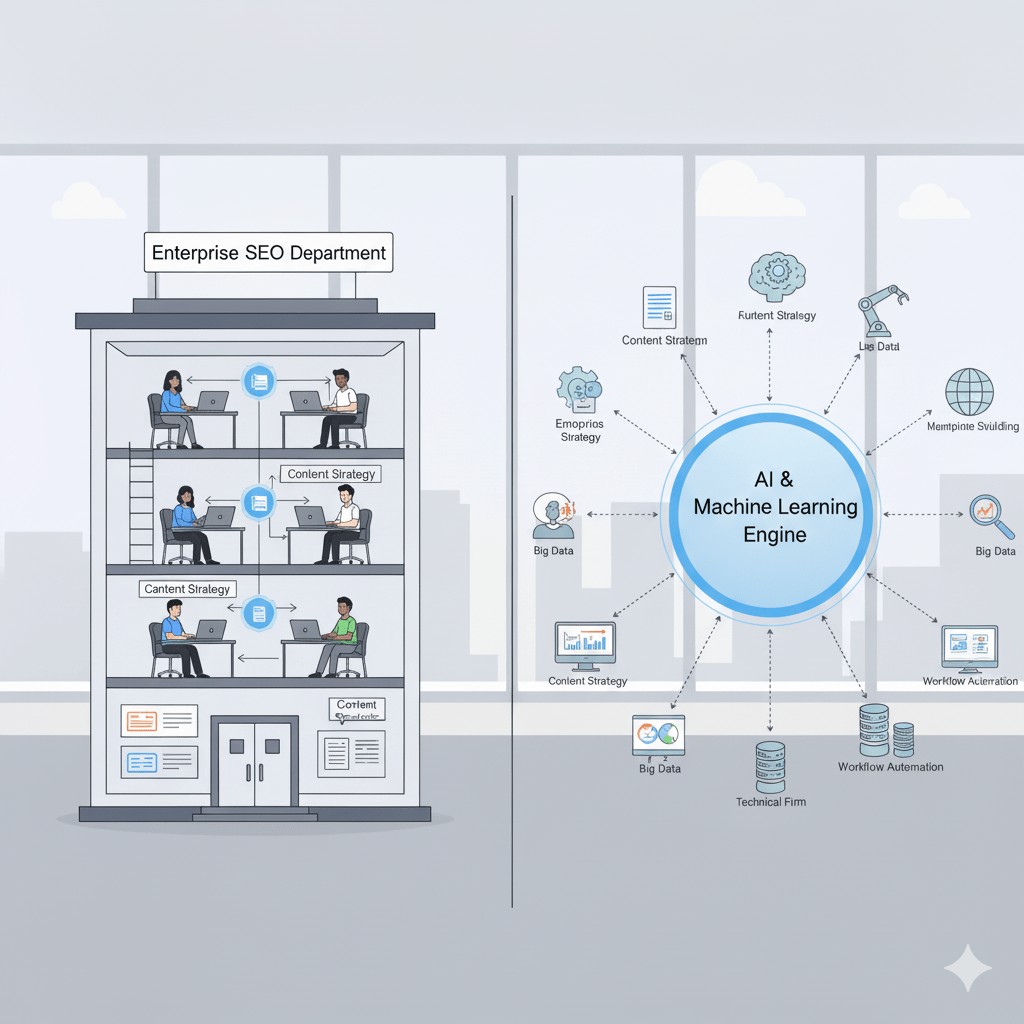
Enterprise SEO automation uses technology, AI, and machine learning to perform repetitive optimization tasks at scale, identify opportunities humans would miss, and execute changes faster than manual processes allow.
It’s not about replacing SEO professionals—it’s about eliminating the tedious work preventing them from focusing on strategic initiatives that actually move the needle.
The Scale Problem Requiring Automation
Manual optimization doesn’t scale beyond a few thousand pages. When you’re managing 500,000+ URLs across multiple markets, languages, and business units, human capacity becomes the bottleneck limiting what’s possible.
Consider this reality check: A skilled SEO can manually optimize maybe 20-30 pages per day (researching keywords, analyzing competitors, crafting titles/descriptions, checking technical elements). At that pace, optimizing 100,000 pages takes 3,300-5,000 days of work—roughly 13-20 years if one person worked on nothing else.
Automation changes the equation: The same 100,000 pages can be analyzed, optimized, and implemented in days or weeks rather than decades.
The AI Revolution in Enterprise SEO
AI isn’t just automating existing workflows—it’s enabling optimization strategies previously impossible at scale. Machine learning models can identify ranking patterns across millions of data points, predict content performance before publishing, and continuously test variations finding optimal implementations.
According to research from BrightEdge, AI-powered SEO platforms reduce manual optimization time by 70% while improving results by 25-40% through pattern recognition and predictive analytics humans simply can’t match at scale.
Pro Tip: The biggest mistake enterprises make with SEO automation is trying to automate everything immediately. Start with high-volume, repetitive tasks where automation delivers obvious ROI (rank tracking, technical monitoring, reporting). Build confidence and expertise before automating more nuanced areas requiring human judgment.
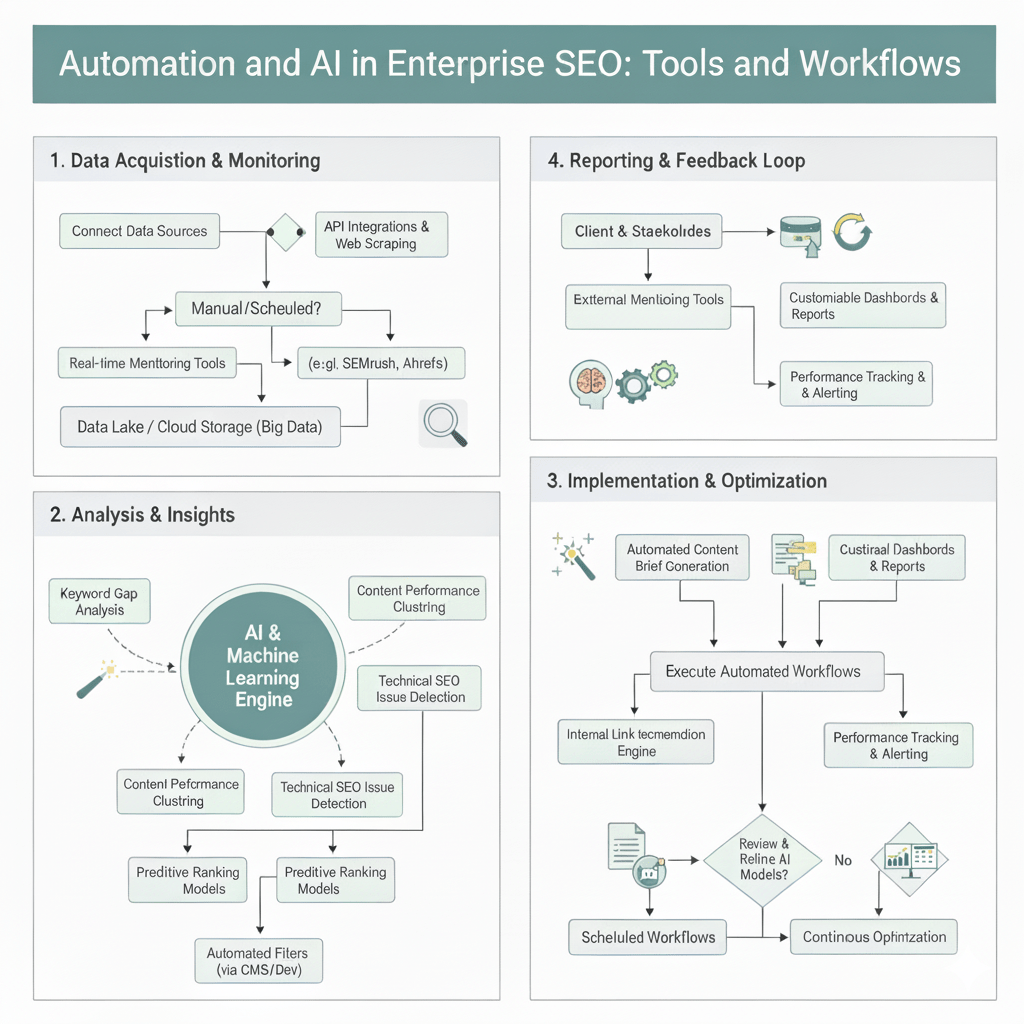
What SEO Tasks Should You Automate at Enterprise Scale?
Not all SEO work benefits from automation. Understanding what to automate versus what requires human expertise determines whether automation becomes force multiplier or expensive disaster.
High-Value Automation Opportunities
Rank Tracking and Performance Monitoring
Manually checking rankings for thousands of keywords across multiple locations is impossible. Automation is non-negotiable.
What to automate:
- Daily rank tracking for priority keywords (5,000-50,000+ terms)
- SERP feature monitoring (featured snippets, PAA, local packs)
- Competitor ranking movements and share of voice
- Performance alerts when rankings drop significantly
- Automated reporting and dashboard updates
Tools: BrightEdge, Conductor, STAT, SEOmonitor, Semrush Position Tracking
Large sites constantly experience technical issues from code deployments, CMS updates, or infrastructure changes. Continuous automated monitoring catches problems before they tank rankings.
What to automate:
- Site crawling (daily or weekly depending on change frequency)
- Broken link detection and 404 monitoring
- Redirect chain identification
- Canonicalization error checking
- Structured data validation
- Core Web Vitals monitoring
- Indexation status tracking
- XML sitemap validation
Tools: Botify, DeepCrawl (Lumar), Screaming Frog (scheduled crawls), OnCrawl, Sitebulb
Content Optimization at Scale
AI can analyze top-ranking content and provide optimization recommendations across thousands of pages simultaneously.
What to automate:
- Keyword gap analysis identifying missing terms
- Content comprehensiveness scoring
- Readability and engagement metrics
- Metadata generation (titles, descriptions)
- Image alt text creation
- Internal linking suggestions
- Content update prioritization
Tools: Clearscope, MarketMuse, Surfer SEO, Frase, Content Harmony
Reporting and Analytics
Manual report creation consumes hours that could go toward optimization. Automate routine reporting while preserving human analysis for insights.
What to automate:
- Performance dashboards updating in real-time
- Weekly/monthly automated reports
- Anomaly detection alerting significant changes
- Data aggregation from multiple sources
- Visualization creation for stakeholder presentations
Tools: Google Data Studio, Tableau, Looker, Power BI, Supermetrics
Tasks Requiring Human Judgment
Strategic planning and prioritization: AI can’t determine which SEO initiatives align with business objectives or navigate organizational politics.
Content strategy and messaging: While AI assists with optimization, human creativity and strategic thinking drive content that truly resonates.
Stakeholder communication: Explaining SEO to executives, developers, and content teams requires human emotional intelligence and persuasion.
Crisis management: When rankings tank or migrations go wrong, human expertise and judgment become critical for recovery.
Ethical considerations: AI makes recommendations without understanding brand reputation, legal implications, or ethical considerations requiring human oversight.
For enterprises building comprehensive SEO technology stacks, automation platforms must integrate with existing martech infrastructure while preserving human oversight on strategic decisions.
What Are the Best AI Tools for Enterprise SEO in 2025?
The AI-powered SEO tools landscape has exploded, but not all platforms deliver at enterprise scale. Here’s what actually works for large organizations.
Comprehensive Enterprise AI SEO Platforms
BrightEdge
The most comprehensive AI-powered enterprise SEO platform combining data aggregation, predictive analytics, and automated recommendations.
AI Capabilities:
- DataCube analyzing 5+ billion keywords daily
- Autopilot recommendations prioritizing high-impact opportunities
- ContentIQ for AI-driven content optimization
- StoryBuilder for automated performance narratives
Best For: Large enterprises (\$100M+ revenue) needing complete platform covering all SEO functions
Pricing: $100K-$500K+ annually depending on scale
Conductor Searchlight
Strong AI platform balancing automation with human-friendly interfaces and strategic recommendations.
AI Capabilities:
- Opportunity Forecast predicting traffic impact before implementation
- Content Recommendations based on competitor analysis
- Automated workflow routing optimization tasks to right team members
- Machine learning-powered content scoring
Best For: Mid-size to large enterprises wanting strong platform without BrightEdge cost
Pricing: $50K-$150K+ annually
MarketMuse
AI-powered content intelligence platform analyzing competitive landscapes and guiding content strategy at scale.
AI Capabilities:
- Content inventory analysis across thousands of pages
- Topic modeling identifying content gaps
- AI-generated content briefs
- Competitive content analysis
- Content ROI prediction
Best For: Content-heavy enterprises (media, publishing, large blogs)
Pricing: $1,500-$7,500/month depending on usage
Specialized AI SEO Tools
Clearscope / Surfer SEO
AI content optimization tools analyzing top-ranking content and providing real-time optimization recommendations.
Use Cases:
- Optimizing individual pages during content creation
- Identifying missing semantic keywords
- Analyzing content comprehensiveness vs competitors
- Metadata optimization
Pricing: $170-$1,200/month (Clearscope), $89-$399/month (Surfer)
Alli AI
Automated technical SEO implementation platform making code changes without developer involvement.
AI Capabilities:
- Automated metadata optimization across entire sites
- Schema markup deployment
- Internal linking improvements
- A/B testing SEO changes
- JavaScript-based implementation without CMS changes
Use Cases: Enterprises frustrated by development bottlenecks preventing SEO implementations
Pricing: $299-$999+/month
Can I Rank? / POP by BrightEdge
AI-powered predictive ranking platforms forecasting which content will rank before publishing.
AI Capabilities:
- Ranking probability analysis
- Content gap identification
- Competitor weakness detection
- Topic opportunity scoring
Use Cases: Content planning and prioritization at scale
Comparison: Enterprise AI SEO Platforms
| Platform | AI Strength | Best Use Case | Complexity | Cost Range |
|---|---|---|---|---|
| BrightEdge | Comprehensive | All-in-one enterprise platform | High | $$$$ |
| Conductor | Balanced | Strategic + tactical optimization | Medium | $$$ |
| MarketMuse | Content Intelligence | Content strategy at scale | Medium | $$ |
| Clearscope | On-page optimization | Individual content optimization | Low | $ |
| Alli AI | Automated implementation | Bypassing dev bottlenecks | Low | $ |
Pro Tip: Don’t buy enterprise AI platforms based on impressive demos. Require proof-of-concept trials on YOUR actual data with YOUR team using the platform. Vendor demos showcase perfect scenarios; POCs reveal real-world limitations and whether the platform fits your specific needs and technical infrastructure.
How Do You Build Automated SEO Workflows at Enterprise Scale?
Individual automation tools help, but real transformation comes from building enterprise SEO workflows connecting multiple systems and automating entire processes end-to-end.
Technical SEO Monitoring and Alerting Workflow
Automated Process:
- Daily site crawl (Botify/DeepCrawl) checking technical health
- Anomaly detection identifies significant issues (traffic drops, indexation changes, error rate increases)
- Automated alerts sent via Slack/email when thresholds exceeded
- Ticket creation in project management system (Jira/Asana) for technical issues
- Weekly summary report aggregating all issues for team review
Implementation Requirements:
- API connections between crawling platform and communication tools
- Defined thresholds for what triggers alerts (not everything is urgent)
- Escalation protocols for critical vs. routine issues
- Regular review of alert effectiveness (too many false positives = ignored alerts)
Business Impact: Catches technical disasters within hours instead of weeks, preventing catastrophic ranking losses.
Content Optimization and Publishing Workflow
Automated Process:
- Keyword research (AI identifies opportunities based on gap analysis)
- Content brief generation (AI creates comprehensive brief with keyword targets, competitor analysis, recommended structure)
- Human content creation (writers create initial draft)
- AI optimization (Clearscope/MarketMuse analyzes draft and recommends improvements)
- Human review and refinement (editors finalize content)
- Automated metadata generation (AI creates optimized titles, descriptions)
- Automated publishing (content pushed to CMS on schedule)
- Performance tracking (automated monitoring of new content rankings/traffic)
Implementation Requirements:
- Integrated tools sharing data (keyword research → brief generation → optimization)
- Clear approval workflows balancing speed and quality
- Template-based briefs standardizing inputs to AI
- Performance benchmarks determining what gets promoted/updated
Business Impact: 10x content production capacity while maintaining or improving quality.
International SEO Automation Workflow
Automated Process:
- Hreflang validation (daily checks ensuring proper implementation)
- International rank tracking (monitoring rankings across all markets)
- Currency/pricing updates (automated localization of pricing content)
- Localized metadata (AI-assisted translation and optimization per market)
- International performance reporting (market-by-market automated dashboards)
Implementation Requirements:
- Hreflang testing tools integrated into deployment pipeline
- Multi-market rank tracking with local search engine support
- Translation API integration (Google Translate API, DeepL)
- Native speaker review process for automated translations
Business Impact: Maintains SEO quality across 20+ markets with team sized for 5 markets.
Link Monitoring and Disavow Automation
Automated Process:
- Daily backlink monitoring (Ahrefs/Majestic/SEMrush APIs)
- Spam link detection (ML models identify toxic backlinks)
- Automated disavow list generation (high-confidence spam added automatically)
- Manual review queue (borderline links flagged for human review)
- Monthly disavow file upload (automated submission to Google Search Console)
Implementation Requirements:
- API access to link intelligence platforms
- Trained ML model understanding your link quality standards
- Human review workflow for edge cases
- Regular validation of automated decisions
Business Impact: Protects against negative SEO attacks without consuming team time monitoring backlinks manually.
For enterprises developing comprehensive SEO automation strategies, workflows must balance efficiency gains with maintaining quality and human oversight where judgment matters.
What Role Does Machine Learning Play in Enterprise SEO?
Machine learning in SEO goes beyond simple automation—it identifies patterns and makes predictions impossible through human analysis alone.
Predictive SEO Analytics
ML models analyze historical ranking data, competitive movements, and algorithmic patterns to predict future performance.
Applications:
- Ranking probability forecasting: Predict likelihood of ranking for target keywords before investing in content
- Traffic impact modeling: Estimate traffic changes from proposed optimizations
- Algorithm update prediction: Identify vulnerability to future updates based on pattern analysis
- Seasonal trend forecasting: Predict traffic fluctuations enabling proactive optimization
Enterprise Example: SaaS company uses ML forecasting to prioritize content investments. Model predicts ranking probability and traffic potential for 10,000 target keywords, enabling data-driven content roadmap focusing on highest-ROI opportunities.
Result: 65% improvement in content ROI by eliminating low-probability targets and doubling down on high-opportunity keywords.
Natural Language Processing for Content
NLP analyzes content semantics, user intent, and topical relationships at scale impossible manually.
Applications:
- Intent classification: Automatically categorize content by search intent (informational, commercial, transactional)
- Topic modeling: Identify semantic themes and relationships across content
- Entity extraction: Detect important entities (people, places, products) requiring structured data
- Content gap analysis: Compare your content against competitors identifying missing topics
- Semantic keyword research: Find related terms beyond traditional keyword tools
Enterprise Example: E-commerce retailer with 500,000 product pages uses NLP to automatically generate category descriptions incorporating semantically related keywords competitors miss.
Result: 45% increase in long-tail organic traffic from improved semantic relevance.
Automated A/B Testing and Optimization
ML powers continuous testing and optimization across thousands of pages simultaneously.
Applications:
- Title tag testing: Automatically test variations finding highest CTR combinations
- Metadata optimization: ML learns from winners and applies patterns across similar pages
- Internal linking optimization: Test different anchor text and link placements
- Content structure testing: Evaluate different heading structures, content lengths
- CTA optimization: Test different calls-to-action for conversion optimization
Enterprise Example: Media site uses automated title testing across 50,000 articles, ML continuously tests variations and implements winners automatically.
Result: 28% average CTR improvement driving 34% organic traffic increase with zero manual work after initial setup.
Anomaly Detection and Problem Identification
ML excels at spotting unusual patterns signaling problems or opportunities.
Applications:
- Traffic anomaly detection: Identify unusual traffic drops/spikes requiring investigation
- Ranking change analysis: Detect correlated ranking movements suggesting algorithm updates
- Crawl budget waste identification: ML spots patterns in log files showing inefficient crawling
- Content decay detection: Identify pages losing rankings before significant traffic impact
- Competitor movement tracking: Alert when competitors gain significant visibility
Enterprise Example: Financial services company uses anomaly detection alerting when any page loses >30% traffic week-over-week.
Result: Average response time to ranking problems reduced from 2-3 weeks to 24-48 hours, minimizing traffic impact from issues.
How Do You Implement Enterprise SEO Automation Without Disasters?
SEO automation disasters happen when enterprises automate without proper governance, testing, or human oversight. Here’s how to implement safely.
Establishing Automation Governance
Define automation policies:
- What can be automated fully without human review?
- What requires human approval before implementation?
- What should never be automated due to risk or complexity?
Example Governance Framework:
| Task | Automation Level | Approval Required |
|---|---|---|
| Rank tracking | Fully automated | None |
| Technical monitoring | Fully automated | None |
| Reporting generation | Fully automated | None |
| Metadata for new pages | Automated with review | Spot-check sample |
| Bulk metadata updates | Automated with approval | Manager approval required |
| Content recommendations | Automated generation | Human execution |
| Link disavows | Automated identification | Human approval required |
| Site structure changes | Never automate | Architecture team + SEO approval |
Start conservative, expand gradually: Begin with low-risk automation (monitoring, reporting) before automating higher-risk implementations (content changes, site structure).
Testing Automation Before Production
Never deploy automation directly to production. Test thoroughly in controlled environments first.
Testing protocol:
- Staging environment testing: Run automation on non-production copy of site
- Small-scale pilot: Apply automation to limited page subset (1-5% of site)
- Performance monitoring: Track impact on pilot pages for 2-4 weeks
- Statistical validation: Ensure results are statistically significant, not random variance
- Gradual rollout: Expand to 10%, 25%, 50%, then full site if results positive
- Continuous monitoring: Even after full deployment, monitor for unintended consequences
Pro Tip: Build “kill switches” allowing immediate automation shutdown if problems emerge. When automating metadata updates across 100,000 pages, ensure you can instantly revert changes if something goes wrong. This safety net enables aggressive automation while limiting downside risk.
Human Oversight and Review Processes
Even with extensive automation, human oversight remains critical for quality control and strategic alignment.
Human review checkpoints:
- Weekly automation audit: Review sample of automated implementations checking quality
- Monthly performance review: Analyze whether automation delivers expected results
- Quarterly strategy alignment: Ensure automation still serves current business priorities
- Exception handling: Human escalation for edge cases automation can’t handle
- Continuous improvement: Human analysis identifying automation improvements
Common Automation Pitfalls to Avoid
Over-automation of nuanced decisions: Not everything should be automated. Brand messaging, crisis communications, and strategic content require human judgment.
Insufficient training data: ML models require substantial training data. Attempting automation with limited data produces unreliable results.
Ignoring edge cases: Automation optimizes for common scenarios but fails on unusual situations. Build exception handling for edge cases.
No performance monitoring: Deploying automation and assuming it works indefinitely without monitoring leads to slow-building problems becoming disasters.
Forgetting to maintain automation: Algorithms change, platforms update, and automation that worked yesterday breaks tomorrow without ongoing maintenance.
Real-World Enterprise SEO Automation Case Studies
Let’s examine how enterprises successfully implemented automation and AI for transformative results.
Case Study #1: Global E-Commerce Platform (5M+ Products)
Challenge: Managing SEO for 5 million product pages across 15 countries manually was impossible. Product descriptions were thin, metadata inconsistent, and international hreflang implementation broken.
Automation Implementation:
- AI-powered metadata generation optimizing titles and descriptions across entire catalog
- Automated hreflang validation and correction
- ML-based product categorization improving site architecture
- Automated content enrichment adding specifications and semantic keywords
- Continuous monitoring alerting technical issues within minutes
Technology Stack:
- MarketMuse for content optimization
- Alli AI for automated metadata implementation
- Botify for technical monitoring
- Custom scripts for hreflang management
- Ahrefs API for competitive monitoring
Results After 12 Months:
- 340% increase in long-tail organic traffic
- Product page rankings improved average 12 positions
- International organic traffic increased 280%
- SEO team time spent on manual optimization reduced 75%
- $28M incremental annual organic revenue
Key Success Factor: Phased implementation starting with low-risk automation (monitoring) before implementing higher-risk changes (content modifications). Built confidence through small wins before large-scale deployment.
Case Study #2: B2B SaaS Platform (150,000 Pages)
Challenge: Content creation couldn’t keep pace with keyword opportunities. Manual optimization of existing content was too slow. Competitive gaps were growing.
Automation Implementation:
- AI content brief generation identifying opportunities and creating detailed briefs
- Clearscope integration providing real-time optimization during content creation
- Automated content decay detection identifying pages requiring updates
- ML-powered internal linking recommendations
- Automated performance reporting by content category
Technology Stack:
- Conductor for opportunity identification
- Clearscope for content optimization
- Screaming Frog (automated scheduled crawls)
- Google Data Studio for automated reporting
- Zapier connecting systems and automating workflows
Results After 18 Months:
- 10x content production capacity (from 20 to 200+ pieces monthly)
- Content ranking in top 10 increased from 32% to 67%
- Organic leads increased 420%
- Content production cost per piece decreased 60%
- SEO team refocused on strategy vs. tactical execution
Key Success Factor: Automation amplified human expertise rather than replacing it. Writers created strategic content while AI handled optimization details and routine recommendations.
Case Study #3: Media Publisher (500K+ Articles)
Challenge: Massive archive of content slowly losing rankings. Manual article updates impossible at scale. Needed systematic approach to content refresh and optimization.
Automation Implementation:
- ML model identifying articles most likely to benefit from updates
- Automated article refresh recommendations (add recent statistics, update examples, refresh metadata)
- AI-powered title testing across entire catalog
- Automated structured data deployment (Article, FAQ, How-To schema)
- Anomaly detection alerting when articles lose significant traffic
Technology Stack:
- MarketMuse for content analysis
- Custom ML models for prioritization
- Alli AI for testing implementation
- OnCrawl for log file analysis
- BigQuery for data aggregation and analysis
Results After 10 Months:
- Updated 45,000 articles (would have taken 15+ years manually)
- Average article organic traffic increased 38%
- Featured snippet wins increased 280%
- Editorial team refocused on new content vs. maintaining archive
- Organic search driving 68% of total traffic (up from 52%)
Key Success Factor: ML prioritization ensuring highest-value articles were updated first, delivering quick wins that built stakeholder support for continued automation investment.
For enterprises seeking comprehensive SEO technology implementation strategies, automation must align with business objectives while preserving quality and brand standards.
Frequently Asked Questions About Enterprise SEO Automation
How much should enterprises invest in SEO automation tools?
Tool budget guidance: 10-20% of total SEO budget for mature programs. For $500K annual SEO budget, allocate $50K-$100K to automation platforms, AI tools, and workflow systems.
Starter stack: $20K-$50K annually (rank tracking, technical monitoring, basic content optimization)
Comprehensive stack: $100K-$300K+ annually (enterprise platforms, AI content tools, advanced analytics, custom integrations)
ROI typically pays back tool investments within 6-12 months through efficiency gains and improved performance.
Will AI replace enterprise SEO professionals?
No. AI augments SEO expertise, it doesn’t replace it. What’s changing is the work SEO professionals do—less tactical execution, more strategic planning and creative problem-solving.
Skills becoming more valuable: Strategic thinking, stakeholder management, creative content strategy, technical architecture, cross-functional coordination.
Skills being automated: Manual optimization, routine reporting, data aggregation, basic research, template-based content.
Enterprises need fewer SEO “doers” but more SEO strategists and specialists. Team size may not decrease dramatically, but composition shifts from tactical executors to strategic leaders.
How do we choose between building custom automation vs buying platforms?
Buy platforms when:
- Established platforms serve your needs well
- Total cost of ownership (including maintenance) favors buying
- Internal development resources are limited
- You need solutions quickly (months vs. years)
- Risk of building something that fails is high
Build custom automation when:
- Your needs are unique and existing platforms don’t address them
- You have strong technical teams capable of building and maintaining
- Competitive advantage comes from proprietary automation capabilities
- Integration requirements exceed what platforms offer
- Long-term TCO favors building despite higher upfront costs
Most enterprises use hybrid approaches: platforms for common needs, custom automation for unique competitive advantages.
What’s the ROI timeline for SEO automation investments?
Quick wins (1-3 months):
- Automated monitoring catching problems early
- Reporting automation saving team time
- Basic technical checks preventing disasters
Medium-term wins (6-12 months):
- Content optimization at scale showing ranking improvements
- Workflow automation increasing team productivity
- ML models identifying opportunities humans missed
Long-term transformation (12-24+ months):
- Compounding efficiency gains enabling 3-5x more work with same team
- Strategic reallocation of human time to high-value activities
- Sustainable competitive advantages through proprietary automation
Most automation investments achieve positive ROI within 6-12 months, with benefits accelerating over time.
How do we prevent automation from damaging our SEO?
Safety measures:
- Start with low-risk automation (monitoring, reporting)
- Always test in staging before production
- Implement gradually (pilot → partial → full rollout)
- Build revert capabilities allowing quick rollback
- Maintain human oversight and approval for high-risk changes
- Monitor performance closely after automation deployment
- Regular audits ensuring automation works as intended
Never automate without:
- Clear understanding of what automation does
- Ability to review automation decisions
- Kill switch disabling automation if problems emerge
- Performance monitoring detecting unintended consequences
How technical do SEO teams need to be for enterprise automation?
Minimum technical competency:
- Understanding APIs and how systems connect
- Basic SQL for data queries and analysis
- Familiarity with marketing automation concepts
- Ability to write simple scripts (Python, JavaScript) helpful but not required
Don’t need:
- Software engineering degrees
- Deep programming expertise
- System architecture knowledge
Most enterprise SEO automation uses platforms and tools designed for marketers, not developers. Technical knowledge helps but isn’t mandatory. Partner with IT/engineering for complex integrations and custom development.
What happens to our SEO strategy when we automate?
Strategy becomes MORE important, not less. Automation handles tactical execution, freeing SEO teams for strategic work.
Strategic work automation enables:
- Competitive analysis and positioning
- Long-term roadmap development
- Cross-functional initiative leadership
- Stakeholder education and alignment
- Testing and experimentation programs
- Market expansion planning
- Technical architecture decisions
Automation doesn’t eliminate strategy—it makes strategic work possible by removing tactical bottlenecks preventing teams from thinking long-term.
Final Thoughts: Building AI-Powered Enterprise SEO Programs
Here’s the reality facing enterprise SEO in 2025: The performance gap between organizations embracing automation/AI and those relying on manual optimization is widening rapidly. This gap will become insurmountable within 2-3 years as AI capabilities accelerate.
Enterprises clinging to manual-only approaches aren’t being cautious—they’re falling behind irreversibly while competitors build systematic advantages through automation and machine learning.
The Strategic Imperative of SEO Automation
According to comprehensive research by Forrester, enterprises adopting AI and automation for SEO achieve 3.8x higher organic growth rates compared to manual-only competitors. That performance gap compounds annually, creating market position differences that become impossible to overcome.
After 5 years, early automation adopters operate with 70% lower SEO costs per dollar of organic revenue while achieving better results—a competitive position that becomes a permanent moat against competitors still optimizing manually.
Building for Long-Term Success
Successful automation and AI in enterprise SEO requires:
Strategic vision: Understanding automation as force multiplier amplifying human expertise, not replacement for strategic thinking.
Phased implementation: Starting with low-risk automation building confidence before tackling complex optimization.
Proper governance: Clear policies determining what gets automated, what requires human oversight, and how quality gets maintained.
Continuous learning: Automation capabilities evolve rapidly. Teams must continuously learn new tools and techniques staying current.
Cultural adaptation: Organizations must embrace data-driven decision-making, rapid testing, and trusting algorithms over gut instinct where appropriate.
The Bottom Line
Automation and AI in enterprise SEO aren’t optional anymore—they’re competitive necessities. The question isn’t whether to automate, but how quickly you can implement automation while maintaining quality and strategic oversight.
Your competitors are already using AI to optimize at scales and speeds impossible manually. The longer you delay automation adoption, the wider the performance gap grows and the harder catching up becomes.
Start with monitoring and reporting automation building quick wins. Expand to content optimization and technical implementations as confidence grows. Eventually, automation should handle 60-70% of tactical SEO work, freeing your team for the strategic initiatives that truly differentiate your enterprise in competitive markets.
The enterprises dominating organic search in 2030 are building automation capabilities today. Start now, iterate continuously, and watch automation transform SEO from resource-constrained bottleneck to scalable growth engine.
For comprehensive frameworks on building future-ready enterprise SEO programs, automation and AI must integrate throughout technical infrastructure, content operations, and strategic planning—becoming core competencies rather than optional enhancements.
⚡ SEO Automation & AI Tool Selector
Interactive Platform Comparison, ROI Calculator & Readiness Assessment
💡 Key Insight
Enterprises using AI and automation for SEO achieve 60% faster implementation times and 40% better ranking performance compared to manual-only approaches (Gartner, 2024). The performance gap continues to widen as AI capabilities accelerate while manual approaches remain constrained by human limitations.
| Task Category | Automation Potential | ROI Timeline | Risk Level |
|---|---|---|---|
| Rank Tracking | 100% | Immediate | Low |
| Technical Monitoring | 95% | 1-2 weeks | Low |
| Reporting | 90% | 1 week | Low |
| Content Optimization | 75% | 1-3 months | Medium |
| Metadata Generation | 70% | 1-2 months | Medium |
| Internal Linking | 65% | 2-4 months | Medium |
| Content Strategy | 30% | Ongoing | High |
| Platform | AI Strength | Best Use Case | Complexity | Annual Cost |
|---|---|---|---|---|
| BrightEdge | 9.5/10 | All-in-one enterprise platform | High | $100K-$500K+ |
| Conductor | 9/10 | Strategic + tactical optimization | Medium | $50K-$150K+ |
| MarketMuse | 8.5/10 | Content strategy at scale | Medium | $18K-$90K+ |
| Clearscope | 7.5/10 | Individual content optimization | Low | $2K-$14K+ |
| Alli AI | 7/10 | Automated implementation | Low | $3.6K-$12K+ |
| Surfer SEO | 7/10 | Content optimization | Low | $1K-$5K+ |
| Platform | Technical SEO | Content AI | Analytics | Workflow | Integration |
|---|---|---|---|---|---|
| BrightEdge | 95% | 90% | 95% | 90% | 95% |
| Conductor | 85% | 85% | 90% | 85% | 90% |
| MarketMuse | 60% | 95% | 75% | 70% | 75% |
| Clearscope | 40% | 85% | 60% | 65% | 70% |
| Alli AI | 80% | 70% | 65% | 75% | 80% |
⚠️ Selection Criteria
Don't buy based on demos alone. Request 30-day trials with your actual data. Test with your team's workflows. Verify integration with your existing tools. Calculate true TCO including implementation, training, and ongoing management costs.
💰 SEO Automation ROI Calculator
Calculate potential returns from implementing SEO automation
📊 Your Automation ROI Projection
✅ Automation Readiness Assessment
Determine if your organization is ready for SEO automation
🎯 Your Automation Readiness
AI Opportunity Detection
ML identifies content gaps and ranking opportunities
Brief Generation
AI creates comprehensive content brief with keywords
Human Creation
Writers create draft following AI brief
AI Optimization
Content analyzed and improvement suggestions provided
Auto-Publishing
Optimized content published with tracking
Daily Crawl
Automated site health check
Anomaly Detection
AI identifies significant issues
Alert & Ticket
Automated notifications & task creation
Human Review
Team prioritizes and addresses
Validation
Automated verification of fixes
💡 Workflow Best Practices
- Start simple: Automate monitoring and reporting before content implementation
- Test thoroughly: Pilot automation on 1-5% of site before full rollout
- Build kill switches: Ability to instantly disable automation if problems emerge
- Maintain human oversight: Regular audits ensuring quality and strategic alignment
- Iterate continuously: Refine automation based on performance data
| Task Category | Automation Level | Approval Required | Risk Level |
|---|---|---|---|
| Rank Tracking | Full | None | Low |
| Technical Monitoring | Full | None | Low |
| Reporting | Full | Spot-check | Low |
| New Page Metadata | Assisted | Sample review | Medium |
| Bulk Updates | Assisted | Manager approval | Medium |
| Content Strategy | Recommendations | Full human control | High |
| Site Structure | Never | Architecture team | High |
🔍 Powered by SEOProJournal.com
Your Trusted Source for Enterprise SEO Intelligence | © 2025